
Wholesale baby food scissors are a practical product category for retailers, distributors, importers, and businesses looking to expand their baby feeding accessories range. As parents become more familiar with convenient food preparation tools, baby food scissors have found a place alongside baby spoons, feeding bowls, food storage containers, and other everyday feeding products.
However, sourcing baby food scissors for resale involves more than finding a product with an attractive appearance or a low unit price. Wholesale buyers need to consider the blade material, product design, available models, minimum order quantity (MOQ), packaging requirements, quality documentation, and the supplier's ability to maintain consistent production over time.
At MIDDIA, we manufacture ceramic scissors and understand that different wholesale customers have different purchasing priorities. A baby product retailer may want a small selection of practical models, while a distributor may need several product options to serve different retail customers. Importers and private label brands, on the other hand, often pay closer attention to product specifications, packaging consistency, and long-term supply arrangements.
This guide explains what to consider when buying baby food scissors in bulk, how to compare standard and customized products, what influences wholesale pricing, and how to evaluate a supplier before placing a larger order. Whether you are purchasing for the first time or looking for a more suitable long-term source, these points can help you make a more informed decision.
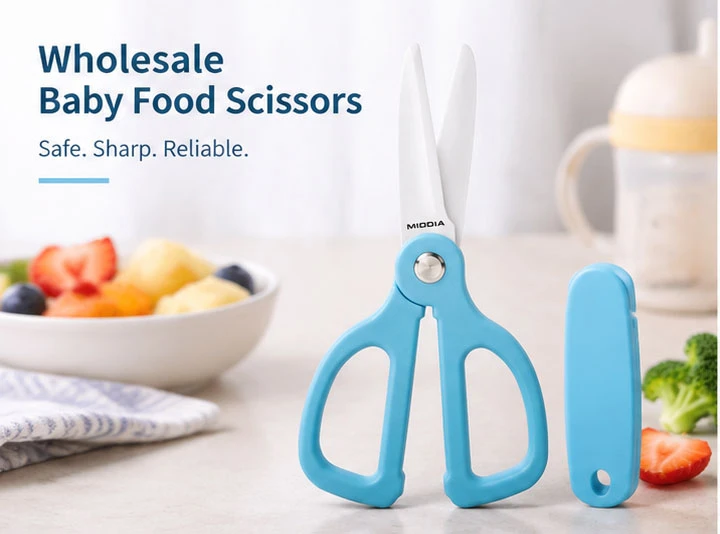
1. Why Baby Food Scissors Are Worth Considering for Your Wholesale Product Range
When developing a baby feeding accessories collection, product selection is usually about finding useful items that complement one another. Not every product needs to be a major purchase. Some smaller accessories can add practical value to an existing product range and give customers another reason to explore a store's baby feeding section.
Baby food scissors are one such product. They are designed to cut prepared food into smaller pieces, making them useful during everyday feeding and food preparation. Depending on the product design, they can be used at home, when visiting relatives, or during family outings.
1.1 The Role of Baby Food Scissors in Baby Feeding Accessories
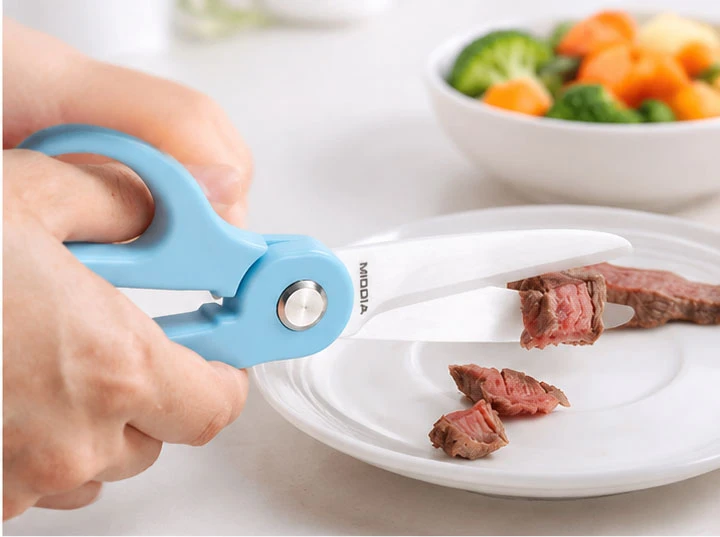
Baby food scissors are generally positioned as food preparation accessories rather than primary feeding utensils. Parents may use them to cut cooked vegetables, soft fruits, noodles, and other suitable prepared foods into smaller portions before serving.
For retailers, this makes the category relevant to several existing product groups:
Baby feeding utensils: Baby spoons, forks, and other feeding accessories.
Food preparation products: Products that help parents prepare appropriately sized food portions.
Portable feeding accessories: Compact products designed for use outside the home.
Baby tableware: Feeding bowls, plates, cups, and related products.
Food storage accessories: Containers and other products used to organize prepared food.
A retailer that already sells baby feeding products may find it easier to introduce baby food scissors than to build an entirely new product category. The product also provides an opportunity to offer a different type of practical accessory without requiring a large amount of shelf space.
Of course, the product should be selected according to its intended use and applicable safety requirements. Baby food scissors are not a substitute for age-appropriate food preparation, adult supervision, or appropriate food texture management.
1.2 Why Retailers May Benefit from Offering Multiple Baby Food Scissors Options
One model rarely meets every customer's preference. Some parents prefer a compact product that fits easily into a feeding bag. Others may pay more attention to protective covers, locking mechanisms, handle design, or the overall appearance of the scissors.
Offering several carefully selected models can help retailers serve these different preferences. It also creates room for different product positions within the same category.
For example, a basic ceramic model can serve as the main product, while a mini version can appeal to customers who prioritize portability. A model with a protective cover may be more suitable for retailers whose customers frequently travel with baby feeding accessories.
There is no need to introduce too many similar products at the beginning. A smaller range with clear differences is often easier to manage, especially for retailers who are still testing customer demand.
2. What Types of Baby Food Scissors Should Wholesale Buyers Consider?
Before requesting wholesale baby food scissors pricing, buyers should understand the differences between the available product models. A product range may contain several designs that look similar at first glance but serve slightly different purchasing and retail purposes.
At MIDDIA, we offer different ceramic baby food scissors models, including CS1, CS2, CS3, CS4, CS5, and CS6. These existing models provide wholesale buyers with options to evaluate without immediately developing a completely new product.
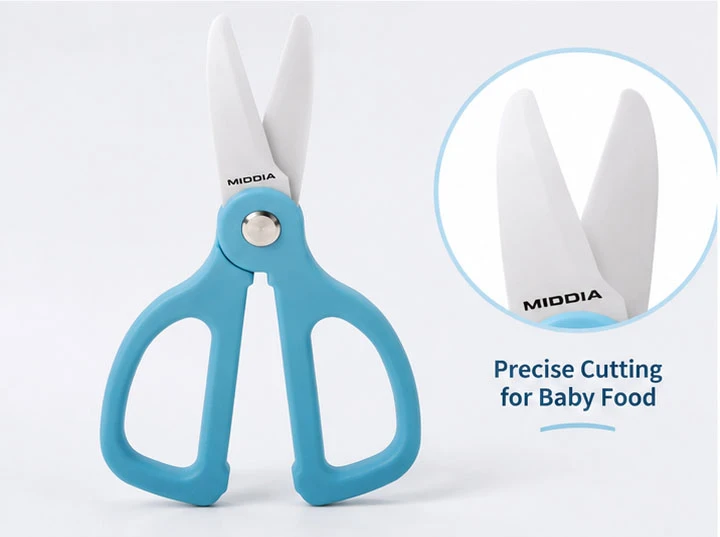
When comparing models, we recommend looking at the complete product rather than focusing only on the blade. Handle design, dimensions, protective accessories, opening and closing operation, and storage convenience all contribute to the product's overall positioning.
2.1 Standard Ceramic Baby Food Scissors
Standard ceramic baby food scissors are a suitable starting point for many wholesale buyers. They provide a familiar scissor format and can be positioned as an everyday food preparation accessory.
One of the main differences between ceramic and stainless steel blades is their material behavior. Zirconia ceramic is known for its hardness and resistance to rust and corrosion under normal conditions. Stainless steel, by comparison, is a metal material with different mechanical properties and maintenance considerations.
For buyers evaluating ceramic scissors, several details deserve attention:
The ceramic blade's surface finish and visible condition.
The alignment of the two scissor blades.
The smoothness and consistency of opening and closing.
The fit and finish of the handles.
The overall product dimensions and weight.
The availability of suitable protective accessories.
Ceramic does not mean indestructible. Zirconia is a hard material, but ceramic blades can chip or break if subjected to inappropriate impact or excessive force. This is why product construction, handling instructions, and quality testing remain important when selecting a ceramic product for wholesale distribution.
2.2 Mini Baby Food Scissors
Mini baby food scissors are intended for buyers who want a more compact product option. Their smaller format can be useful for storage in a feeding bag, diaper bag, or travel accessory pouch.
From a retail perspective, portability gives this type of product a clear selling point. It can be introduced as an accessory for families who prepare food outside their own kitchens or prefer to carry a small set of feeding essentials.
However, wholesale buyers should not assume that smaller automatically means better. Before selecting a mini model, check whether the handle is comfortable to operate, whether the blades provide suitable cutting performance for the intended food types, and whether the product can be stored securely.
Dimensions should also be confirmed rather than estimated from product photographs. A difference of only a few millimeters can influence how customers perceive the product's size and portability.
2.3 Baby Food Scissors with Protective Covers
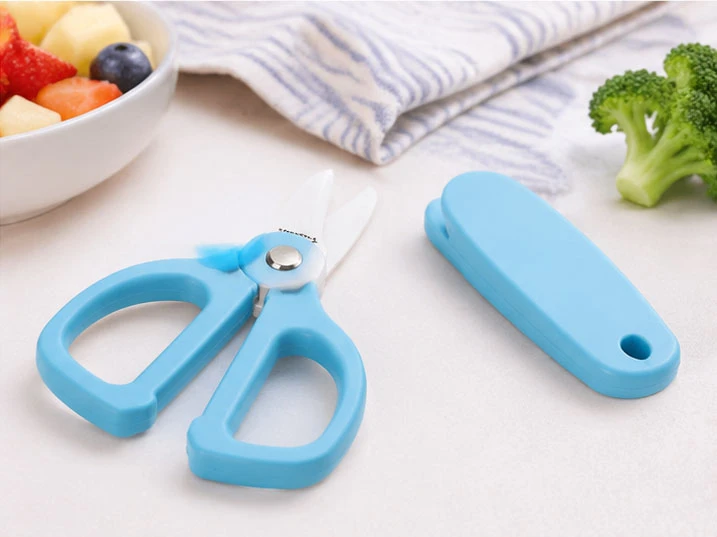
A protective cover is a useful feature for scissors that are frequently stored or carried. It helps shield the blades from contact with other objects and can make the product easier to organize inside a feeding bag.
For wholesale buyers, the cover should be evaluated as part of the complete product rather than treated as an unimportant accessory.
We recommend checking:
Whether the cover fits the scissors properly.
Whether it can be attached and removed without excessive difficulty.
Whether it remains securely in place during normal storage.
Whether the material and surface finish are consistent.
Whether the packaged product looks presentable for retail display.
A poorly fitting protective cover can affect the customer's experience even when the scissors themselves are well made. For this reason, the fit between the scissors and their cover should be included in sample evaluation and production inspection.
2.4 Baby Food Scissors with Safety Locks
Some models incorporate a locking mechanism to help keep the scissors in a closed position during storage. This feature can be useful for products intended to be carried in a bag or stored with other feeding accessories.
When assessing a model with a safety lock, buyers should examine how the mechanism operates. It should be reasonably easy for an adult to use, should remain in its intended position, and should not interfere with normal opening and closing.
It is also important to distinguish between a locking mechanism and a complete child-safety solution. A lock is one product feature; it does not replace safe storage practices or adult supervision.
2.5 How to Build a Balanced Product Range
When selecting models for wholesale distribution, we generally recommend starting with clear product differences rather than choosing several versions that perform almost the same role.
The following table illustrates how a retailer or distributor might organize a small baby food scissors collection.
| Product Type | Product Positioning | Potential Retail Selling Point |
|---|---|---|
| Standard Ceramic Scissors | Core product | Everyday food preparation |
| Mini Baby Food Scissors | Portable option | Compact size and convenient storage |
| Protective Cover Model | Storage-focused option | Blade protection and portability |
| Safety Lock Model | Functional option | Closed-position storage mechanism |
These categories are useful for organizing purchasing decisions, but buyers should check the actual specifications of each available model. Some models may combine more than one feature, and the final product selection should be based on confirmed product details rather than category names alone.
You can explore the MIDDIA Ceramic Scissors Collection to review the available baby food scissors models and identify suitable options for your business.
3. Standard Products vs. Custom Baby Food Scissors: Understanding MOQ Before Ordering
Minimum order quantity is one of the first things wholesale buyers usually ask about. It affects the initial purchasing budget, inventory planning, and the amount of risk involved when introducing a new product.
However, there is an important distinction that buyers should understand: the MOQ for an existing standard product is not necessarily the same as the MOQ for a customized product.
3.1 What Is the MOQ for Standard Baby Food Scissors?
Standard baby food scissors are existing products manufactured according to established specifications. The product structure, main components, and basic design are already defined, so the buyer does not need to arrange a completely new product development process.
This makes standard products a practical option for businesses entering the category for the first time.
At MIDDIA, the MOQ for standard models should be confirmed according to the selected model, order quantity, packaging requirements, and current production arrangements. We do not recommend assuming that every model has exactly the same MOQ.
For a first order, buyers should provide the following information when requesting a quotation:
The preferred model or models.
The estimated quantity for each model.
Whether the order uses standard packaging.
Whether any additional accessories are required.
The intended delivery destination.
With these details, the supplier can provide a more accurate quotation instead of giving a general price that may change after the specifications are confirmed.
3.2 What Is the MOQ for Customized Baby Food Scissors?
Customization allows a business to create a product presentation that better matches its own brand. It can include a logo, a different product color, or customized retail packaging.
Unlike standard products, customized orders may involve additional preparation, printing arrangements, packaging materials, color matching, or production coordination. These requirements can increase the minimum quantity needed for an order.
At MIDDIA, our current customization MOQ guidelines are:
| Customization Type | MIDDIA MOQ | Typical Purpose |
|---|---|---|
| Custom Logo | 2,000 pcs | Adding a company or brand identity |
| Custom Color | 3,000 pcs | Matching a brand's visual identity |
| Custom Packaging | 3,000 pcs | Creating branded retail packaging |
These quantities refer to the stated customization options and should not be interpreted as a universal MOQ for every possible project. Final requirements depend on the selected product, customization method, and production arrangement.
For example, a buyer who only wants to add a logo to an existing model has different requirements from a brand that wants a new color and specially designed packaging. The two projects should not be expected to have identical purchasing conditions.
3.3 Which Ordering Option Is Better for First-Time Buyers?
There is no single answer for every business. The right approach depends on how familiar the buyer is with the product category and how much demand has already been established.
For new retailers: Standard products are usually the more practical starting point. They allow the business to test customer interest without immediately taking on additional customization costs.
For established distributors: Purchasing several standard models may help cover different downstream customer preferences. The product range can be expanded after actual sales performance becomes clearer.
For baby product brands: Custom logo or packaging options may be worthwhile when the business already has a defined brand identity and a suitable purchasing volume.
For importers: It may be useful to compare a standard-product order with a customized order, considering not only the unit price but also the total initial investment and expected inventory turnover.
Our suggestion is simple: do not customize a product just because customization is available. First make sure the product itself fits your market. Branding and packaging can then be developed around a more clearly defined product strategy.
4. What Affects the Wholesale Price of Baby Food Scissors?
Wholesale buyers sometimes receive noticeably different quotations for products that appear similar in photographs. This is not necessarily a sign that one supplier is overcharging or that another has found a way to manufacture the same product at a much lower cost.
The actual specifications may be different. Materials, processing requirements, accessories, packaging, order quantities, and customization all influence the final price.
When we prepare wholesale quotations at MIDDIA, we consider these requirements together. Comparing prices is most useful when the products being compared have the same specifications.
4.1 Blade Material and Manufacturing Requirements
Blade material is one of the basic factors affecting product cost. Ceramic blades and stainless steel blades require different materials and manufacturing processes.
For zirconia ceramic blades, manufacturing involves more than simply shaping a piece of ceramic material. The process generally includes powder preparation, forming, sintering, and precision grinding. The finished blade must also be checked for its appearance, dimensions, edge condition, and suitability for the intended product design.
These manufacturing stages influence the final product cost. The level of processing and quality requirements can also vary between different models.
Stainless steel products have their own material and processing considerations, so a fair comparison should look at the complete product specification rather than assuming that one material always costs more.
4.2 Product Design and Functional Components
Two baby food scissors may use similar blades but have different overall costs because their designs are not identical.
For example, the following features can affect the manufacturing requirements:
Overall product dimensions and structural design.
Handle materials and color requirements.
Protective cover design and material.
Safety lock components, where applicable.
Assembly requirements and finishing details.
The number of accessories included with each product.
Buyers should make sure that the quotation clearly identifies which accessories are included. Otherwise, two quotations may appear comparable while actually describing different product configurations.
4.3 Order Quantity and Customization
Order quantity has a direct influence on production planning and unit cost. A larger order may allow certain manufacturing and packaging costs to be distributed across more products.
However, this does not mean that placing the largest possible order is always the best commercial decision. If a product has not yet been tested in the target market, excess inventory can create a different problem.
Customization can also affect pricing. A logo, custom color, or special packaging design may require additional preparation, materials, and production coordination. Some costs may be fixed for a project, while others depend on the quantity ordered.
For a useful quotation comparison, ask suppliers to separate the product price, customization costs, packaging costs, and any other applicable charges.
4.4 Packaging and Shipping Costs
Packaging is another detail that can be overlooked during the initial price comparison.
Individual retail packaging, color boxes, protective packaging, and bulk cartons all have different material and production requirements. The packaging configuration also affects carton dimensions and the number of products that can be packed into each shipping carton.
For imported products, freight costs may depend on shipment volume, weight, destination, and transport method. A product with a slightly lower factory price may not necessarily result in a lower total landed cost.
We recommend comparing quotations based on the same delivery conditions. Buyers should clarify whether the quotation covers the product only, product packaging, domestic transportation, international freight, or other applicable charges.
Looking at the total purchasing cost gives a much clearer picture than comparing the unit price alone.
5. Why Wholesale Buyers Should Request Samples Before Placing Bulk Orders
A product photograph can communicate its general appearance, but it cannot tell a buyer everything about how the scissors feel, operate, and fit together. This is especially important for a product with moving components and a ceramic blade.
We encourage wholesale buyers to evaluate samples before confirming a larger order. A sample provides an opportunity to check the actual product rather than relying entirely on specifications or marketing descriptions.
5.1 What Should You Check When Evaluating Baby Food Scissors Samples?
A useful sample evaluation should cover several aspects of the product.
1. Blade material and appearance
Check the blade's visible surface for obvious chips, cracks, or other defects. The material and blade construction should match the supplier's stated specifications.
2. Cutting performance
Evaluate the scissors using suitable food samples that reflect the intended application. Check whether the scissors open and close consistently and whether the cutting performance meets the requirements of the selected model.
It is worth remembering that cutting performance depends on food texture, preparation, and the condition of the blades. A test with one type of food should not be treated as proof that the scissors will perform identically with every food material.
3. Handle comfort and grip
Check the handle dimensions, surface finish, and ease of operation. A product may look attractive but still feel uncomfortable if its handle design does not suit the intended user.
4. Protective cover fit
If the model includes a protective cover, check that it fits correctly and can be attached and removed as intended.
5. Safety lock operation
For models with locking mechanisms, check whether the lock engages and releases consistently. It should not interfere with the normal operation of the scissors.
6. Product dimensions and weight
Measure the sample and compare it with the confirmed product specifications. These details matter for product listings, packaging design, and retail positioning.
7. Surface finish and assembly quality
Examine the handles, joints, edges, and visible assembly points. The product should have a consistent finish without obvious assembly defects.
8. Packaging condition
Check whether the product is protected properly during storage and transportation. If the sample is intended for retail sale, also consider how the packaging will look when displayed to customers.
5.2 How to Verify Product Quality and Safety Documentation
Product testing and compliance documentation are important when sourcing baby feeding accessories. However, buyers should understand what each document actually demonstrates instead of relying on certification names alone.
At MIDDIA, our ceramic baby food scissors have passed an SGS 1-meter drop test. This provides a specific test reference for evaluating the tested product under the stated drop-test conditions.
For wholesale buyers, it is useful to review the relevant report and confirm the tested model, test conditions, sample identification, and results. A drop test should not be interpreted as a guarantee that a ceramic product cannot break under every possible impact or handling condition.
We also have FDA- and LFGB-related compliance documentation for relevant products and materials. These documents are important references when buyers evaluate materials intended for food-related applications.
There is an important distinction here. FDA is a United States regulatory framework, while LFGB refers to German food and consumer goods legislation. Depending on the material and product configuration, different requirements and testing approaches may apply.
Therefore, buyers should request the actual documentation and verify:
Which product or material was tested.
Whether the tested material matches the material used in the ordered product.
Which testing methods and requirements were applied.
Whether the report is still relevant to the current product specification.
Whether additional testing or documentation is required in the destination market.
We recommend checking these details before finalizing a purchase, especially when importing products for a regulated retail market. The presence of a document alone does not establish that every version of a product automatically meets every requirement in every country.
5.3 Why Bulk Orders Should Match the Approved Sample
After a sample has been approved, the next important step is to make sure that the specifications are clearly recorded.
This is particularly relevant when a buyer is ordering several models or plans to place repeat orders. A verbal description such as "the same as the sample" may not be detailed enough for a complicated order.
We recommend confirming the following information:
Exact product model and product code.
Blade material and relevant specifications.
Handle material and color.
Protective cover and accessory configuration.
Product dimensions and weight, where specified.
Logo position and customization details, if applicable.
Individual packaging and carton specifications.
Approved sample reference and quality acceptance requirements.
These details should be documented before mass production begins. They provide a reference for both the buyer and the manufacturer when checking the finished order.
At MIDDIA, we believe sample approval is not just a formality. It is an important step in reducing misunderstandings between product development, purchasing, and production.
6. Packaging Options and Shipping Considerations for Wholesale Baby Food Scissors
Packaging has two different jobs in wholesale business. It protects the product during handling and transportation, and it determines how the product is presented when it reaches the retail channel.
A retailer selling directly to consumers may need individual packaging, while a distributor supplying other businesses may prefer a different carton arrangement. Importers should consider both requirements before confirming an order.
6.1 Choosing the Right Packaging for Your Sales Channel
There are several common packaging approaches to consider.
Individual retail packaging: Each product is packed separately for sale. This can be suitable for retailers, supermarkets, baby product stores, and e-commerce businesses.
Color box packaging: A printed box can provide space for product information, brand identity, product images, and other retail details. This is often considered by businesses that want a more developed retail presentation.
Bulk packaging: Products are packed in larger quantities for distribution or further packaging. This option may suit buyers who have their own packaging arrangements or supply other businesses.
Customized packaging: Brands can develop packaging according to their own visual identity and market requirements. This may include brand logos, colors, product information, and packaging artwork.
When choosing packaging, buyers should consider more than its appearance. The packaging should also provide appropriate protection for the product, especially when ceramic blades are involved.
For customized packaging, confirm the artwork, dimensions, printing details, and final sample before approving mass production.
6.2 What Should Importers Confirm Before Shipping?
Before arranging shipment, importers should confirm that the order information matches the actual products being packed.
A practical shipping checklist includes:
Total order quantity and the quantity of each model.
Individual product packaging specifications.
Carton dimensions and packing quantity per carton.
Gross weight and net weight.
Shipping marks and carton labels, where required.
Product descriptions and relevant shipping documentation.
Destination country and delivery address.
Transportation method and estimated delivery schedule.
Applicable customs, import, and product compliance requirements.
For ceramic products, suitable packaging protection deserves particular attention. Buyers should ask how the products are arranged inside the retail packaging and export cartons, and whether the packaging configuration has been checked for the expected transportation conditions.
Shipping arrangements should also be agreed upon in advance. The final cost and delivery schedule may vary depending on the destination, shipment size, selected transport method, and agreed trade terms.
6.3 Why Packaging Consistency Matters for Repeat Orders
For a business that sells the same product over an extended period, consistent packaging is part of product management.
Imagine a retailer receiving one shipment with a certain box size and another shipment with a noticeably different package. Even if the scissors themselves are unchanged, the difference may affect shelf presentation, warehouse organization, and product photography.
For distributors and importers, consistent packaging also makes it easier to manage product codes, carton quantities, and inventory records.
We recommend keeping approved packaging specifications and artwork on file. If a buyer wants to change the design later, the revised version should be confirmed before production rather than introduced informally during a repeat order.
7. How to Choose the Right Baby Food Scissors Product Mix for Your Business
Choosing the right product mix is not simply a matter of selecting as many models as possible. A wholesale range should reflect the customers a business serves, the channels through which it sells, and the amount of inventory it can reasonably manage.
The same baby food scissors collection may need to be organized differently for a specialist baby store, a regional distributor, or an established baby product brand.
7.1 For Baby Product Retailers
Retailers usually need products that are easy to explain, display, and manage. A small selection with clear differences can be more practical than a large collection of similar models.
One possible starting point is a standard ceramic baby food scissors model as the core product, supported by a model with a protective cover or a more compact version.
When selecting products for a retail store, consider:
Whether the product fits the store's existing baby feeding category.
Whether the packaging communicates the product's main features clearly.
Whether customers can understand the difference between available models.
Whether the product dimensions and packaging suit the available shelf space.
Whether the expected selling price leaves enough room for the retailer's operating costs and margin.
Retailers should also pay attention to the product information provided to customers. Material descriptions, care instructions, intended use, and relevant safety information should be accurate and easy to understand.
7.2 For Distributors and Wholesalers
Distributors often serve multiple retailers, each with slightly different purchasing preferences. They may therefore need a broader selection than a single retail store, but that does not mean every available model should be stocked in large quantities.
A more controlled approach is to select two or three models with different product positions and monitor which ones receive the strongest demand from downstream customers.
For distributors, the main considerations include:
How many models are needed to serve existing retail customers.
Whether the selected models have clearly different functions or designs.
How much inventory can be allocated to each product.
Whether the supplier can maintain consistent specifications.
How easily the products can be reordered.
Whether the packaging and carton arrangements suit warehouse operations.
It is also useful to avoid introducing too many similar SKUs at the beginning. Products that are difficult to distinguish may compete for the same customers and create unnecessary inventory complexity.
7.3 For Baby Product Brands and Importers
Brands and importers may have additional requirements because the product needs to fit an existing brand identity and distribution strategy.
Some businesses begin with standard products to understand customer response before investing in custom branding. Others already have an established product range and prefer to introduce baby food scissors with their own logo and retail packaging from the beginning.
For these buyers, the purchasing process should cover more than product appearance. It should include the following:
Product model and technical specifications.
Branding requirements and logo application.
Custom color and packaging options.
MOQ and total initial investment.
Sample approval and production reference.
Testing documents and destination-market requirements.
Repeat-order arrangements.
A brand should also consider whether the selected model fits its existing product range. A compact feeding accessory may complement a travel feeding collection, while a standard model may be more suitable for a broader everyday baby feeding category.
7.4 A Practical Wholesale Product Selection Example
For a business introducing baby food scissors for the first time, a small product combination can be a useful starting point.
For example, a buyer might consider the following allocation for an initial product assortment:
| Product Category | Suggested Role | Illustrative Allocation |
|---|---|---|
| Standard Model | Core product | 50% |
| Protective Cover Model | Functional option | 30% |
| Mini Model | Portable option | 20% |
This is an illustrative planning example, not a recommended industry-wide sales ratio or a statement about actual market demand.
The right allocation depends on the buyer's sales channel, target customers, purchasing budget, and expected inventory turnover. A retailer with limited shelf space may need a different combination from a distributor supplying dozens of stores.
After the first sales period, the buyer can review which models perform better and adjust the next order accordingly. This approach helps avoid committing too much inventory to products that have not yet demonstrated sufficient demand.
8. How to Evaluate a Baby Food Scissors Wholesale Supplier
Choosing a wholesale supplier is one of the most important decisions in a product sourcing project. A competitive quotation may attract attention, but the real value of a supplier becomes clearer when buyers examine manufacturing capabilities, product documentation, communication, and production consistency.
For baby feeding accessories, these considerations deserve particular attention because product materials, construction, and intended use all matter.
8.1 Check the Supplier's Manufacturing Capabilities
Not every company that offers baby food scissors is necessarily the manufacturer. Some businesses operate primarily as trading companies, while others have their own production facilities or established manufacturing partners.
Both business models can serve wholesale buyers, but the buyer should understand who is responsible for production and quality control.
When evaluating a supplier, ask questions such as:
Does the company manufacture the products directly?
Which product models are currently available?
Does the supplier have experience with ceramic blade processing?
Can it explain the main manufacturing and quality inspection stages?
Can it provide standard product specifications?
Does it support both standard products and customization?
At MIDDIA, our experience in ceramic scissors manufacturing allows us to offer different ceramic baby food scissors models and discuss product requirements with wholesale buyers from a manufacturing perspective.
For buyers who are comparing several suppliers, a detailed discussion about materials, blade finishing, product assembly, and model differences can often be more useful than a general statement that a company offers high-quality products.
8.2 Review Product Testing and Compliance Documents
Documentation is another important part of supplier evaluation. Buyers should request the relevant test reports and compliance documents rather than relying only on logos or short statements on a product page.
For MIDDIA ceramic baby food scissors, the relevant quality references include:
SGS 1-meter drop test: Our ceramic baby food scissors have passed a 1-meter drop test. Buyers can review the applicable report and confirm the tested model and conditions.
FDA-related documentation: Relevant documentation can help buyers assess whether the applicable materials meet the requirements associated with their intended food-related use in the United States.
LFGB-related documentation: Relevant test or compliance documents can support the evaluation of applicable materials and requirements for the German market.
Buyers should verify the actual scope of each document. A report for one material or product configuration should not automatically be treated as evidence covering every model or every possible use.
We also recommend checking whether the supplier can explain how the product's specifications relate to the available reports. This is particularly important when a buyer plans to customize the product or change its material configuration.
For more information about our ceramic product range, visit the MIDDIA Ceramic Scissors product page.
8.3 Evaluate Communication and After-Sales Support
Good communication is often underestimated during the first quotation stage. However, it becomes much more important when an order involves multiple models, customized packaging, sample approval, or several production steps.
A reliable supplier should be able to explain product specifications clearly and respond to reasonable questions about the order.
During supplier evaluation, consider whether the company can:
Provide accurate product specifications and model information.
Explain MOQ and customization requirements.
Arrange samples for evaluation.
Confirm packaging details before production.
Communicate production progress and expected delivery schedules.
Respond to quality questions and order-related issues.
For overseas buyers, clear written communication is especially useful. Confirming important details through an approved specification sheet or purchase order can reduce misunderstandings between different teams.
8.4 Look Beyond the Initial Quotation
A supplier's first quotation is only one part of the purchasing decision. Buyers should also consider what happens after the first shipment.
For example, if a retailer sells a particular model successfully, it may want to reorder the same product several months later. At that point, the buyer will need confidence that the product specifications, packaging, and quality requirements can be maintained.
Before choosing a supplier, discuss the following points:
Whether the selected model is expected to remain available.
How repeat orders will be arranged.
Whether approved product specifications can be retained.
How changes to materials or packaging will be communicated.
What production lead time should be expected for future orders.
These details may not appear as important as unit price when a buyer is placing the first order, but they can have a meaningful impact on the overall sourcing relationship.
9. Long-Term Restocking: What Wholesale Buyers Should Plan Ahead
For distributors and retailers, the first order is only the beginning of product management. If baby food scissors become part of a regular product range, inventory planning and repeat purchasing will gradually become more important.
A supplier that can support a clear ordering process and maintain agreed product specifications can make this process easier.
9.1 Establish a Restocking Plan Based on Sales Performance
Wholesale buyers should avoid relying entirely on assumptions when deciding how many products to reorder.
Instead, review the sales performance of each model over a reasonable period. Look at which products sell more consistently, which ones attract repeat customer interest, and whether certain models perform better through particular sales channels.
Some useful indicators include:
Sales quantity by product model.
Current inventory and available stock.
Average time required to sell a batch of products.
Seasonal or promotional purchasing patterns.
Expected supplier production lead time.
Once these figures are available, the buyer can plan replenishment more realistically. The aim is to maintain enough inventory to support sales without unnecessarily tying up working capital.
9.2 Maintain Consistent Product Specifications Across Orders
Consistency matters when a business sells the same product repeatedly. Customers generally expect a product they purchase again to have the same basic design, dimensions, accessories, and packaging as before.
To support this, buyers should retain an approved product specification and sample reference.
For ceramic baby food scissors, relevant records may include:
Model number and product photographs.
Blade material and relevant product specifications.
Handle design and color.
Protective cover and accessory configuration.
Packaging artwork and dimensions.
Approved sample and inspection requirements.
If a change is necessary, it should be communicated and confirmed before the next production run. This helps avoid unexpected differences between shipments.
9.3 Discuss Future Supply Arrangements with Your Supplier
Long-term supply planning does not require a complicated agreement for every buyer. Even a basic discussion about expected order frequency and purchasing volume can help both sides prepare.
For example, an importer that expects to place regular orders can share its approximate purchasing plan with the supplier. This information may help with production scheduling, material preparation, and packaging arrangements.
Buyers should also clarify whether the supplier's stated lead time refers to standard products or customized orders. Custom packaging and other requirements may need additional preparation time.
At MIDDIA, we believe a wholesale relationship should extend beyond the first shipment. Consistent product specifications, clear order communication, and realistic production planning are important when buyers need to replenish inventory over time.
Wholesale Baby Food Scissors Buying Checklist
Before confirming a bulk order, distributors, retailers, and importers can use the following checklist to review the most important purchasing details.
Product selection: Have you identified the models that suit your target customers?
Material: Have you confirmed whether the blades are ceramic or stainless steel?
Product specifications: Have you checked the dimensions, handle design, and included accessories?
Standard MOQ: Have you confirmed the minimum order quantity for each selected model?
Customization MOQ: If you need a logo, custom color, or special packaging, have you checked the applicable quantity requirements?
Wholesale pricing: Are the quotation, packaging, and shipping conditions clearly defined?
Sample evaluation: Have you inspected the actual product before approving mass production?
Testing documents: Have you reviewed the applicable SGS, FDA-related, and LFGB-related documents?
Packaging: Have you confirmed individual packaging, carton quantities, and protective arrangements?
Shipping: Have you agreed on the delivery destination, transport method, and expected schedule?
Quality consistency: Are the approved sample and product specifications documented?
Restocking: Have you discussed future order arrangements and production lead times?
Not every buyer needs to finalize every detail at the same stage. For an initial standard-product order, model selection, sample approval, MOQ, and pricing may be the first priorities. Packaging customization and long-term supply arrangements can be developed as the purchasing project becomes clearer.
Frequently Asked Questions About Wholesale Baby Food Scissors
1. What Is the MOQ for Wholesale Baby Food Scissors?
The MOQ for wholesale baby food scissors depends on the selected model, order configuration, and supplier's production arrangements. At MIDDIA, standard product quantities should be confirmed according to the specific model. For customization, our current MOQ guidelines are 2,000 pieces for custom logo orders and 3,000 pieces for custom color or custom packaging orders. Buyers should confirm the final requirements before placing an order.
2. Can I Buy Baby Food Scissors in Bulk Without Customizing the Product?
Yes. Wholesale buyers can purchase existing standard baby food scissors models without adding a custom logo, color, or packaging design. This is often a practical option for retailers and distributors who want to introduce the category or evaluate customer demand before investing in private label products. Standard models can also reduce the preparation involved in a customized project.
3. What Should Retailers Consider When Choosing Wholesale Baby Food Scissors?
Retailers should consider blade material, product dimensions, handle comfort, protective covers, locking mechanisms, packaging, and the needs of their target customers. It is also useful to compare different models and avoid stocking too many products with nearly identical functions. Product testing documents and clear usage information should be reviewed before introducing the product to a retail market.
4. Are Ceramic Baby Food Scissors Suitable for Wholesale Distribution?
Ceramic baby food scissors can be a suitable option for wholesale distribution when the product design, manufacturing quality, and intended application meet the buyer's requirements. Zirconia ceramic is known for its hardness and resistance to rust and corrosion. However, ceramic blades can be brittle under impact, so buyers should evaluate product construction, cutting performance, sample quality, and relevant test documentation before ordering in bulk.
5. Can Wholesale Baby Food Scissors Be Customized with a Company Logo?
Yes. MIDDIA supports custom logo options for baby food scissors. Our current MOQ for custom logo orders starts at 2,000 pieces. Buyers should provide the preferred model and logo requirements so that the suitable application method and final production details can be confirmed. Custom colors and packaging have separate MOQ requirements.
6. What Certifications or Test Reports Should Buyers Request?
Buyers should request documents relevant to the actual product materials and intended market. Depending on the product and destination, these may include applicable FDA-related or LFGB-related material compliance documents, as well as product-specific test reports. MIDDIA ceramic baby food scissors have passed an SGS 1-meter drop test. Always check the tested model, sample identification, testing conditions, and document scope rather than relying only on certification names.
7. How Can Wholesale Buyers Ensure Consistent Quality for Repeat Orders?
The most practical approach is to approve a sample and document the product specifications before mass production. Keep records of the model number, blade material, handle design, accessories, packaging, and quality acceptance requirements. For subsequent orders, compare the production specifications with the approved reference and confirm any proposed changes in advance. Regular communication with the supplier also helps maintain consistency.
Get Wholesale Pricing for MIDDIA Baby Food Scissors
Looking for a reliable source of wholesale baby food scissors for your retail, distribution, or import business?
At MIDDIA, we offer a range of ceramic baby food scissors models for different product positioning and purchasing requirements. Whether you are sourcing standard products for bulk orders or planning customized products for your own brand, our team can help you review suitable options.
We welcome inquiries from baby product retailers, distributors, wholesalers, importers, and brands interested in developing their baby feeding accessories range.
Contact our team to discuss:
Available baby food scissors models and product specifications.
Standard product MOQ and wholesale pricing.
Custom logo, color, and packaging requirements.
Sample availability and product evaluation.
Testing documentation and quality requirements.
Bulk order arrangements and future replenishment.
Share your preferred models, estimated order quantity, and packaging requirements with us. We can then provide more relevant information for your purchasing project.