When we speak with retailers, distributors, and product buyers about baby feeding accessories, one question comes up quite often: should they purchase individual feeding products or develop a complete product range?
It is an important decision, especially for businesses entering the baby feeding market or looking to expand an existing maternal and infant product category. A retailer may start with feeding spoons or bowls, while another may be interested in functional products such as baby food scissors, food feeders, and portable feeding tools. Each product serves a slightly different purpose, and not every item will appeal to the same customer.
From our experience as a manufacturer of ceramic cutting tools and ceramic baby feeding scissors, we believe that building a practical product range requires more than simply selecting popular products. Buyers need to consider customer needs, product positioning, material selection, packaging, supplier capabilities, minimum order quantities, and long-term inventory management.
This guide explains how to approach baby feeding accessories wholesale, evaluate different product categories, select suitable suppliers, and gradually develop a product range that fits your retail or distribution business.
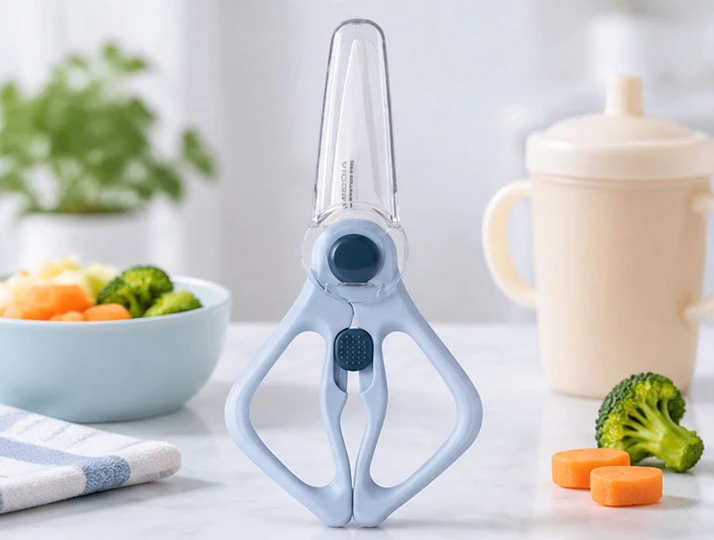
1. What Are Baby Feeding Accessories?
Baby feeding accessories are products designed to support different stages and activities of feeding, from preparing food to serving meals and helping babies develop independent eating habits.
For retailers and distributors, this category offers several product opportunities. Some products meet everyday feeding needs, while others provide convenience for parents preparing food at home or feeding children outside.
When planning a wholesale assortment, it is useful to divide baby feeding products according to their primary functions rather than treating them as one large category.
1.1 Common Products Included in Baby Feeding Accessories
The following table provides an overview of common baby feeding products and their potential retail positions.
| Product Category | Main Function | Retail Positioning | Important Buying Considerations |
|---|
| Baby Feeding Scissors | Cutting food into smaller pieces | Functional feeding tool | Blade material, protection, handling, cleaning |
| Baby Feeding Spoons | Serving purees and soft foods | Essential feeding product | Material, shape, size, handle design |
| Baby Feeding Forks | Supporting self-feeding | Essential feeding product | Grip, tine design, dimensions |
| Food Feeders | Introducing selected soft foods | Functional accessory | Food-contact materials, cleaning, construction |
| Feeding Bowls | Holding and serving meals | Core feeding item | Stability, capacity, material |
| Snack Containers | Storing snacks during daily activities | Convenience product | Capacity, sealing, portability |
| Portable Feeding Sets | Combining tools for feeding outside the home | Travel-oriented product | Storage, packaging, product combinations |
These products do not necessarily need to be sourced from one manufacturer. However, retailers can create a more consistent shopping experience by selecting products that complement each other in terms of function, design, and packaging.
1.2 Why Retailers Should Look Beyond Individual Products
Purchasing one product at a time may be a reasonable way to test a new category. However, a product range gives customers more opportunities to find related items within the same store or brand.
For example, a parent shopping for feeding spoons may also need a bowl, a food storage container, or a convenient tool for cutting food into smaller portions. If these products are presented as part of a coordinated feeding collection, the retailer can make product discovery easier.
For distributors, a broader assortment can also create opportunities to serve different types of retail customers. A specialist baby store may prefer individual functional products, while an online retailer may be more interested in coordinated sets and gift-oriented packaging.
However, a larger product range is not automatically a better one. The important question is whether each product has a clear role and whether there is enough customer demand to justify keeping it in stock.
2. Where Do Baby Feeding Scissors Fit in a Wholesale Product Range?
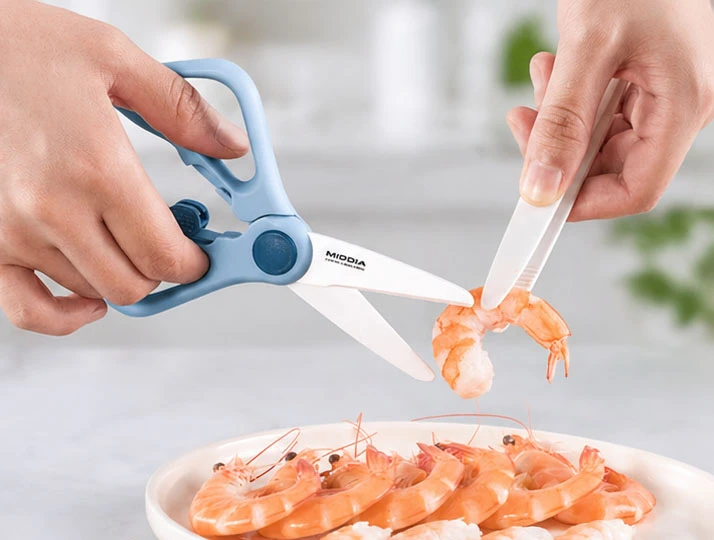
Baby feeding scissors are a practical category within the wider baby feeding accessories market. Unlike spoons and bowls, which are primarily used for serving food, feeding scissors are designed to help caregivers cut suitable foods into smaller pieces before serving.
They are particularly relevant to parents who prepare meals at home, pack food for outings, or want a compact tool for everyday feeding preparation.
For wholesale buyers, this makes baby feeding scissors an interesting functional addition to an existing feeding assortment.
2.1 Why Baby Feeding Scissors Can Complement Other Feeding Products
One reason feeding scissors can work well within a broader product range is their clearly defined purpose. They solve a specific food-preparation task rather than duplicating the function of another feeding accessory.
Consider a retailer already selling baby spoons, forks, and feeding bowls. Adding baby feeding scissors introduces another practical product that customers may need during the same stage of their child's development.
From a merchandising perspective, feeding scissors can offer several advantages:
Complementary functionality: They support food preparation alongside products used for serving and eating.
Compact product format: Their relatively small size can make them suitable for different retail displays and storage arrangements.
Clear product demonstration: Retailers can explain their purpose through product images and demonstrations.
Packaging flexibility: They can be sold individually or included in selected feeding accessory sets.
Branding opportunities: Different handle colors, protective covers, and retail packaging may support a coordinated product identity, subject to manufacturing capabilities.
These are product-positioning opportunities rather than guaranteed sales results. Buyers should still evaluate their own market, customer feedback, and price positioning before placing a large order.
2.2 Baby Feeding Scissors Compared With Other Feeding Tools
When developing a wholesale assortment, it helps to understand how each product contributes to the overall range.
| Product | Customer Need | Product Role | Packaging Opportunity |
|---|
| Feeding Spoon | Serving and feeding soft foods | Essential | Individual or multi-piece set |
| Feeding Fork | Supporting self-feeding | Essential | Individual or coordinated set |
| Baby Feeding Scissors | Preparing smaller food portions | Functional | Individual retail package or feeding kit |
| Food Feeder | Introducing suitable soft foods | Functional | Individual package |
| Portable Feeding Set | Feeding during travel and outings | Convenience-oriented | Storage case or gift packaging |
We believe baby feeding scissors are best positioned as a complementary product rather than a replacement for conventional feeding tools. This distinction helps buyers develop a more logical assortment and avoid unnecessary overlap between SKUs.
2.3 Choosing the Right Feeding Scissors for Your Market
Not all baby feeding scissors are designed in the same way. Buyers should compare the blade material, handle construction, overall dimensions, protective components, and cleaning requirements.
At MIDDIA, our ceramic baby feeding scissors use zirconia ceramic cutting components. Ceramic offers a different material profile from conventional stainless-steel cutting blades, including high hardness and resistance to rust under normal conditions of use.
However, material selection should not be the only purchasing criterion. The complete product needs to be evaluated, including its structure, assembly, handling, blade protection, and suitability for the intended market.
For buyers considering ceramic feeding scissors, we recommend reviewing the following:
Whether the ceramic cutting components are properly finished.
Whether the blades align correctly when opened and closed.
Whether the protective cover fits securely.
Whether the handles are comfortable to hold.
Whether the product can be cleaned according to the manufacturer's instructions.
Whether the available test documentation covers the product being purchased.
These details are especially important for retailers selling products under their own brand, because the end customer will associate the product experience with the retailer's name.
3. How to Build a Baby Feeding Accessories Product Range
A successful product assortment does not have to contain dozens of items. In fact, starting with too many similar products can create unnecessary inventory pressure and make purchasing decisions more complicated.
We suggest beginning with customer use cases, then selecting products that serve different purposes. This approach allows retailers to build a coherent assortment while keeping the initial SKU structure manageable.
3.1 Start With Customer Use Cases, Not Product Quantity
Before contacting a wholesale baby feeding accessories supplier, consider how your customers actually use feeding products.
Several common situations can help guide product selection.
Home feeding: Parents preparing meals at home may need feeding spoons, bowls, forks, and food-preparation tools.
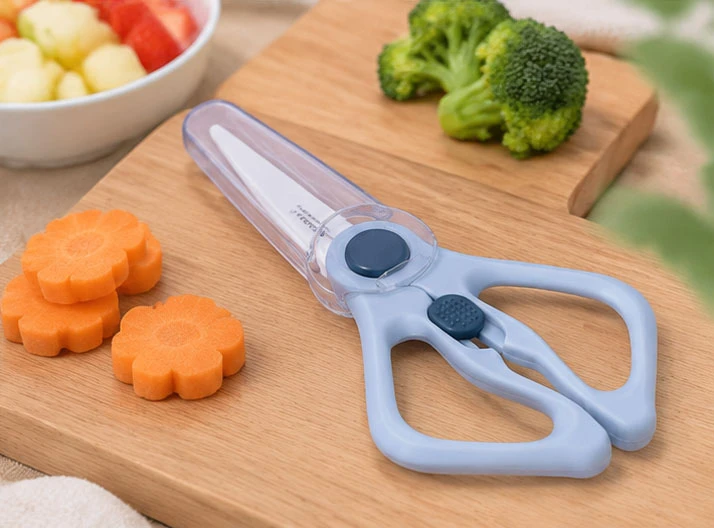
Food preparation: Products such as baby feeding scissors can help caregivers cut suitable foods into smaller portions before serving.
Self-feeding: Spoons, forks, and other appropriately designed feeding tools may support different stages of independent eating.
Travel feeding: Compact products, protective cases, and portable feeding accessories may be more relevant to customers who frequently go outside with their children.
Gift purchasing: Coordinated feeding sets and attractive retail packaging may be suitable for gift-oriented product collections.
These use cases can overlap, but they provide a useful starting point for deciding which products deserve priority.
3.2 Build a Basic, Functional, and Premium Product Structure
One practical way to organize a baby feeding accessories collection is to divide products into three commercial positions.
| Product Level | Purpose | Example Products | Retail Strategy |
|---|
| Basic | Cover everyday feeding requirements | Spoons, forks, feeding bowls | Core assortment |
| Functional | Provide additional practical functions | Baby feeding scissors, food feeders | Complementary products |
| Premium | Offer convenience or coordinated product experiences | Portable feeding kits, gift sets | Higher-value assortment |
This structure is useful because it gives each product a reason to exist in the collection. It also helps purchasing teams evaluate whether a new product adds something meaningful or simply duplicates an existing item.
For example, a retailer could begin with a basic feeding collection and introduce ceramic baby feeding scissors as a functional product. If customer response is positive, the retailer may later explore coordinated packaging or additional feeding accessories.
3.3 Use Baby Feeding Scissors as a Functional Add-On
From our experience manufacturing ceramic baby feeding scissors, we see the product as a practical addition to a wider feeding collection.
Its function is relatively easy to communicate: caregivers use an appropriate feeding tool to cut suitable foods into smaller pieces before serving. This gives the product a clear position alongside spoons, forks, and bowls.
For retailers, several merchandising approaches are worth considering:
Place feeding scissors alongside other food-preparation accessories.
Include them in selected portable feeding collections.
Present the product as an individual functional tool.
Use product demonstrations to explain its intended application.
Provide clear cleaning, storage, and handling instructions.
It is important to communicate the intended age range and usage instructions based on the actual product documentation. Feeding scissors should be handled by adults and kept out of children's reach. They are a food-preparation tool, not a toy.
4. How to Evaluate Baby Feeding Accessories Before Buying Wholesale
Product selection is one of the most important stages of wholesale sourcing. A product may look attractive in a catalogue, but buyers need to understand its materials, construction, testing, packaging, and consistency before committing to bulk purchasing.
When we discuss product requirements with wholesale customers, we encourage them to evaluate the complete product rather than focusing on appearance or quotation price alone.
4.1 Material Selection and Food-Contact Suitability
Material selection affects several aspects of a feeding product, including its durability, cleaning requirements, appearance, and intended applications.
For baby feeding accessories, buyers should ask suppliers to identify the materials used in each product component. A single item may contain different materials for its handle, cutting components, protective cover, or other structural parts.
For ceramic baby feeding scissors, zirconia ceramic is used for the cutting components. Zirconia is a high-hardness technical ceramic, and its material properties differ from those of stainless steel.
However, it is important not to assume that one material makes an entire product automatically suitable for every food-contact application. The complete product design, manufacturing process, applicable regulations, and supporting test documentation all matter.
When evaluating materials, ask the supplier:
What materials are used in each product component?
Are the materials suitable for their intended food-contact applications?
What supporting test reports or compliance documents are available?
What cleaning and maintenance instructions should be followed?
Are there any material-related limitations that retailers should communicate to customers?
4.2 Product Safety and Structural Design
Baby feeding products require careful attention to structural design because they are used in an environment involving food and young children.
For feeding scissors, buyers should pay particular attention to blade alignment, handle stability, protective covers, assembly quality, and the overall design of the product.
A product can have an attractive appearance but still perform poorly if its components are not assembled consistently.
We recommend checking:
Whether the cutting components are properly aligned.
Whether the opening and closing movement is consistent.
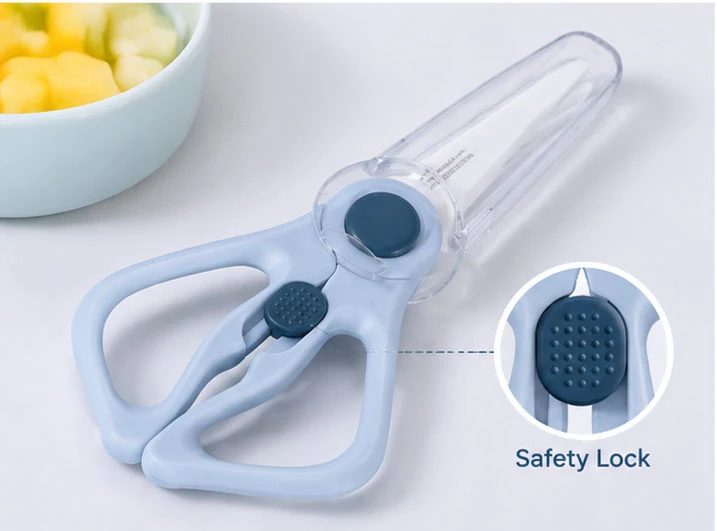
Whether the protective cover can be fitted and removed as intended.
Whether the handles have visible defects or sharp unwanted edges.
Whether the product remains structurally stable during normal intended use.
Whether the product comes with appropriate instructions and warnings.
These checks should be part of sample evaluation before wholesale orders are confirmed.
4.3 Testing and Certification: What Wholesale Buyers Should Check
Testing documents and certifications are important when sourcing baby feeding products, particularly for importers and retailers selling into markets with specific product compliance requirements.
However, buyers should understand exactly what each document demonstrates. A test report, a certification, a regulatory declaration, and a food-contact compliance document are not interchangeable.
At MIDDIA, our ceramic baby feeding scissors have supporting documentation associated with FDA and LFGB requirements, as well as an SGS 1M drop test. We encourage buyers to review the actual documents rather than relying only on a product catalogue statement.
SGS 1M drop test: This is a product-related testing reference that buyers can use when evaluating the documented drop-test performance of the relevant product. The exact test conditions, sample configuration, acceptance criteria, and results should be checked in the SGS report.
FDA-related documentation: FDA is a US regulatory authority, not a universal product certification label. Buyers should verify which applicable FDA requirements, materials, or food-contact testing are covered by the documentation provided.
LFGB-related documentation: LFGB is associated with German food and consumer goods legislation. Buyers sourcing products for European markets should check the actual test scope and whether the documentation covers the relevant product materials and intended applications.
We do not recommend choosing a supplier based on certification claims alone. Buyers should also examine product specifications, material information, sample quality, and manufacturing consistency.
4.4 Ease of Cleaning and Maintenance
Cleaning is a practical consideration that can influence customer satisfaction with baby feeding accessories.
Products with complicated structures or difficult-to-reach areas may require more attention during daily maintenance. Buyers should therefore examine how the product is cleaned, whether components can be removed, and whether the manufacturer provides clear instructions.
For feeding scissors, particular attention should be paid to areas around the blade connection and other assembled components where food residue may collect.
Retailers should avoid making unsupported claims such as dishwasher-safe or sterilizer-safe unless the manufacturer has confirmed these uses through appropriate product specifications or testing.
4.5 Packaging and Product Protection
Packaging is not simply an additional cost. It affects how products are stored, transported, displayed, and understood by customers.
For baby feeding scissors, a protective cover is especially relevant because it helps protect the cutting components during storage and transportation when used as intended.
When reviewing packaging, wholesale buyers should consider:
Whether the product is adequately protected during transportation.
Whether the packaging clearly identifies the product and its intended use.
Whether cleaning and handling instructions are included.
Whether barcode and retail information can be added.
Whether the package is suitable for the intended retail channel.
Whether packaging dimensions are practical for shipping and storage.
4.6 MOQ and Customization Requirements
Minimum order quantity is an important part of wholesale purchasing, especially for retailers testing a new product category.
Some suppliers offer standard products with relatively straightforward ordering arrangements, while custom colors, logos, or retail packaging may require different production quantities.
Before requesting a quotation, buyers should separate standard-product requirements from customization requirements.
For example, ask whether the supplier can provide:
Standard products without customization.
Custom logo printing or branding.
Different handle colors, where available.
Custom retail boxes or packaging.
Product inserts and instruction cards.
Barcode and label customization.
At MIDDIA, our current customization planning for ceramic baby food scissors includes a custom-logo MOQ of 2,000 pieces and custom packaging or color options from 3,000 pieces, subject to final product specifications and order confirmation.
Buyers should always confirm the applicable MOQ, customization feasibility, sample requirements, and production schedule for their particular order.
4.7 Consistency Between Production Batches
Sample approval is only the beginning of supplier evaluation. For a retailer or distributor, the product received in the next order should remain consistent with the approved sample.
Differences in product dimensions, blade alignment, color, assembly, or packaging can create problems for businesses that depend on repeat orders.
When evaluating a wholesale baby feeding accessories supplier, ask how production batches are checked and how approved specifications are maintained.
We believe this is particularly important for private-label buyers. Once a retailer has introduced a product under its own brand, consistency becomes part of the brand experience.
4.8 Supplier Communication and Documentation
Good communication can make a significant difference during product development and repeat purchasing.
A reliable supplier should be able to explain product specifications, clarify material questions, provide relevant documents, and communicate any changes that may affect the order.
Before placing an order, ask for the information needed to make an informed purchasing decision, including product specifications, sample details, applicable testing documents, packaging information, and production arrangements.
Do not hesitate to ask questions about details that are not clear. It is generally easier to resolve specification differences before production than after goods have arrived.
5. Wholesale Baby Feeding Products: How to Compare Suppliers
After evaluating the products themselves, the next step is finding a supplier who can support your business beyond the initial order.
For retailers and distributors, choosing a baby feeding accessories supplier is not simply a matter of comparing quotations. A supplier may offer an attractive unit price, but if communication is slow, product specifications are unclear, or quality varies between orders, the overall purchasing cost can become much higher than expected.
We have found that wholesale buyers generally need to evaluate three things together: the supplier's product knowledge, its manufacturing or sourcing capabilities, and its ability to support repeat business.
5.1 Manufacturer vs. Trading Company: Which Is Better?
Both manufacturers and trading companies can be suitable wholesale partners. The right choice depends on the products you are purchasing, the level of customization required, and how much control you need over production information.
The following comparison can help buyers understand the differences.
| Evaluation Factor | Direct Manufacturer | Trading Company |
|---|
| Product Knowledge | Usually has direct knowledge of manufacturing processes and specifications | Depends on communication with its manufacturing partners |
| Customization | Can often coordinate product modifications directly with production teams | Depends on the capabilities of the factories it works with |
| Production Communication | Direct communication may simplify technical discussions | Information may pass through additional communication stages |
| Quality Control | May provide more direct visibility into factory inspection procedures | Depends on supplier management and inspection arrangements |
| Product Development | Can be suitable for developing products based on manufacturing capabilities | May coordinate development across different factories |
| MOQ Flexibility | Depends on production processes, materials, and order requirements | May offer flexibility by combining products from different sources |
| Product Range | Usually strongest in its own manufacturing categories | May offer a wider selection across different product categories |
There is no universal answer to which type of supplier is better. A trading company may be convenient for a buyer sourcing many unrelated product categories. A direct manufacturer may be more suitable when technical details, product customization, or production consistency are important.
For example, if you are purchasing ceramic baby feeding scissors and need to discuss blade materials, product construction, protective covers, or customized packaging, working directly with a manufacturer can make technical communication more straightforward.
5.2 Look Beyond the Quotation Price
Price is naturally important in wholesale purchasing, but the lowest quotation does not always represent the best commercial decision.
Consider a simple situation: two suppliers offer what appears to be the same feeding scissors. One provides a lower price but cannot clearly explain the material specifications or testing documentation. The other offers a more detailed product specification, relevant test reports, and a defined sample approval process.
For a retailer selling under its own brand, the second supplier may offer better purchasing value even if the initial unit price is higher.
When comparing quotations, look at the complete purchasing arrangement:
Unit price and price validity period.
MOQ and quantity-based pricing.
Product specifications and included accessories.
Packaging costs and customization charges.
Sample costs and sample lead time.
Production lead time.
Inspection and quality requirements.
Shipping terms and delivery arrangements.
Documentation and after-sales communication.
These details help buyers compare suppliers on a more realistic basis instead of making decisions based on one number.
6. What Makes a Reliable Baby Feeding Accessories Supplier?
A reliable supplier should be able to explain not only what it sells but also how the products are made, evaluated, and supplied.
For baby feeding products, this becomes especially important because the products are associated with food preparation and use around young children. Buyers need enough information to assess whether a product is suitable for their target market and whether the supplier can support future orders.
6.1 Product Specifications Should Be Clear
Every wholesale product should have a reasonably clear specification sheet. It does not need to be complicated, but it should contain enough information for buyers to understand exactly what they are purchasing.
For ceramic baby feeding scissors, useful specifications may include:
Product dimensions and weight.
Blade material and handle material.
Product structure and assembly details.
Protective cover information.
Available colors and product variations.
Cleaning and maintenance instructions.
Packaging dimensions and included components.
Having this information in writing reduces the possibility of misunderstandings during quotation, sample approval, and mass production.
6.2 Ask for Relevant Testing and Compliance Documents
Do not rely entirely on statements such as food-grade, non-toxic, or certified. Ask the supplier which standards or testing requirements apply to the product and whether supporting documentation is available.
It is also important to check whether a report covers the exact product, material, or component being purchased. A report for one material or product model should not automatically be treated as evidence for every item in a supplier's catalogue.
For importers, this information is particularly useful when discussing product requirements with local compliance teams or regulatory consultants.
6.3 Sample Availability and Production Capability
A supplier should be willing to explain its sample process and how an approved sample relates to the final production order.
When reviewing a sample, buyers should check the product's appearance, dimensions, materials, functional performance, packaging, and documentation.
For customized products, the approved sample should also reflect the agreed design details. If a different material, color, or packaging component is introduced later, the supplier should communicate the change before production continues.
6.4 The Ability to Support Repeat Orders
For a distributor or established retailer, a successful first order is only one part of the relationship. The supplier also needs to support replenishment and future product development.
Ask how product specifications are recorded, how production changes are communicated, and what information is retained for repeat orders.
A supplier who can maintain a clear record of approved specifications is easier to work with when you need to reorder the same product several months later.
7. How We Approach Quality Control at MIDDIA
At MIDDIA, our experience in ceramic cutting tools has shaped the way we approach product development and manufacturing. Ceramic components require attention to material properties, processing, finishing, and assembly. These considerations also matter when developing ceramic baby feeding scissors.
We understand that wholesale buyers are not only purchasing a finished product. They are also making a decision about the product quality their customers will receive and the consistency they can expect from future orders.
For this reason, we believe quality evaluation should cover more than a final visual inspection.
7.1 Material and Component Inspection
The first consideration is whether the materials and components correspond to the approved product specifications.
Our ceramic cutting products use zirconia ceramic, a technical material known for its high hardness. However, the properties of the finished component depend on more than the material name. Processing, grinding, finishing, and dimensional control all contribute to the final result.
For a ceramic baby feeding scissors product, buyers should also consider the other components, including the handle, connecting parts, and protective cover.
We pay attention to whether the supplied components match the agreed specifications and whether there are visible defects that could affect assembly or the final product appearance.
7.2 Dimensional and Assembly Checks
Dimensions and assembly quality can influence the way feeding scissors feel and function during use.
Important inspection points include blade alignment, handle assembly, opening and closing movement, and the fit of the protective cover.
Even when two products look similar in photographs, differences in assembly can affect the customer's experience. This is why physical sample evaluation remains important for wholesale buyers.
For private-label orders, we also recommend confirming product dimensions, color references, logo positions, and packaging details before mass production.
7.3 Functional Testing
A feeding scissors product should be evaluated as a complete assembled item, not simply as a collection of individual components.
Functional checks may include:
Whether the blades open and close as intended.
Whether the cutting components are properly aligned.
Whether the handle assembly remains stable.
Whether the protective cover fits correctly.
Whether the finished product matches the approved sample.
The exact inspection method and acceptance criteria should be established according to the product specifications and applicable requirements.
7.4 Drop Testing and Product Durability
Product durability is another area that wholesale buyers may want to investigate, particularly for products that contain ceramic components.
Our ceramic baby feeding scissors have undergone an SGS 1M drop test. This provides buyers with a documented testing reference when evaluating the product.
We recommend reviewing the actual SGS report for the relevant product model, including the test conditions, sample details, evaluation criteria, and results. A drop-test result should be understood within the scope of the specific test rather than interpreted as a guarantee that the product cannot be damaged under every possible condition.
For buyers, this is also a useful reminder that testing information should be connected to a specific product and a clearly defined test method.
7.5 Documentation for Wholesale Buyers
Documentation helps buyers make purchasing decisions with greater confidence and supports communication between suppliers, importers, retailers, and compliance teams.
Depending on the product and market requirements, relevant information may include:
Product specifications.
Material information.
Applicable FDA-related documentation.
LFGB-related testing or compliance documentation.
SGS drop-test report.
Packaging information and product instructions.
We encourage buyers to request the documents relevant to their intended market and confirm that the product model and test scope match the goods being purchased.
For us, documentation is not simply something to provide after a customer asks for it. It is part of the information that helps both sides establish clear product expectations before an order is placed.
8. Packaging Baby Feeding Accessories for Retail
Packaging plays a larger role in wholesale product development than many first-time buyers expect. It affects product protection, shelf presentation, shipping efficiency, and the way customers understand a product.
For retailers and distributors, the packaging strategy should match the product's position in the overall assortment.
8.1 Individual Product Packaging
Individual packaging is often a practical starting point for retailers testing a new product.
For baby feeding scissors, a suitable package may include the product, protective cover, product identification, and basic usage or maintenance information.
This approach is useful for:
Specialist baby product stores.
Online retail listings.
Distributors supplying independent retailers.
Retailers introducing a new functional feeding product.
Individual packaging also allows buyers to test product demand before investing in more complicated product combinations.
8.2 Multi-Product Feeding Sets
Once a retailer has established demand for individual products, coordinated sets may be worth considering.
For example, a feeding collection might combine selected products such as:
The specific combination should make practical sense. Adding products simply to increase the number of items in a box does not necessarily create a better customer experience.
Buyers should also consider whether all components can be sourced with consistent quality, packaging dimensions, and delivery schedules.
8.3 Travel Feeding Kits
Portable feeding accessories can be positioned around convenience. Parents who travel frequently or spend time outside the home may prefer compact products that are easy to store and carry.
A travel-oriented assortment could include selected feeding tools, a suitable protective case, and clear cleaning instructions.
For feeding scissors, a properly designed protective cover is particularly relevant to storage and transportation. Retailers should ensure that the product is packaged and described according to its actual design and intended use.
8.4 Private-Label Packaging
For baby product brands and established distributors, private-label packaging can help create a more recognizable product collection.
Common customization elements include:
Brand logo and visual identity.
Packaging colors and layout.
Retail box design.
Barcode and product identification.
Instruction leaflets.
Product information and required warnings.
At MIDDIA, we work with buyers who want to develop ceramic baby feeding scissors for their own product collections. Our current customization arrangements include custom logos from 2,000 pieces and custom packaging or color options from 3,000 pieces, subject to confirmation of the selected model and specifications.
We recommend discussing packaging requirements early rather than waiting until the production stage. Artwork approval, packaging materials, printing, and assembly can all affect the final delivery schedule.
9. How to Manage SKUs When Buying Baby Feeding Accessories Wholesale
SKU management is one of the less visible parts of wholesale purchasing, but it can have a direct impact on inventory efficiency.
A retailer may be tempted to introduce several colors, sizes, and packaging versions of the same product. While variety can help serve different customers, too many variations can create slow-moving inventory and complicate replenishment.
9.1 Avoid Too Many Similar SKUs
Imagine a retailer introducing a ceramic baby feeding scissors product in three colors, two packaging versions, and two handle variations.
If every combination is treated as a separate SKU, the business may need to manage a large number of inventory items before it has enough sales data to understand which options customers prefer.
For a new product category, this can tie up purchasing funds without necessarily improving sales performance.
We suggest starting with a smaller number of clearly differentiated options. For example, one standard product specification with one or two carefully selected retail presentations may be sufficient for an initial market test.
9.2 Start With a Controlled SKU Mix
The following is an illustrative assortment structure for a retailer entering the baby feeding accessories category.
| Product Type | Suggested SKU Role | Initial Purchasing Consideration |
|---|
| Baby Feeding Spoon | Core | Choose a practical standard design |
| Baby Feeding Fork | Core | Coordinate with the spoon where appropriate |
| Baby Feeding Scissors | Functional | Evaluate blade material, cover, and packaging |
| Portable Feeding Tool | Optional | Test demand before expanding |
| Feeding Accessory Set | Premium | Develop after selecting suitable individual products |
This is not a fixed formula. A specialist feeding retailer may need a different assortment from an online distributor or a general baby products wholesaler.
The purpose is to give every SKU a clear commercial role before committing to inventory.
9.3 Review SKU Performance Before Expanding
After the first sales period, buyers should review actual product performance rather than expanding the range based only on assumptions.
Useful indicators include:
Sales velocity: How quickly does each SKU sell?
Repeat orders: Which products generate regular replenishment?
Customer feedback: Are customers satisfied with the product design and function?
Return rate: Are there recurring quality or expectation-related problems?
Packaging performance: Does the packaging remain suitable during shipping and retail handling?
Inventory turnover: Which products occupy storage space for too long?
These observations can help retailers decide whether to add colors, introduce a new feeding tool, or develop a coordinated set.
10. From Single-Product Purchasing to a Complete Feeding Range
For many retailers and distributors, building a complete product range is a gradual process. There is no need to source every possible feeding accessory from the beginning.
We often recommend approaching product expansion in stages. This gives buyers time to understand customer demand, evaluate supplier performance, and manage inventory before moving into more complex product development.
10.1 Stage One: Test One Product
Start with a product that has a clear function and fits your target customer group.
For example, a retailer already selling baby feeding accessories may introduce ceramic baby feeding scissors as an additional food-preparation tool.
Before placing a bulk order, evaluate samples, compare specifications, check the relevant documentation, and confirm the packaging requirements.
The initial objective is to understand whether the product fits your existing customer base and retail positioning.
10.2 Stage Two: Add Complementary Products
Once the first product has established a place in the assortment, consider adding complementary feeding products.
These might include spoons, forks, feeding bowls, or portable accessories, depending on the retailer's existing product categories.
It is worth reviewing whether the products share similar customer groups and whether they can be presented together in a meaningful way.
10.3 Stage Three: Develop a Private-Label Range
For businesses with established sales channels, private-label development can be the next step.
Instead of selling generic products, the retailer can develop a more consistent identity through product selection, colors, logo placement, and packaging design.
However, private labeling requires clear specifications. Before production, confirm the following:
Final product model and dimensions.
Approved materials and colors.
Logo artwork and placement.
Packaging design and printing requirements.
Product instructions and required warnings.
Applicable testing and compliance documentation.
MOQ and production lead time.
At MIDDIA, we can discuss custom-logo and packaging requirements for our ceramic baby feeding scissors with buyers who want to develop their own product identity.
10.4 Stage Four: Build a Long-Term Supplier Relationship
When a product performs well, maintaining a stable supply becomes more important than continually searching for a new quotation.
Retailers and distributors should work with suppliers to maintain approved product specifications, communicate forecast changes, and plan replenishment orders in advance.
Over time, a good supplier relationship can also support new product development, coordinated packaging, and expansion into additional feeding accessories.
For buyers, the objective is not simply to purchase more products. It is to create a sourcing arrangement that supports the business as its product range grows.
11. Baby Feeding Accessories Wholesale Supplier Checklist
Before placing a wholesale order, buyers should have a clear list of questions for the supplier. The following checklist can be used when comparing manufacturers, trading companies, and baby feeding accessories suppliers.
12 Questions to Ask Before Placing a Wholesale Order
What materials are used? Ask for details about the materials used in each product component.
Is the product suitable for its intended food-contact application? Request relevant supporting information and documentation.
What testing has been completed? Confirm the specific product model and test scope.
Can you provide test reports? Ask for the actual documents rather than relying only on marketing descriptions.
What certifications or compliance documents are available? Check their applicability to your target market.
What is the MOQ? Confirm standard and customized order quantities separately.
Can the product be private labeled? Discuss logo options, colors, and other available modifications.
Can packaging be customized? Confirm artwork, printing, packaging materials, and associated costs.
How are production batches inspected? Ask about inspection procedures and product consistency.
Can samples be provided before bulk production? Confirm sample availability and approval procedures.
What is the production lead time? Ask about the estimated schedule after specifications and packaging are approved.
Can the supplier support future product expansion? Discuss whether it can support repeat orders and related product development.
A supplier who can answer these questions clearly gives buyers a better foundation for making purchasing decisions. If some information is unavailable, ask whether it can be provided before order confirmation.
12. Why Work With a Manufacturer for Baby Feeding Accessories?
When sourcing baby feeding accessories wholesale, working directly with a manufacturer can be useful when product specifications, customization, and repeat production are important to your business.
Manufacturers have direct involvement in the products they produce, although the actual level of customization, documentation, and production control varies from one factory to another.
For buyers developing their own brand, the following capabilities are worth discussing.
12.1 Direct Communication About Product Specifications
Product development often involves technical questions that cannot be answered by looking at photographs alone.
For ceramic baby feeding scissors, buyers may want to discuss zirconia ceramic components, blade structure, handle design, protective covers, and product dimensions.
Direct communication with a manufacturer can make it easier to clarify these requirements and confirm whether a requested modification is technically feasible.
12.2 Product Customization and Private Label
Private-label buyers often need more than a standard product with a logo added to the packaging.
They may want to coordinate product colors, branding, packaging dimensions, instruction cards, and other details to match their existing product collection.
A manufacturer should be able to explain which options are available, what the MOQ is for each option, and whether the requested design affects the production schedule.
12.3 Quality and Testing Documentation
Buyers should be able to review relevant product information before committing to a wholesale order.
For our ceramic baby feeding scissors, the available documentation includes FDA-related and LFGB-related materials, as well as an SGS 1M drop-test reference. The exact reports and their applicable product models should be confirmed during the purchasing process.
We encourage buyers to evaluate the actual documents alongside product samples and specifications. This creates a more complete understanding of the product than relying on a short certification statement.
12.4 Packaging Development
Packaging is often one of the first things a customer notices when purchasing a retail product.
For this reason, packaging should be discussed together with product development. A well-planned package needs to protect the product, communicate its purpose, and meet the requirements of the retailer's sales channel.
We can discuss available packaging and branding arrangements with buyers interested in developing ceramic baby feeding scissors for their own collections.
12.5 Product Range Expansion
Some buyers initially contact us because they are looking for a specific ceramic product. As their sourcing requirements become clearer, they may also want to explore additional products or coordinated product collections.
We believe it is useful to understand the buyer's broader business plans at an early stage. This helps both sides discuss product positioning, specifications, packaging, and potential future development more effectively.
At MIDDIA, our manufacturing background is rooted in ceramic cutting tools, and ceramic baby feeding scissors are one of the product categories through which we work with baby product retailers, distributors, and brands.
13. Frequently Asked Questions About Baby Feeding Accessories Wholesale
13.1 What Are Baby Feeding Accessories?
Baby feeding accessories are products used to prepare, serve, store, or feed food to babies and toddlers. Common examples include feeding spoons, forks, bowls, food feeders, baby feeding scissors, snack containers, and portable feeding sets.
For retailers, these products can be organized into essential feeding items, functional food-preparation tools, and convenience-oriented accessories.
13.2 What Products Should I Include in a Baby Feeding Accessories Range?
A practical starting assortment may include feeding spoons, forks, bowls, and baby feeding scissors. Retailers can then consider adding food feeders, portable accessories, or coordinated feeding sets according to customer demand.
The right combination depends on your target market, retail channel, price positioning, and inventory budget.
13.3 Are Baby Feeding Scissors a Good Wholesale Product?
Baby feeding scissors can be a useful complementary product for retailers already selling feeding accessories. They serve a specific food-preparation function and can be positioned alongside spoons, forks, and other feeding tools.
Before purchasing, buyers should evaluate the material, product construction, protective cover, cleaning requirements, testing documentation, and retail packaging.
13.4 What Should I Look for in a Baby Feeding Accessories Supplier?
Look for a supplier who can provide clear product specifications, material information, relevant testing documents, samples, transparent MOQ requirements, and reliable communication.
If you plan to develop your own brand, customization capabilities, packaging support, and consistency between production batches should also be considered.
13.5 What Certifications Should Baby Feeding Products Have?
The applicable requirements depend on the product, materials, intended use, and destination market. Buyers should identify the relevant food-contact and product-safety requirements before placing an order.
FDA-related documentation may be relevant to certain US regulatory requirements, while LFGB-related testing is commonly considered when evaluating food-contact materials for the German market. The actual scope of each document must be checked. Neither should be treated as a universal certification for every product.
13.6 What MOQ Should I Expect When Buying Baby Feeding Accessories Wholesale?
MOQ varies by supplier, product design, material, production process, and customization requirements.
Standard products may have different order requirements from products involving custom colors, logos, or packaging. Buyers should request a quotation based on their exact product specifications rather than assuming one MOQ applies to every option.
13.7 Can Baby Feeding Accessories Be Private Labeled?
Yes. Many manufacturers offer private-label options such as logo printing, custom colors, retail packaging, and product information inserts.
However, each customization option may have its own MOQ, artwork requirements, and production lead time. Confirm these details before approving the order.
13.8 Should Retailers Buy Individual Products or Complete Feeding Sets?
Both approaches can work. Individual products are useful for testing demand and allowing customers to select specific items. Complete feeding sets can provide a coordinated product presentation and may suit gift-oriented or convenience-focused retail channels.
For businesses entering the category, starting with individual products and introducing sets after evaluating customer response can be a practical approach.
13.9 How Can I Evaluate a Baby Feeding Accessories Manufacturer?
Review the manufacturer's product specifications, production capabilities, sample quality, testing documentation, customization options, quality-control procedures, and repeat-order arrangements.
It is also useful to communicate directly with the supplier about your intended market and product requirements before requesting a final quotation.
14. Conclusion: Build Your Baby Feeding Product Range Around Real Customer Needs
Building a successful baby feeding accessories range is not about purchasing as many products as possible. It is about selecting products that serve clear customer needs and creating an assortment that makes sense for your retail or distribution business.
Start with essential feeding products, consider functional additions such as baby feeding scissors, and gradually introduce convenience products or coordinated sets when customer demand supports the expansion.
At the same time, pay close attention to material selection, product testing, supplier communication, packaging, MOQ, and production consistency. These details may not always be visible in a product photograph, but they matter throughout the purchasing and retail process.
At MIDDIA, we work with buyers interested in ceramic baby feeding scissors and related ceramic products. Whether you are evaluating a new feeding accessory, looking for a wholesale supplier, or considering a private-label product, we believe a clear discussion of specifications and requirements is the best starting point.
If you are planning to expand your baby feeding product range, explore our ceramic baby feeding scissors and discuss your product requirements with our team.
Explore MIDDIA Baby Feeding Accessories
Looking for a ceramic baby feeding scissors supplier for your retail business or private-label brand? Explore MIDDIA's product options and discuss wholesale quantities, custom logos, packaging, and product development with our team.
Explore MIDDIA Baby Feeding Accessories
