
When selecting baby food scissors, appearance is only one part of the decision. For parents, the product needs to be practical and comfortable to use during everyday feeding. For baby product brands, retailers, distributors and importers, the evaluation goes further. They need to understand the blade material, manufacturing precision, structural reliability, protective features and food-contact safety before deciding whether a product is suitable for their market.
Baby food scissors may look like relatively simple products, but their quality depends on several components working together. A well-made blade cannot compensate for a weak handle connection, just as a durable handle does not guarantee that the blade edges are properly aligned. Even when a manufacturer uses food-contact-suitable materials, the complete product still needs to be evaluated according to its intended use and applicable requirements.
As a ceramic scissors manufacturer, we believe that evaluating baby food scissors quality requires looking beyond material descriptions and product photographs. Buyers should examine how the blade is manufactured, how the components are assembled, whether protective features work as intended and what testing documents are available to support product claims.
In this guide, we explain the main quality factors we consider during ceramic scissors production. We also provide a practical inspection checklist that retailers, importers, baby product brands and purchasing teams can use when comparing products or reviewing a potential manufacturing supplier.
1. Why Product Quality Should Be a Priority When Selecting Baby Food Scissors
The Role of Baby Food Scissors in Everyday Feeding
Baby food scissors are designed to help caregivers cut food into smaller pieces during meal preparation or feeding. Depending on the product design, they may be used at home, in restaurants, while travelling or in other feeding situations where convenient food preparation is important.
Unlike ordinary household scissors, baby food scissors are intended for a specific use environment. Their design should consider food contact, ease of cleaning, comfortable handling and the protection of the blade when the product is not being used.
For example, a parent may need to cut soft vegetables, noodles, fruit or other prepared foods into manageable portions. The scissors should open and close smoothly, and the blades should work consistently without requiring excessive force.
From a product development perspective, these requirements influence several design decisions. Blade geometry, handle dimensions, joint construction and protective accessories all contribute to the finished product's usability.
Why Blade Performance and Structural Reliability Matter
Blade performance is one of the first things buyers notice, but it should not be the only inspection point. A product may appear sharp when new but still have problems with blade alignment, closing accuracy or inconsistent cutting performance.
Structural reliability is equally important. If the connection between the blade and handle becomes loose, the scissors may not maintain their original operating performance. A poorly fitted protective cover or unreliable locking mechanism can also affect how conveniently the product can be stored and handled.
These details are particularly relevant to retailers and importers. Product complaints do not always come from major manufacturing defects. Sometimes, repeated issues involving loose components, difficult operation or damaged protective covers can create unnecessary after-sales work.
We therefore recommend evaluating the complete product rather than approving a sample based only on its appearance or initial cutting performance.
What Retailers and Importers Should Evaluate Before Purchasing
When reviewing a new baby food scissors product, purchasing teams should consider at least five areas:
Material suitability: Are the blade and handle materials appropriate for the intended application?
Manufacturing quality: Are the blade edges, surfaces and assembled components consistent?
Structural design: Do the handle, pivot, protective cover and locking mechanism work properly?
Testing documentation: Can the manufacturer provide relevant material, food-contact and product testing information?
Production consistency: Can the supplier maintain the same quality requirements across different production batches?
These questions provide a more useful starting point than simply comparing prices or selecting the product with the most attractive packaging.
2. Blade Materials: What Makes a Quality Baby Food Scissor Blade?
Understanding Zirconia Ceramic as a Blade Material
Zirconia ceramic is widely used in the production of cutting tools because of its high hardness, wear resistance and chemical stability. It is an important material in our ceramic scissors manufacturing business, particularly for products where resistance to corrosion and long-term edge performance are desirable.
Zirconia, or zirconium dioxide (ZrO2), is a technical ceramic material. It is not the same as ordinary pottery ceramic. Its properties depend on the powder composition, additives, forming process, sintering conditions and subsequent machining operations.
For baby food scissors, the material offers several characteristics worth considering:
High hardness: Zirconia ceramic is harder than conventional stainless steel, which helps it maintain a cutting edge under suitable operating conditions.
Wear resistance: Its hardness contributes to resistance against normal abrasive wear during use.
Corrosion resistance: Zirconia does not rust in the way ordinary carbon steel can, and it offers excellent resistance to many common chemical environments.
Low metallic interaction: Ceramic blades do not introduce iron-based rust or metallic corrosion products from the blade material.
Non-metallic composition: Ceramic provides an alternative to conventional metal blade materials for product designers.
However, high hardness should not be confused with unlimited durability. Zirconia ceramic is also a brittle material. It can chip or fracture when exposed to inappropriate impact, excessive bending or concentrated mechanical stress.
That is why we consider material selection and blade processing together. A suitable ceramic formulation is important, but the finished blade must also have appropriate geometry, edge finishing and structural support.
Key Properties of Zirconia Ceramic Blades
When buyers compare ceramic baby food scissors, it is useful to understand what the material can and cannot offer.
First, hardness contributes to wear resistance. A properly manufactured ceramic edge can maintain its cutting characteristics during normal use. This can be an advantage for products intended for repeated food preparation.
Second, corrosion resistance makes ceramic different from ordinary steel. A zirconia blade does not develop iron-based rust when exposed to moisture. This is relevant for kitchen and feeding products that may be cleaned frequently.
Third, ceramic has a different mechanical response from stainless steel. Stainless steel generally offers greater ductility, while ceramic is harder but more brittle. Product design must account for this difference, particularly around the blade edge and the areas where the blade connects to the handle.
Buyers should also remember that ceramic material properties do not automatically establish food-contact compliance. The final product needs to be assessed according to the materials used, the intended food-contact conditions and applicable market requirements.
Ceramic vs. Stainless Steel: What Buyers Should Evaluate
Both zirconia ceramic and stainless steel can be used in cutting products. The appropriate choice depends on the intended product design, operating environment, price positioning and quality requirements.
| Evaluation Factor | Zirconia Ceramic | Stainless Steel |
|---|---|---|
| Hardness | Very high | Varies by steel grade and heat treatment |
| Wear Resistance | Generally excellent | Depends on alloy, hardness and treatment |
| Corrosion Behavior | Highly corrosion-resistant | Depends on stainless steel grade and environment |
| Mechanical Behavior | Hard but relatively brittle | Generally more ductile and impact-tolerant |
| Maintenance | Does not develop iron-based rust | Requires suitable cleaning and maintenance |
| Manufacturing | Requires controlled ceramic forming, sintering and grinding | Uses metal forming, machining and finishing processes |
There is no single material that is automatically best for every application. Buyers should consider the actual product structure and performance rather than relying on general material comparisons.
For brands developing ceramic baby food scissors, zirconia can be an attractive option when high hardness, wear resistance and corrosion resistance are important product characteristics. At the same time, its brittleness means the blade must be designed and manufactured carefully.
Why Material Quality Depends on More Than the Material Name
One point we often emphasize is that writing “zirconia ceramic” on a product specification does not tell buyers everything they need to know.
Different ceramic raw materials and production processes can produce different results. Powder consistency, forming density, sintering control and grinding quality all influence the final blade.
In our manufacturing process, ceramic blades go through several production stages. The ceramic material is prepared and formed, followed by sintering and precision grinding. Each stage contributes to the final dimensions, surface condition and edge quality.
For this reason, purchasing teams should ask suppliers about their material specifications and manufacturing process. A supplier that can explain how its ceramic blades are produced provides more useful information than one that only makes general claims about hardness or sharpness.
3. Blade Precision and Edge Design: Details That Affect Product Quality
Blade Alignment and Closing Accuracy
Blade alignment is a practical inspection point that is easy to overlook when evaluating product photographs.
When baby food scissors are opened and closed, the two blades should move in a controlled manner. Their relative positions should remain consistent, and the cutting edges should meet as intended by the product design.
If the blades are misaligned, the scissors may produce uneven cutting results. Excessive gaps, incorrect contact positions or inconsistent closing movement can also indicate problems with machining or assembly.
During product inspection, we recommend opening and closing the scissors several times. Buyers should observe whether the movement is smooth and whether the blades return to the expected position without unusual resistance.
For quality management teams, dimensional inspection can provide additional evidence. Critical dimensions should be checked against the approved product drawings or manufacturing specifications rather than relying entirely on visual judgment.
Cutting Edge Consistency and Surface Finish
The cutting edge is one of the most important parts of a scissor blade. Small defects may affect cutting performance and indicate insufficient control during the finishing process.
When inspecting ceramic blades, buyers should look for:
Visible chips or cracks along the blade edge.
Uneven grinding marks or inconsistent edge finishing.
Surface defects that are not consistent with the approved sample.
Unexpected differences between the two blades.
Damage around the blade tip or other concentrated-stress areas.
Because zirconia ceramic is brittle, edge finishing requires appropriate manufacturing control. A blade can have excellent hardness and still be unsuitable if the grinding process introduces defects or produces an inconsistent edge profile.
We pay attention to the relationship between blade dimensions, edge finishing and assembly accuracy. These factors should be evaluated together, not as separate marketing specifications.
Blade Tips and Edge Geometry
The shape of the blade tip is another important part of baby food scissors design.
Depending on the intended product positioning, manufacturers may use different tip shapes and blade geometries. Some designs emphasize a compact profile, while others focus on providing a more protected or rounded tip structure.
There is no reason to assume that every product should have exactly the same tip design. What matters is whether the geometry is appropriate for the intended application and whether the finished product matches its approved specifications.
Buyers should examine the blade tip for visible damage, unexpected sharp projections and inconsistent finishing. If the product includes a protective cover, they should also check whether the cover properly protects the exposed blade area.
It is important to distinguish between a blade design feature and a safety certification. A rounded tip or protective cover may contribute to product design, but neither one alone proves that the complete product meets all applicable safety requirements.
How to Identify Poor Blade Processing
For importers and quality inspectors, a simple visual and functional inspection can reveal several potential problems.
Start by comparing the finished sample with the approved reference sample. Check the blade length, width, tip shape and visible surface condition. Then operate the scissors and observe whether the blades move consistently.
For ceramic blades, pay particular attention to small chips and edge damage. These defects may be difficult to identify in low-resolution product photographs, so physical samples should be inspected under suitable lighting.
When a buyer is evaluating a new supplier, it is also reasonable to ask how the manufacturer controls blade dimensions and identifies defects during production. The answer should describe an actual inspection process, not just a statement that every product is checked.
4. Handle Materials and Structural Reliability
Choosing Suitable Handle Materials
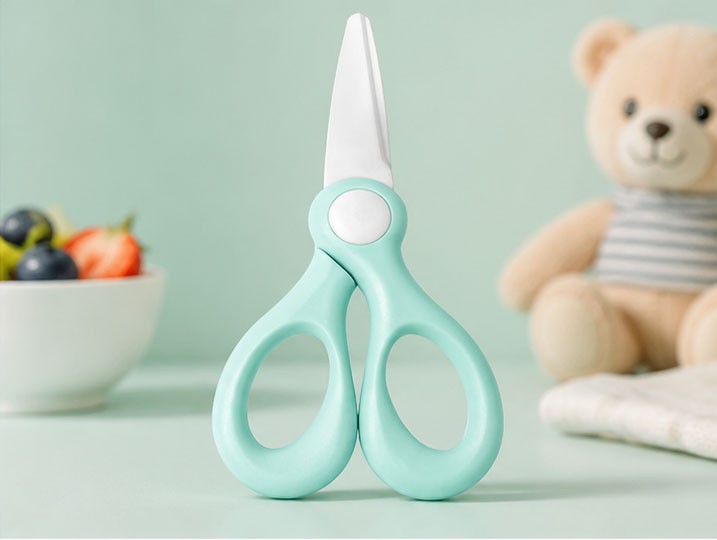
The handle is an important part of the complete baby food scissors product. It affects grip, operating comfort, assembly strength and the overall user experience.
Depending on the design, handles may use different plastic materials or combinations of materials. The appropriate choice depends on the intended product structure, manufacturing method and market requirements.
For buyers, the most useful questions are not simply whether a handle uses a particular plastic. They should also ask whether the material is suitable for the intended application, whether its specifications are controlled and whether it maintains its shape during normal use.
If the handle contains several materials, coatings or decorative components, those materials should also be considered during product evaluation. Their suitability cannot be assumed from the blade material alone.
Handle Strength and Grip Design
Baby food scissors should be comfortable to hold and operate. Handle openings that are too small or too large may make the product inconvenient for some users.
Grip design also influences the amount of control required during cutting. A handle with an appropriate shape can make repeated opening and closing more comfortable.
From a manufacturing perspective, we recommend checking both the external shape and the structural condition of the handle. Look for visible cracks, deformation, sharp molding defects or areas where the material appears poorly finished.
For products with a specific grip texture, the texture should be consistent with the approved design. Decorative details should not interfere with normal operation or make the product unnecessarily difficult to clean.
Joint, Pivot and Assembly Quality
The pivot or joint connects the moving components of the scissors. Its condition has a direct influence on opening and closing performance.
A properly assembled product should not feel excessively loose or have abnormal resistance during operation. The blades should remain in their intended relative positions throughout normal movement.
During inspection, buyers should look for:
Excessive movement around the pivot.
Unusual friction or sticking during operation.
Loose fasteners or visibly uneven assembly.
Blade movement that changes unexpectedly during use.
Cracks or deformation around the handle connection.
These checks are especially relevant when comparing products from different manufacturers. Two products may look almost identical in a catalogue but have noticeably different assembly quality when physically inspected.
How Handle Design Affects Daily Usability
Good product design should consider the entire feeding routine. The scissors need to be comfortable to handle, straightforward to operate and practical to clean and store.
For brands and retailers, usability also affects how customers perceive product quality after purchase. A product that is difficult to open, uncomfortable to hold or inconvenient to store may receive negative feedback even when its blade material is technically suitable.
We therefore encourage buyers to evaluate the product as a complete tool. Blade performance, handle comfort and assembly quality should work together rather than being developed independently.
5. Baby Scissors Safety Features: Protective Covers, Locks and Design
Why Blade Protective Covers Matter
A protective cover is a useful accessory for baby food scissors because it helps shield the blade during storage and transportation.
However, simply including a cover in the package does not guarantee that it works properly. The cover should fit the product, remain in place under normal handling and allow users to remove it without unnecessary difficulty.
When inspecting a sample, check whether the cover fully protects the intended blade area. Look for excessive gaps, loose fitting or parts that may become damaged during normal handling.
Buyers should also consider the material and construction of the cover. If it is made from plastic or contains multiple components, its material specifications and applicable safety requirements should be included in the product evaluation.
Evaluating the Reliability of Safety Locks
Some baby food scissors designs include a locking mechanism to help keep the blades closed when the product is not being used.
A lock should be evaluated through actual operation. Buyers should check whether it engages correctly, stays in the intended position and can be released without excessive force.
A mechanism that looks attractive but does not remain securely in position may create unnecessary inconvenience. On the other hand, a lock that is excessively difficult to operate may reduce usability.
We recommend testing the mechanism repeatedly during sample evaluation and checking whether its performance remains consistent.
Rounded or Protected Blade Tips
Blade tip design should match the intended product positioning and applicable safety expectations.
Some products use rounded or otherwise protected tips to reduce exposed sharp points. Other designs may use a protective cover to shield the blade when stored.
Buyers should inspect the actual product rather than relying on product descriptions alone. Check whether the tip is finished consistently and whether there are any unexpected chips, sharp projections or manufacturing defects.
It is also important to remember that protective design features do not replace proper use instructions or appropriate product safety evaluation.
Small Components and Assembly Risks
Small parts deserve attention during product inspection, especially when a product includes removable covers, locks or decorative components.
Check whether these components are securely attached where required and whether their construction matches the approved sample. Consider how the product will be packaged, transported and handled by the end user.
For products intended for families with young children, manufacturers and brands should assess foreseeable use and misuse scenarios according to the relevant market requirements.
From a quality control perspective, assembly inspection should include both the main scissors structure and the additional protective components. A good blade does not compensate for an accessory that repeatedly falls off or fails to function as intended.
6. Food Contact Safety: What Certifications and Testing Should Buyers Check?
Why Food-Contact Safety Must Be Evaluated at the Product Level
Food-contact safety is one of the most important considerations when selecting baby food scissors. However, it is also an area where product descriptions can sometimes create confusion.
Zirconia ceramic has excellent chemical stability and corrosion resistance. These are useful material characteristics, but they do not automatically mean that an entire pair of ceramic baby food scissors has been approved for every food-contact application.
A complete product may contain several materials, including:
Zirconia ceramic blades.
Plastic handles.
Metal pivot or connecting components.
Protective covers.
Coatings, printing or decorative materials, where applicable.
Each relevant material should be considered according to its intended function and potential contact with food. The testing requirements may differ depending on the material, contact conditions and destination market.
We believe buyers should review the actual testing documents rather than relying on a general statement that a product is made from food-safe materials.
Understanding FDA-Related Food Contact Requirements
For products entering the United States, buyers should understand the applicable FDA requirements for food-contact materials.
The U.S. Food and Drug Administration regulates substances used in food-contact applications under the Federal Food, Drug, and Cosmetic Act and relevant regulations. Depending on the material and intended conditions of use, different regulatory provisions or compliance pathways may apply.
For example, a plastic handle or other food-contact component may require a different compliance assessment from a zirconia ceramic blade. The applicable requirements depend on the material composition, manufacturing conditions and intended use.
When reviewing supplier documents, U.S. importers should pay attention to:
The exact material or component covered by the documentation.
The applicable FDA regulatory reference or compliance basis.
The intended food-contact conditions.
Whether the document relates to the actual product material and specification.
Whether additional testing or supporting information is required for the finished product.
One important distinction: FDA does not generally issue a universal product certification for ordinary baby food scissors. Therefore, buyers should be careful with statements such as "FDA certified" unless the supplier can explain precisely what document, authorization or compliance evidence is being referenced.
For our customers, we recommend reviewing the available FDA-related food-contact documentation together with the relevant product and material specifications.
What LFGB Testing Means for Baby Food Scissors
LFGB refers to the German Food and Feed Code, which forms part of Germany's food-contact regulatory framework. It is an important reference for companies selling products into Germany and other European markets.
Depending on the materials involved, LFGB-related testing may evaluate aspects such as the migration of certain substances, sensory characteristics or other relevant requirements.
However, LFGB should not be treated as a single universal test that automatically covers every possible product material and use condition.
For baby food scissors, buyers should confirm which components were included in the testing, what test methods were applied and whether the reported results correspond to the intended product application.
We recommend asking the manufacturer for the actual LFGB test documentation rather than relying only on a product catalogue statement.
How to Review SGS Testing Reports and Supporting Documents
Third-party testing organizations such as SGS can provide useful independent testing services. For purchasing teams, the value of a report depends on its scope and whether the tested sample represents the product being purchased.
When reviewing an SGS report, check the following information:
Product identification: Does the report clearly identify the tested product or material?
Sample information: Is the sample consistent with the product being considered?
Test items: Which specific properties or requirements were evaluated?
Test methods: Are the methods and conditions identified?
Results: Does the report clearly state the results and applicable conclusions?
Report details: Are the issuing laboratory, report number and date available for verification?
A report should never be interpreted beyond its actual testing scope. For example, a mechanical drop test does not establish food-contact compliance, while a food-contact migration test does not demonstrate the mechanical reliability of the complete scissors.
These are different types of evidence, and buyers should review them separately.
Why Material Claims Alone Are Not Enough
A manufacturer may describe a ceramic blade as rust-resistant, chemically stable or suitable for food-related applications. These descriptions can help explain the material, but they are not substitutes for applicable testing documentation.
The complete product needs to be evaluated based on its actual construction. If the handle, pivot or protective cover contains other materials, those components should not be overlooked.
For this reason, we encourage brand owners and importers to request both product specifications and available testing documents before approving a product for their market.
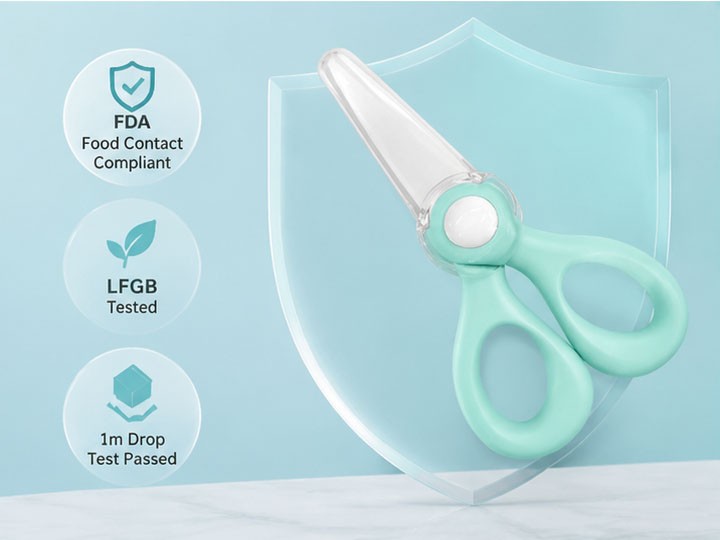
At MIDDIA, our baby food scissors have undergone relevant quality and compliance testing, including SGS 1-meter drop testing and FDA-related and LFGB testing. Buyers can request the available product documentation to review the tested items and applicable scope for the specific model they are considering.
7. Manufacturing Quality Control: How Reliable Baby Food Scissors Are Made
Raw Material Inspection
Finished-product quality begins long before assembly. The quality of incoming materials can influence blade performance, handle appearance and the consistency of the final product.
For ceramic blades, material preparation is an important part of the manufacturing process. Zirconia powder specifications and material consistency influence subsequent forming and sintering operations.
For handles and other components, manufacturers should also establish suitable incoming material requirements. These may include material identification, appearance, dimensions and other specifications relevant to the product design.
We consider raw material inspection an important first step because problems introduced at the beginning of production can become more difficult and expensive to correct later.
Ceramic Blade Processing and Precision Inspection
Ceramic scissors manufacturing requires several controlled processes. After the zirconia ceramic material is prepared, it is formed into the required shape and undergoes sintering. The blade is then processed through grinding and finishing operations to achieve the specified dimensions and edge geometry.
Each process has a different purpose.
Forming establishes the initial shape. Sintering develops the ceramic body's required material structure. Grinding and finishing bring the blade closer to its final dimensions and cutting geometry.
Because ceramic is hard and brittle, processing conditions need to be controlled carefully. Poor grinding or inappropriate handling may cause edge damage or other defects.
During inspection, manufacturers should compare critical dimensions with the approved drawings and check the visible blade condition. Particular attention should be given to the cutting edge, blade tip and areas that may experience mechanical stress.
We believe that precision manufacturing is not simply about achieving a sharp edge. It is also about producing blades that are consistent with the approved product design.
Assembly and Functional Testing
After blade processing, the different components need to be assembled correctly.
Assembly quality influences the relationship between the blades, handle and pivot. Even a well-processed blade may not perform as intended if the finished scissors have incorrect alignment or an unstable connection.
Functional testing should therefore include opening and closing movement, blade alignment and the stability of the assembled components.
Where applicable, the manufacturer should also inspect protective covers and locking mechanisms. These accessories should match the approved specifications and operate consistently.
For buyers, it is worth asking whether functional inspection is performed on every finished product, sampled products or at another defined inspection frequency. The inspection plan should be clear rather than described with vague statements such as "strict quality control."
Drop Testing and Structural Reliability
Drop testing is one way to evaluate how a product responds to a defined impact condition.
Our MIDDIA baby food scissors have passed an SGS 1-meter drop test. This provides an additional quality reference for buyers who want to understand the product's performance under the specific test conditions.
However, drop testing should be interpreted carefully. A test result applies to the tested sample, test method, drop height, orientation and acceptance criteria stated in the corresponding report.
It does not mean that the product is indestructible or that every possible impact scenario has been covered.
For ceramic scissors, this distinction is particularly important. Zirconia offers high hardness and wear resistance, but ceramic materials can still be damaged by concentrated impact or inappropriate mechanical stress.
When reviewing a drop test report, buyers should check the test conditions and post-test inspection results. It is also useful to understand whether the test evaluated the complete product, including its handles, blade assembly and protective accessories.
Final Product Inspection and Packaging Checks
Before products are packed for shipment, final inspection should verify that the finished items match the approved specifications.
Typical inspection points include:
Overall appearance and surface condition.
Blade edge and tip condition.
Blade alignment and opening and closing performance.
Handle condition and assembly stability.
Protective cover fit and locking function.
Product dimensions and other agreed specifications.
Packaging condition and product protection.
Packaging deserves attention because products can be damaged during storage and transportation if the internal structure does not provide sufficient protection.
For brands selling through retail stores or e-commerce channels, packaging also affects product presentation and the customer's first impression. It should protect the product while remaining consistent with the brand's requirements.
8. Baby Food Scissors Quality Inspection Checklist for Buyers
After understanding the materials, design features and testing processes, purchasing teams can turn these considerations into a practical inspection procedure.
We recommend separating the evaluation into three main areas: material inspection, food-contact documentation and finished-product structural inspection. This makes it easier to identify what evidence is needed and prevents one test report from being used to support unrelated quality claims.
Material Inspection
The first step is to confirm whether the materials match the approved product specifications.
Confirm the blade material and its stated specifications.
Check whether the zirconia ceramic blade has visible cracks, chips or surface defects.
Review handle material information and component specifications.
Identify any coatings, decorative finishes or additional materials.
Check whether the supplied product matches the approved reference sample.
Food-Contact Safety Documentation
The next step is to review available testing and compliance documents.
Request relevant FDA-related food-contact compliance documentation for the intended U.S. market.
Review LFGB test reports where relevant to the target market.
Confirm which materials or product components were tested.
Check the test methods, conditions and results.
Verify that the documentation corresponds to the product specification being purchased.
Buyers should not assume that a report for one material or model automatically covers every component or product variation.
Blade and Structural Inspection
Physical inspection is necessary even when the manufacturer provides detailed technical documents.
Check blade alignment and closing accuracy.
Inspect the cutting edge and blade tip for visible defects.
Open and close the scissors repeatedly to assess operating movement.
Check the stability of the pivot and blade-to-handle connection.
Look for loose components, cracks or deformation.
Compare the finished sample with the approved product drawing or reference sample.
Protective Features and Packaging Inspection
Protective components should be checked as part of the complete product rather than treated as minor accessories.
Confirm that the blade cover fits correctly.
Check whether the locking mechanism works consistently, if included.
Inspect removable components for damage or unstable fitting.
Review packaging protection and internal product positioning.
Confirm that labels, instructions and product information meet the agreed requirements.
Manufacturing and Batch Consistency
Finally, buyers should consider whether the manufacturer can reproduce the approved quality consistently.
Ask about incoming material inspection.
Review ceramic blade processing and finishing controls.
Understand the manufacturer's assembly and functional inspection procedures.
Request relevant testing reports and quality records.
Confirm the inspection frequency and acceptance criteria for production batches.
Clarify how defective products are identified and handled.
The following table provides a compact version of the checklist for purchasing and quality management teams.
| Inspection Category | What Buyers Should Check | Supporting Evidence |
|---|---|---|
| Blade Material | Zirconia ceramic specifications and material consistency | Material specifications |
| Blade Precision | Alignment, edge consistency and surface finish | Visual and dimensional inspection |
| Blade Structure | Tip design, edge condition and closing accuracy | Physical product inspection |
| Handle Quality | Material suitability, strength and grip design | Material information and physical inspection |
| Assembly Quality | Pivot stability and smooth operation | Functional testing |
| Protective Features | Cover fitting and lock reliability | Functional inspection |
| Food Contact Safety | Applicable food-contact requirements and tested materials | FDA-related documentation and LFGB test reports |
| Drop Resistance | Structural performance under specified impact conditions | SGS drop test report |
| Production Quality | Inspection procedures and batch consistency | QC records and inspection reports |
| Packaging | Product protection and packaging integrity | Packaging inspection |
One practical recommendation: buyers should establish their own acceptance criteria before mass production begins. These criteria may include critical dimensions, acceptable visual defects, functional requirements, testing conditions and packaging specifications.
Once the requirements have been agreed upon, the approved sample and inspection criteria can serve as references for subsequent production batches. This is more effective than relying on general quality descriptions after an order has already been placed.
9. How to Evaluate a Baby Food Scissors Manufacturer Beyond Product Samples
Ask for Material Specifications and Test Reports
A product sample is useful, but it only represents one physical example. It does not provide a complete picture of the manufacturer's material sourcing, production controls or ability to maintain consistent quality.
When evaluating a baby food scissors manufacturer, buyers should request relevant technical documents and testing information.
For ceramic products, this may include blade material specifications, product drawings, available food-contact documentation and finished-product testing reports.
We recommend asking suppliers to identify which product model and components are covered by each document. This simple step helps avoid confusion when a manufacturer offers several similar products with different materials or designs.
Review Manufacturing and Quality Control Procedures
Buyers should also understand how the manufacturer manages production.
For ceramic scissors, the manufacturing process may involve material preparation, forming, sintering, precision grinding, assembly and final inspection. Each stage can influence the quality of the finished product.
A reliable supplier should be able to explain the main production steps and the quality checks used to control them.
It is reasonable to ask questions such as:
How are incoming materials inspected?
How are ceramic blade dimensions and edge conditions controlled?
What checks are performed during assembly?
How is opening and closing performance evaluated?
Are finished products inspected before packaging?
How are non-conforming products identified and handled?
Clear answers help purchasing teams distinguish between a manufacturer with an established production process and a supplier that mainly relies on outsourced product sourcing.
Check Product Consistency Across Production Batches
Consistency is particularly important for brands and distributors that plan to reorder the same product over time.
A sample may meet expectations, but buyers also need confidence that mass production will follow the approved specifications.
Before placing an order, we recommend confirming the reference sample, product drawings, critical dimensions, material requirements and inspection criteria.
For larger or repeated orders, buyers may also consider pre-shipment inspection or other agreed quality verification procedures.
The goal is to establish a clear quality standard that both the buyer and manufacturer understand. This reduces the possibility of disputes caused by different expectations about appearance, assembly, performance or packaging.
Confirm Customization and Quality Requirements Before Ordering
Many baby product brands and retailers are not looking for a completely standard product. They may need customized colors, logo printing, packaging or adjustments to specific product details.
Customization introduces additional quality considerations. For example, a new handle color may involve different material specifications, while a customized package may require updated dimensions and product protection arrangements.
We recommend confirming the following points before production:
Product model and approved sample.
Blade and handle material specifications.
Logo, color and packaging requirements.
Applicable testing and documentation needs.
Inspection criteria and acceptance standards.
Production quantity and delivery requirements.
For OEM and ODM projects, these details should be discussed during product development rather than left until the final inspection stage.
At MIDDIA, we work with customers who need ceramic scissors for different product lines and market requirements. We understand that product quality is not only about manufacturing a single sample correctly. It is also about translating the customer's specifications into a repeatable production process.
10. Frequently Asked Questions About Baby Food Scissors Quality
Q1. What materials are best for baby food scissors?
The best material depends on the product's intended use, design and market requirements. Zirconia ceramic offers high hardness, wear resistance and excellent corrosion resistance, while stainless steel generally provides greater ductility and impact tolerance. Buyers should compare the complete product construction, including the blade, handle and other components, rather than selecting a material based on one characteristic alone.
Q2. Are zirconia ceramic blades suitable for baby food scissors?
Zirconia ceramic can be a suitable blade material for baby food scissors because of its hardness, wear resistance and corrosion resistance. However, its brittleness means that blade geometry, edge finishing and structural design require careful attention. Buyers should also verify the food-contact suitability of the relevant product materials through applicable documentation and testing.
Q3. What safety features should baby food scissors have?
Important design features may include a suitable blade tip, a well-fitted protective cover, a reliable locking mechanism where applicable and stable component assembly. Buyers should inspect these features physically and evaluate them according to the product's intended use. No single design feature should be treated as proof of complete product safety.
Q4. How can buyers verify food-contact safety?
Buyers should request relevant food-contact documentation and check which materials, components and test conditions are covered. For the U.S. market, applicable FDA food-contact requirements should be considered. For Germany and relevant European markets, LFGB-related requirements may also be important. The actual product composition and intended conditions of use determine the appropriate assessment.
Q5. What is the difference between FDA and LFGB testing?
FDA refers to the U.S. regulatory framework for food-contact substances and other regulated products, while LFGB is part of Germany's food and feed legislation. They are not interchangeable certifications. The applicable requirements, test methods and documentation depend on the destination market and materials used in the product. Buyers should review the specific legal and testing basis rather than assuming that passing one assessment automatically satisfies another.
Q6. Why should baby food scissors undergo drop testing?
Drop testing can provide information about how a product responds to a defined impact condition. It may help evaluate the structural integrity of the scissors and identify potential weaknesses in the assembled product. However, results apply only to the stated test conditions and acceptance criteria. A successful drop test does not establish food-contact compliance or guarantee resistance to every possible type of impact.
Q7. What should importers check before purchasing baby food scissors?
Importers should review blade and handle materials, manufacturing precision, assembly quality, protective features, food-contact documentation and applicable product testing. They should also evaluate the manufacturer's production controls, batch consistency and ability to provide the required technical documents. An approved sample and clearly defined inspection criteria are useful references before mass production.
Conclusion: Quality Is More Than a Material Specification
Choosing high-quality baby food scissors requires more than checking whether the product uses ceramic or stainless steel. Blade material, manufacturing precision, edge condition, handle construction, protective features and food-contact documentation all contribute to the overall product evaluation.
For retailers, distributors and baby product brands, the most reliable approach is to assess these factors separately and then consider how they work together in the finished product.
A zirconia ceramic blade may offer excellent hardness and corrosion resistance, but its quality still depends on material consistency, controlled processing and proper edge finishing. Similarly, a product may have a suitable handle design and protective cover, but buyers still need to inspect assembly quality and verify the relevant testing documents.
At MIDDIA, we approach ceramic scissors manufacturing with attention to material selection, blade processing, product assembly and finished-product inspection. Our baby food scissors have passed an SGS 1-meter drop test and undergone FDA-related and LFGB testing. We can provide available product specifications and relevant quality documentation for customers who want to evaluate our products for their markets.
Whether you are a baby product brand developing a new collection, an importer comparing suppliers or a retailer looking for a reliable product range, we believe that clear specifications and verifiable quality information should be part of every purchasing decision.
Request Product Specifications and Quality Information
Looking for reliable ceramic baby food scissors for your brand, retail business or distribution portfolio? At MIDDIA, we focus on zirconia ceramic blade processing, product assembly and manufacturing quality control.
Contact our team to request product specifications, available SGS 1-meter drop test reports, FDA-related and LFGB testing documentation, and OEM/ODM customization information. We can help you review the product details and quality requirements for your target market.
Request Product Information →