
When sourcing baby food scissors for a retail business, baby product brand, or distribution network, the purchasing decision involves much more than comparing product prices. Importers and purchasing managers also need to understand minimum order quantities (MOQ), sample availability, customization options, production lead times, and the quality documentation available from a supplier.
These details can directly affect the initial investment, inventory planning, product launch schedule, and overall sourcing risk. For businesses entering the baby feeding accessories market, choosing a supplier with flexible purchasing options can make the first order considerably easier to manage.
At MIDDIA, we work with baby product retailers, distributors, importers, and private-label brands looking for ceramic baby food scissors. We understand that different buyers have different purchasing priorities. Some prefer to start with standard products to evaluate market demand, while others already have an established brand and need customized logos, colors, and retail packaging.
In this guide, we explain how Baby Food Scissors MOQ works at MIDDIA, what buyers should know before requesting samples, which factors affect production lead time, and how to prepare for a wholesale or OEM order. Our goal is to make the sourcing process easier to understand before you commit to a bulk purchase.
1. Understanding Baby Food Scissors MOQ for Wholesale Buyers
1.1 What Does MOQ Mean When Sourcing Baby Food Scissors?
MOQ stands for Minimum Order Quantity. It refers to the smallest number of units a supplier is willing to accept for a particular order or product configuration.
When searching for baby food scissors wholesale suppliers, buyers will often find that MOQ varies considerably. One manufacturer may accept relatively small orders for existing products, while another may require a larger quantity because the order involves customized colors, printed packaging, or special production arrangements.
There is no universal MOQ for baby food scissors. The actual quantity depends on several factors, including:
Product availability: Existing models that are already part of a supplier's product range may have lower purchasing requirements than newly developed products.
Customization level: Adding a brand logo, changing the product color, or developing custom packaging can introduce additional preparation and production requirements.
Material and production arrangements: Different product configurations may require different material preparation and manufacturing processes.
Packaging requirements: Customized retail boxes and printed materials may have their own minimum production quantities.
Order volume: Larger orders may require a different production schedule and purchasing arrangement.
For this reason, buyers should not compare supplier quotations based on MOQ alone. It is equally important to understand what is included in the quoted order and whether the quantity applies to standard products or customized products.
1.2 Why Does MOQ Matter to Importers and Distributors?
MOQ has a direct relationship with inventory investment. Ordering too many units before understanding customer demand can create unnecessary stock pressure. On the other hand, ordering too few units may make it difficult to maintain inventory when a product begins selling well.
Different types of buyers usually approach this decision from different perspectives.
For importers: The first priority is often to control the initial purchasing investment. A manageable wholesale quantity allows an importer to introduce ceramic baby food scissors into an existing product portfolio without committing too much capital to an untested product.
For distributors: Inventory availability is important because distributors may need to supply several retailers or regional resellers. They should consider both the initial order quantity and the expected replenishment schedule.
For baby product retailers: Retailers may prefer to test a product in a limited number of stores or through an online sales channel before increasing their inventory.
For established baby product brands: Branding and product presentation may be more important than the lowest possible MOQ. These buyers often want a consistent visual identity across their product collections, including logo placement, product colors, and retail packaging.
Understanding these differences helps buyers select a purchasing arrangement that matches their current business stage rather than ordering more inventory than they actually need.
1.3 Standard Wholesale Orders vs. Custom Orders
When sourcing baby food scissors, we generally recommend that buyers first distinguish between standard wholesale purchasing and customized OEM or private-label purchasing.
A standard wholesale order uses an existing product model and its available specifications. Buyers can select a suitable design, confirm the quantity, and discuss packaging and delivery arrangements. This approach is useful for businesses that want to introduce a new product without developing a complete private-label configuration immediately.
A custom order involves additional brand or product requirements. Depending on the project, buyers may request a printed logo, a different product color, or customized retail packaging.
At MIDDIA, selected standard ceramic baby food scissors models have a wholesale MOQ starting from 100 pieces. For buyers who need branding or a more personalized product presentation, we offer separate customization options with different minimum quantities.
Understanding these differences before requesting a quotation helps avoid confusion during the purchasing process.
2. MIDDIA Baby Food Scissors MOQ: Standard Products and Customization
One of the most common questions we receive from wholesale buyers is how many pieces they need to order. The answer depends mainly on whether they want an existing product or a customized version.
To make the purchasing options easier to understand, the following table summarizes the starting MOQ for selected MIDDIA ceramic baby food scissors products and customization services.
| Order Type | Starting MOQ | Suitable For |
|---|---|---|
| Standard Wholesale Products | 100 PCS | Importers, retailers, and distributors |
| Custom Logo | 2,000 PCS | Private-label brands and product companies |
| Custom Product Color | 3,000 PCS | Brands developing a specific visual identity |
| Custom Packaging | 3,000 PCS | Retail brands and distributors requiring branded packaging |
These quantities are starting references for the corresponding order configurations. The final MOQ should be confirmed according to the selected model, customization requirements, and packaging specifications.
2.1 Standard Wholesale MOQ: Starting from 100 Pieces
For buyers who want to test the market or add ceramic baby food scissors to an existing product range, standard wholesale purchasing is often the most practical starting point.
Selected MIDDIA ceramic baby food scissors models have a standard wholesale MOQ starting from 100 pieces. Buyers can choose from available product designs without immediately committing to a full private-label project.
Our product range includes different sizes and designs intended for different product positioning requirements. For example, buyers may consider the following models when comparing available options:
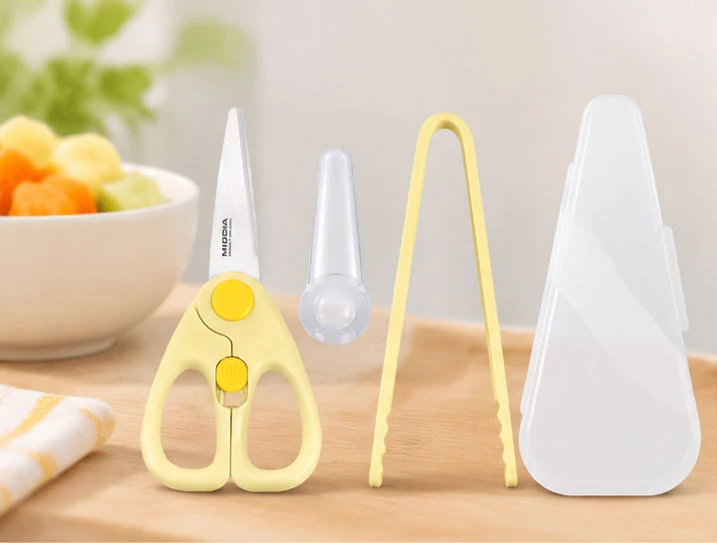
CS3: A compact ceramic baby food scissors model with a 2.5-inch blade and a protective cover.
CS4: Another 2.5-inch ceramic baby food scissors option with a protective cover, suitable for buyers comparing different product configurations.
CS5: A compact Tiny Bite design with a 2-inch ceramic blade, intended for buyers looking for a smaller product format.
The exact product specifications, available colors, and accessories should be checked against the selected model before placing an order.
Starting with standard wholesale products offers several practical advantages:
Lower initial purchasing commitment compared with fully customized orders.
Access to existing product designs and configurations.
An opportunity to evaluate customer feedback before expanding the product range.
A simpler purchasing process when no special branding or packaging is required.
More straightforward inventory planning for first-time buyers.
For a retailer or importer entering the baby feeding accessories category, this can be a reasonable way to evaluate whether ceramic baby food scissors fit the needs of their customers.
Buyers can explore our Ceramic Baby Food Scissors Collection to compare available models and discuss the most suitable option for their market.
2.2 Custom Logo Baby Food Scissors: MOQ from 2,000 Pieces
For brands that already have a customer base or want to build a recognizable product identity, adding a brand logo is a natural next step.
At MIDDIA, custom logo baby food scissors projects start from 2,000 pieces. This option allows buyers to develop private-label products using selected existing product models rather than starting with a completely new product design.
A customized logo can help a product become more consistent with the rest of a brand's baby feeding accessories collection. It can also make product identification easier for retailers and consumers.
Before production, we recommend that buyers prepare the following information:
Company or brand logo in a suitable digital format.
Preferred logo dimensions.
Expected logo position on the product.
Any specific requirements for logo appearance or printing.
Selected product model and estimated order quantity.
Logo application depends on the product structure and the available customization method. Therefore, the actual placement and appearance should be evaluated and confirmed before mass production.
We encourage buyers to review the customized sample or approved logo presentation carefully. This helps both sides establish a clear reference for the final order.
2.3 Custom Color Baby Food Scissors: MOQ from 3,000 Pieces
Product color can play an important role in the way a baby product is positioned in the market. Some brands prefer neutral colors, while others use a distinctive color palette across their baby feeding accessories.
For buyers who need a customized product color, MIDDIA offers custom color options starting from 3,000 pieces.
This option is particularly relevant for:
Baby product brands developing their own product collections.
Distributors working with established retail brands.
Importers looking for product differentiation.
Businesses that want their baby food scissors to match other products in a coordinated collection.
When requesting a custom color, buyers should provide a clear color reference whenever possible. A Pantone reference or physical color sample can help communicate the intended result more accurately.
However, a digital color reference does not always reproduce exactly the same appearance on a physical product. The final color should therefore be reviewed and confirmed using an appropriate sample or agreed production reference.
Before placing a bulk order, buyers should also confirm whether the selected color is available for the specific product model and whether it affects the overall production schedule.
2.4 Custom Packaging for Private Label Baby Scissors: MOQ from 3,000 Pieces
For many importers and retailers, product packaging is almost as important as the product itself. The retail box is often the first thing a customer sees when browsing a product in a store or receiving an online order.
MIDDIA offers custom packaging options starting from 3,000 pieces. This allows buyers to develop packaging that reflects their brand identity and meets their retail presentation requirements.
Depending on the project, customized packaging may include:
Brand logo and visual identity.
Customized retail box design.
Product images and descriptions.
Product specifications and care information.
Barcode and retail labeling information.
Instruction leaflets or additional printed materials, where required.
We recommend that buyers prepare their packaging artwork before the production schedule is finalized. The design should be checked for dimensions, printing details, product information, and any labeling requirements applicable to the destination market.
For international orders, it is particularly important to confirm packaging language and required product information before approving the final artwork.
A well-planned packaging design can make a private-label baby food scissors product easier to introduce into an existing retail collection. It also helps buyers maintain consistency across different product categories.
2.5 Can Buyers Combine Different Customization Options?
Yes. Buyers can discuss combining different customization requirements within one OEM or private-label project.
For example, a brand may want to add its logo to the product and use a customized retail box. Another buyer may want a specific product color together with matching packaging and branding.
Common combinations include:
Custom logo with standard product color.
Custom logo with custom packaging.
Custom color with customized retail packaging.
Custom logo, color, and packaging within one private-label project.
However, buyers should not automatically assume that combining two customization options means the order can use the lower MOQ of either option.
For example, a custom logo project starts from 2,000 pieces, while custom color and packaging projects start from 3,000 pieces. When several requirements are combined, the applicable MOQ needs to be confirmed according to the complete order configuration.
When requesting a quotation, we recommend describing all customization requirements together rather than asking for each item separately. This allows us to evaluate the project more accurately and provide a clearer purchasing plan.
3. Baby Food Scissors Samples: What Should Buyers Request Before Ordering?
For buyers who have not previously sourced ceramic baby food scissors, requesting a physical sample is an important part of the supplier evaluation process.
Product images can show the general appearance, but they cannot fully communicate how a product feels in the hand, how the blades move, or how the protective cover fits. These details are easier to evaluate when buyers can inspect the actual product.
3.1 Why Should Importers Request Samples First?
A sample gives purchasing managers an opportunity to assess whether the selected product matches their intended market and product positioning.
When evaluating a baby food scissors sample, buyers should pay attention to several practical details.
Product dimensions and weight: The size and weight influence how the product feels during use and whether it fits the requirements of the intended customer group.
Blade appearance and cutting performance: Buyers can inspect the ceramic blade surface, alignment, and functional cutting performance on appropriate food textures.
Handle design: The handle should be evaluated for its overall shape, grip, assembly, and ease of handling.
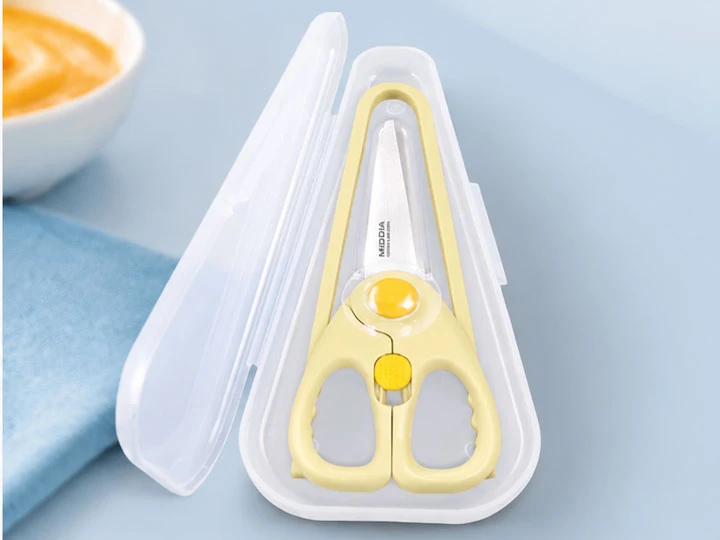
Protective cover: If the selected model includes a cover, buyers should check whether it fits properly and can be used as intended.
Packaging: For retail projects, the sample can also help buyers evaluate whether the packaging size, presentation, and product arrangement suit their sales channel.
These checks help buyers identify potential issues before placing a larger order. They also provide a useful basis for discussing product adjustments or selecting a different model.
3.2 MIDDIA Baby Food Scissors Sample Availability
We understand that buyers often need to evaluate a product before committing to a wholesale order. For this reason, sample arrangements can be discussed before mass production.
For selected standard MIDDIA ceramic baby food scissors models, the sample preparation time is approximately 2–3 days.
This refers to preparation time for applicable standard samples, not the total time required for international delivery.
For customized samples involving logos, special colors, or packaging, the preparation schedule may be different. The actual timing depends on the customization requirements and the availability of the necessary materials.
Sample costs and international courier charges should also be confirmed when requesting a sample.
To help us arrange the appropriate sample, buyers should provide:
The preferred product model.
The required sample quantity.
The intended market or destination country.
Any logo or customization requirements.
The preferred shipping method, if applicable.
Providing these details at the beginning makes it easier to identify the appropriate sample arrangement.
3.3 What Should Be Checked When Evaluating Samples?
We recommend using a consistent inspection checklist rather than evaluating a sample based only on its appearance.
| Inspection Area | What Buyers Should Check |
|---|---|
| Blade Material | Confirm the stated ceramic material and inspect the blade appearance. |
| Cutting Performance | Evaluate functional cutting performance on appropriate food textures. |
| Handle | Check grip, assembly, surface finish, and overall handling. |
| Protective Cover | Confirm the cover fits the selected model and functions as intended. |
| Dimensions | Compare actual measurements with the agreed product specifications. |
| Color | Check whether the physical appearance matches the agreed color reference. |
| Packaging | Review packaging dimensions, presentation, and product protection. |
| Documentation | Review applicable testing reports and compliance documents. |
For baby feeding accessories, buyers should also consider the intended use of the product. A sample that looks attractive may still need further evaluation to determine whether its design, material information, and documentation meet the purchasing requirements of the target market.
3.4 How to Confirm a Sample Before Mass Production
Sample approval should be treated as a formal purchasing step rather than a quick visual check.
At MIDDIA, we encourage buyers to establish the final product configuration before moving into mass production. This is particularly important for private-label orders, where several product and packaging details may need to be confirmed.
A practical sample confirmation process includes the following steps:
Select the product model: Confirm the exact baby food scissors model and its specifications.
Confirm the configuration: Review the blade, handle, protective cover, and included accessories.
Review customization: Check logo placement, color requirements, and other agreed branding details.
Evaluate the physical sample: Inspect the product and conduct the necessary functional checks.
Approve packaging: Confirm the retail packaging artwork and product information, where applicable.
Confirm the final specifications: Establish the approved product and packaging details as the reference for the bulk order.
Before moving into mass production, we encourage buyers to evaluate the physical sample against their intended market requirements. Once the product configuration and customization details are confirmed, the approved specifications can serve as an important reference for the bulk order.
4. Quality Testing and Compliance: What Importers Should Verify
When sourcing baby food scissors, purchasing managers should look beyond the product quotation and ask what quality testing and compliance documentation is available.
This is particularly important for products intended for the baby feeding accessories category. Buyers need to understand the materials used, the intended product application, and which testing documents are relevant to their target market.
At MIDDIA, our ceramic baby food scissors have undergone an SGS 1-meter drop test, and we have FDA- and LFGB-related certification and documentation for applicable products and materials. Buyers can discuss the relevant documents when evaluating a specific model.
4.1 SGS 1-Meter Drop Test: An Additional Quality Reference
A drop test evaluates how a product or product assembly responds to a defined impact condition. It can provide useful information about structural integrity and potential damage under the specified test conditions.
MIDDIA baby food scissors have passed an SGS 1-meter drop test. This provides an additional quality reference for buyers who want to evaluate product durability before placing a wholesale or private-label order.
For ceramic baby food scissors, drop testing deserves particular attention because ceramic blades have different physical characteristics from conventional stainless steel blades. Ceramic materials are known for hardness and wear resistance, but they can also be susceptible to impact damage under certain conditions.
When reviewing a drop test report, buyers should pay attention to:
The exact product model included in the test.
The testing organization and report identification.
The test height and conditions.
The product configuration during testing.
The inspection criteria and reported results.
It is important to understand that passing a 1-meter drop test does not mean a product is indestructible or that it cannot be damaged under other impact conditions.
We recommend that importers review the applicable SGS documentation rather than relying only on a general marketing statement. This makes it easier to determine whether the tested configuration matches the product they intend to purchase.
4.2 FDA-Related Documentation for the US Market
For importers supplying the United States, FDA-related requirements may be an important part of the product and material evaluation process.
However, buyers should understand that FDA requirements depend on the actual product application and the materials involved. A general statement that a product is FDA certified or FDA approved does not automatically establish compliance for every possible use.
When evaluating ceramic baby food scissors, buyers should identify which product components may come into contact with food and review the relevant material information and supporting documentation.
We recommend confirming the following points with the supplier:
Which materials are covered by the available FDA-related documentation?
Does the documentation relate to the intended food-contact application?
Which product model or material specification was evaluated?
Are there any limitations regarding the documented application?
Does the target market require additional testing or documentation?
At MIDDIA, buyers can discuss the available FDA-related documents for the applicable products and materials during the sourcing process.
For importers, the most useful approach is to review the actual documentation and confirm its relevance to the intended product configuration before placing a bulk order.
4.3 LFGB Documentation for European Market Requirements
For buyers targeting Germany and other European markets, LFGB-related documentation may be relevant when evaluating food-contact materials and products.
LFGB is associated with German food and feed legislation and is commonly referenced by buyers when reviewing food-contact material safety requirements.
When evaluating ceramic baby food scissors for European distribution, buyers should not assume that a single document automatically covers every component of the product.
Instead, purchasing managers should confirm:
Which product materials are covered by the available documentation.
Whether the tested materials correspond to the intended product configuration.
Which test methods and conditions were applied.
Whether additional destination-market requirements need to be considered.
MIDDIA can provide relevant LFGB-related documentation for applicable products and materials for buyers to review during the purchasing process.
For importers supplying multiple European countries, we recommend confirming the applicable requirements with their local compliance team or regulatory specialist before commercial distribution.
4.4 Why Should Testing Documents Be Reviewed Before Bulk Orders?
Testing documents should not be treated as paperwork that only needs attention after an order has been placed.
For professional buyers, reviewing the available documentation before mass production can help identify whether a product meets the requirements of the intended sales market.
We recommend checking four important areas:
1. Product identification. Confirm that the tested product or material corresponds to the model being purchased.
2. Material specifications. Review the stated material information and compare it with the supplier's product specifications.
3. Testing scope. Understand which properties were evaluated and what the test results actually demonstrate.
4. Product consistency. Confirm that the approved sample and planned bulk order use the agreed product configuration.
At MIDDIA, we encourage buyers to raise documentation questions during the quotation and sample evaluation stages. This gives both sides an opportunity to clarify requirements before the production schedule is finalized.
5. Baby Food Scissors Production Lead Time: What Affects Delivery?
Production lead time is another important factor when selecting a baby scissors supplier. For importers, the delivery schedule can affect product launches, seasonal sales, inventory replenishment, and retail commitments.
One point that is often misunderstood is the difference between sample preparation time, mass production lead time, and international shipping time. These are separate stages and should be considered individually.
5.1 Sample Preparation Time vs. Mass Production Lead Time
For selected standard MIDDIA models, sample preparation takes approximately 2–3 days. This is the preparation period for applicable standard samples and does not include international courier transportation.
Customized samples may require additional preparation depending on the requested logo, color, packaging, and material arrangements.
Mass production follows a different schedule. The time required depends on the order quantity, product configuration, customization requirements, material availability, and factory production arrangements.
For this reason, we do not recommend using the standard sample preparation period as an estimate for bulk production.
| Stage | Time Considerations |
|---|---|
| Standard Sample Preparation | Approximately 2–3 days for selected standard models. |
| Customized Sample Preparation | Confirmed according to logo, color, and packaging requirements. |
| Mass Production | Confirmed according to quantity, specifications, and production scheduling. |
| International Shipping | Depends on destination, shipping method, and logistics arrangements. |
When requesting a quotation, buyers should ask the supplier to clarify the expected schedule for each stage. This provides a more realistic understanding of the total purchasing timeline.
5.2 Key Factors That Affect Baby Scissors Supplier Lead Time
There is no single production schedule that applies to every baby food scissors order. Several factors can influence how long a project takes.
Order quantity
A larger order may require more production time than a smaller standard wholesale order. The actual impact depends on the selected model and the factory's available production arrangements.
Product model
Existing models may be easier to arrange than products requiring special configurations. Buyers should confirm whether their selected model is available for the intended order.
Customization requirements
Adding a logo, changing product colors, or developing custom packaging can introduce additional preparation steps. Each requirement should be confirmed before production planning begins.
Sample approval
Delays in approving samples can affect the entire purchasing schedule. If buyers need several rounds of revisions, the final production arrangement may also need to be adjusted.
Packaging preparation
Customized retail boxes require artwork confirmation and printing preparation. If the artwork or product information changes repeatedly, packaging arrangements may take longer than expected.
Production scheduling
Factory workload and production planning also influence the expected completion date. Buyers should confirm the schedule for their specific order rather than relying on general industry estimates.
5.3 How Can Buyers Avoid Unnecessary Production Delays?
Many delays can be reduced through better preparation before placing an order.
Based on the purchasing requirements we commonly discuss with buyers, we recommend the following approach:
Choose the product model and confirm its specifications before requesting the final quotation.
Provide the estimated order quantity and customization requirements together.
Prepare the brand logo in an appropriate digital format.
Provide a clear color reference for customized color projects.
Complete packaging artwork and product information as early as possible.
Evaluate samples carefully and consolidate feedback before requesting changes.
Confirm the final approved specifications before mass production.
These steps help reduce unnecessary communication and make it easier to establish a realistic production schedule.
5.4 When Should Importers Place Their Orders?
For international buyers, the purchasing schedule should account for more than factory production time.
We recommend working backward from the expected product launch or inventory arrival date.
For example, a buyer planning to introduce a new baby feeding accessory collection should consider the following stages:
Supplier evaluation and product selection.
Sample preparation and international delivery.
Physical sample inspection and approval.
Logo and packaging confirmation, if applicable.
Mass production.
Finished product inspection and export preparation.
International transportation and customs clearance.
Each stage requires time, and some stages depend on decisions made during earlier steps.
For seasonal products or major retail launches, buyers should communicate their expected delivery date when requesting the first quotation. This allows the supplier to evaluate whether the proposed order schedule is realistic.
6. Bulk Baby Scissors Orders: How We Maintain Quality Consistency
When buyers move from samples to bulk baby scissors orders, product consistency becomes increasingly important.
A sample may look correct, but the buyer also needs confidence that the finished order will follow the approved specifications. This is particularly relevant for private-label projects, where product appearance, branding, accessories, and packaging all need to match the agreed configuration.
At MIDDIA, we consider quality control an important part of the sourcing process rather than something that begins only when the finished products are ready for shipment.
6.1 Incoming Material Inspection
Material inspection is an important starting point for maintaining product consistency.
Depending on the selected model, relevant materials and components may include:
Zirconia ceramic blade materials.
Plastic handle materials, according to the product specification.
Protective covers and related accessories.
Retail packaging and other printed materials.
Buyers should confirm that the materials used in the bulk order correspond to the approved product specifications.
For customized projects, this also includes checking that the agreed color and branding requirements have been communicated clearly before production.
6.2 In-Process Quality Inspection
During manufacturing and assembly, product checks can help identify potential issues before the order reaches the finished-product stage.
Depending on the product model and inspection plan, relevant checks may include:
Blade appearance and alignment.
Handle assembly and surface condition.
Product dimensions and configuration.
Protective cover fitting.
Visible surface defects.
Functional cutting checks.
For buyers, these inspection points are useful because they connect the product specifications discussed during sampling with the actual requirements of the bulk order.
6.3 Finished Product Inspection Before Shipment
Before shipment, finished products should be checked against the agreed order requirements.
For baby food scissors orders, the inspection scope may include:
Product appearance and overall condition.
Correct product model and configuration.
Accessories and protective covers.
Product quantity.
Customized logo and color requirements.
Retail packaging and labeling.
Outer carton information and packing quantities.
The purpose of finished-product inspection is to identify inconsistencies before the goods leave the factory.
For importers, this is especially important when the products will be distributed through several retail channels. A clear inspection and packing arrangement helps make the receiving process more predictable.
6.4 Keeping Bulk Orders Consistent with Approved Samples
One of the most useful practices in wholesale purchasing is maintaining a clear record of the approved sample and final specifications.
For standard orders, the selected model and product configuration should be clearly identified. For customized orders, the reference should also include the approved logo, color, packaging artwork, and any other agreed details.
If a buyer wants to change the product configuration after sample approval, the change should be discussed before production continues.
At MIDDIA, we recommend confirming these details in writing to reduce misunderstandings between the buyer and supplier.
This is especially important for repeat orders. Having an established product reference makes it easier to discuss replenishment without restarting the entire product selection process.
7. International Sourcing and Shipping Preparation for Importers
For overseas buyers, placing a wholesale order involves several steps beyond product manufacturing. Import documentation, packaging details, shipping arrangements, and destination-market requirements should all be considered before the goods are dispatched.
7.1 Information to Confirm Before Placing an International Order
Before confirming a purchase order, we recommend that buyers review the following information with their supplier:
Selected product model and specifications.
Total order quantity and unit price.
Customization requirements and applicable MOQ.
Logo artwork and product color references.
Individual packaging requirements.
Carton dimensions and gross weight.
Destination country and delivery address.
Payment terms and agreed shipping terms.
Expected production completion and shipping schedule.
These details should be confirmed before the order enters production whenever possible.
For private-label buyers, packaging information deserves particular attention. Incorrect dimensions, incomplete product information, or unapproved artwork can create unnecessary problems during the final stages of the order.
7.2 What Should Buyers Prepare for Customs and Importation?
International shipments generally require commercial and transportation documents. The exact documentation depends on the destination country, product classification, shipping method, and applicable customs requirements.
Common documents and information may include:
Commercial Invoice: Contains transaction and product value information.
Packing List: Provides carton quantities, packing details, and shipment information.
Product Description: Identifies the goods being imported.
HS Code: The applicable tariff classification should be confirmed according to the product's actual characteristics and destination-country rules.
Compliance Documentation: Relevant testing reports or material documents, where required.
Transportation Documents: Documents depend on the selected shipping method.
Importers should not assume that the same HS Code, import duty, or documentation requirement applies to every country. These details should be confirmed with a customs broker or qualified import specialist before shipment.
For products entering markets with specific requirements for baby feeding accessories or food-contact materials, buyers should also review applicable regulations before finalizing the import arrangement.
7.3 Planning Repeat Orders and Inventory Replenishment
Once a product has been successfully introduced into the market, the next challenge is maintaining sufficient inventory.
For distributors and retailers, repeat orders should be planned according to actual sales performance rather than waiting until the existing stock is almost depleted.
We recommend keeping records of:
Previous order quantities.
Selected product models and specifications.
Approved logo and packaging artwork.
Historical sales performance.
Inventory levels and expected replenishment dates.
Previous production and transportation schedules.
These records make repeat purchasing easier and help buyers communicate their requirements more efficiently.
For private-label brands, retaining the approved product and packaging references is particularly useful. It helps maintain a consistent product presentation across different orders.
8. Frequently Asked Questions About Baby Food Scissors MOQ, Samples and Lead Time
Below are some common questions we receive from importers, distributors, and purchasing managers who are evaluating wholesale or private-label baby food scissors.
8.1 What Is the Standard MOQ for Wholesale Baby Food Scissors?
MIDDIA's wholesale MOQ for selected standard ceramic baby food scissors models starts from 100 pieces. The exact MOQ depends on the selected model and order configuration. Customized orders have separate minimum quantity requirements.
8.2 What Is the MOQ for Custom Logo Baby Food Scissors?
Custom logo baby food scissors orders at MIDDIA start from 2,000 pieces. Buyers should provide their logo artwork and preferred placement so that the customization requirements can be reviewed before production.
8.3 What Is the MOQ for Custom Color Baby Food Scissors?
Custom color projects start from 3,000 pieces. Buyers can provide a Pantone reference or another suitable color reference for evaluation. The final color should be confirmed before mass production.
8.4 What Is the MOQ for Custom Baby Food Scissors Packaging?
MIDDIA offers custom packaging options starting from 3,000 pieces. Buyers can discuss their retail box design, logo, product information, and other packaging requirements before confirming the order.
8.5 How Long Does It Take to Prepare a Baby Food Scissors Sample?
Sample preparation for selected standard MIDDIA models takes approximately 2–3 days. Customized samples may require additional preparation. International shipping time is separate from sample preparation time.
8.6 Can I Request Samples Before Placing a Bulk Order?
Yes. Buyers can discuss sample availability before placing a wholesale or OEM order. We recommend inspecting the actual product, checking its specifications, and confirming any customization requirements before moving into mass production.
8.7 Have MIDDIA Baby Food Scissors Passed a Drop Test?
Yes. MIDDIA ceramic baby food scissors have passed an SGS 1-meter drop test. Buyers can discuss the applicable test documentation and confirm whether it covers their selected product configuration.
8.8 Does MIDDIA Provide FDA and LFGB Documentation?
MIDDIA has FDA- and LFGB-related certification and documentation for applicable products and materials. Buyers should confirm the specific documents, tested materials, and applicable scope according to their intended market and product configuration.
8.9 How Long Does Bulk Production Take?
Bulk production lead time depends on order quantity, product model, customization requirements, material preparation, and factory scheduling. We recommend requesting a project-specific production estimate when submitting the quotation request.
8.10 Can I Order Both Standard and Customized Baby Food Scissors?
Buyers can discuss purchasing both standard and customized products within their sourcing projects. However, MOQ requirements may differ between product configurations. The applicable quantities should be confirmed separately according to the final order details.
8.11 What Information Should I Provide to Get a Wholesale Quotation?
To receive a more accurate quotation, buyers should provide the preferred product model, estimated quantity, customization requirements, packaging preferences, destination country, and expected purchasing schedule. Providing these details together helps the supplier evaluate the project more efficiently.
8.12 Can I Customize Both the Scissors and Retail Packaging?
Yes. Buyers can discuss combining product customization and retail packaging requirements. For example, a private-label project may include a custom logo, customized product color, and branded retail packaging. The final MOQ and production arrangement should be confirmed according to the complete project requirements.
9. Request a Wholesale or OEM Quotation from MIDDIA
Choosing the right baby food scissors supplier is not only about finding an acceptable unit price. Buyers also need to understand MOQ requirements, sample arrangements, customization possibilities, quality documentation, and the expected delivery schedule.
At MIDDIA, we work with baby product brands, importers, distributors, retailers, and purchasing companies looking for ceramic baby food scissors for their product collections.
Whether you are starting with standard wholesale products or planning a private-label project, we can help you review the available models and discuss the appropriate purchasing arrangement.
Our current starting options include:
Standard wholesale orders from 100 pieces for selected models.
Custom logo projects starting from 2,000 pieces.
Custom color projects starting from 3,000 pieces.
Custom packaging projects starting from 3,000 pieces.
Sample preparation in approximately 2–3 days for selected standard models.
To help us understand your requirements, please include the following information when contacting our team:
Product model or preferred design.
Estimated order quantity.
Whether you need a standard product or private-label customization.
Logo, color, and packaging requirements.
Destination country.
Expected purchasing or delivery schedule.
With these details, we can better understand your project and discuss the available product options, MOQ, sample arrangements, and production schedule.
If you are planning to add ceramic baby food scissors to your product portfolio, contact MIDDIA to discuss your wholesale or OEM requirements.
Planning Your Baby Food Scissors Wholesale or OEM Order?
Looking for a reliable ceramic baby food scissors supplier for your retail business or private label brand? MIDDIA offers flexible wholesale and OEM options to support different purchasing requirements.
Standard wholesale orders from 100 PCS
Custom logo options from 2,000 PCS
Custom color and packaging from 3,000 PCS
Sample preparation in 2–3 days for selected standard models
Tell us your preferred product model, order quantity, branding requirements, and destination market. Our team will help you evaluate the available options and discuss a suitable sourcing solution.
Request a Wholesale or OEM Quotation →MIDDIA | Ceramic Baby Food Scissors Manufacturer
Wholesale · Private Label · OEM Customization