
Developing a private-label baby feeding product involves more than choosing an existing item and adding a company logo. For brands, retailers, distributors, and product development teams, creating custom baby food scissors requires a series of decisions about product design, materials, customization, sample evaluation, quality requirements, and manufacturing arrangements. Each decision can influence the final product, its retail presentation, and the experience of the people who use it.
At MIDDIA, we work with customers interested in developing ceramic baby food scissors and other ceramic feeding accessories for their own product lines. Some buyers already have a clear idea of the product they want. Others are exploring the baby feeding category and need help comparing existing models, selecting suitable configurations, or understanding what can be customized.
We believe a successful OEM or ODM project starts with a practical development plan. Buyers should understand what they want to sell, manufacturers should understand the required specifications, and both sides should agree on the sample before mass production begins.
So, how are custom baby food scissors developed? From our product development perspective, the process generally involves eight stages: defining product requirements, selecting a model, confirming customization details, developing samples, evaluating product quality, approving the final sample, preparing mass production, and arranging packaging and shipment.
This guide explains each stage and highlights the information buyers should prepare before starting a custom baby food scissors project.
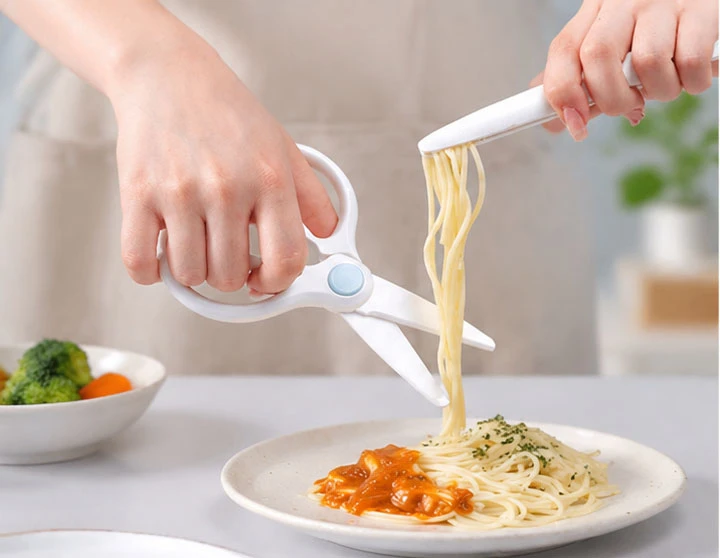
Step 1 – Define Your Custom Baby Food Scissors Product Requirements
Before discussing prices, logos, or packaging, we recommend starting with the product itself. A clear understanding of the target market and intended use makes the rest of the development process much easier to manage.
For example, a baby product brand developing a premium feeding collection may have different requirements from a retailer looking for a practical, affordable accessory. Both may be interested in ceramic baby food scissors, but their priorities for appearance, packaging, product configuration, and retail positioning may not be the same.
Identify Your Target Customers and Sales Channels
The first question is not simply what type of scissors you want to manufacture. It is who will purchase the product and where it will be sold.
Baby product brands: These businesses often want a product that fits an existing brand identity. Logo placement, coordinated colors, packaging design, and consistency with other feeding accessories may be important.
Baby product retailers and distributors: Retailers and distributors usually need a product that is easy to explain, display, store, and sell through their established channels. Product configuration and retail packaging may receive particular attention.
E-commerce sellers and importers: Online sellers need to consider product photographs, packaging dimensions, product descriptions, shipping protection, and the information customers expect to see before purchasing.
Product development teams: These buyers may be comparing several suppliers or evaluating whether an existing model can be adapted to meet a specific market requirement.
Understanding the sales channel also helps determine what information should appear on the packaging. A product intended for physical retail may need a different presentation from one sold primarily through an online store.
Define the Intended Product Positioning
Baby food scissors can serve different positions within a baby feeding product range. Before selecting a model, consider how the product will fit into your overall collection.
For example, some brands may position ceramic baby food scissors as an everyday food preparation accessory. Others may include them in a portable feeding set or a premium collection of ceramic baby feeding products.
We suggest considering the following questions:
Will the scissors be sold as an individual product or as part of a feeding set?
Is a protective cover required for storage and transportation?
Will the product be positioned as an everyday accessory or a premium item?
Does the appearance need to match other products in the brand's collection?
Which features are essential, and which are optional?
These questions help buyers distinguish between requirements that affect the product structure and preferences that can be addressed through branding or packaging.
Prepare an Initial Product Requirement Checklist
Before requesting a quotation or sample, it is useful to prepare a basic specification sheet. It does not need to contain every technical detail at the beginning. A clear initial brief is enough to help the manufacturer understand the project.
| Requirement | Information to Prepare |
|---|---|
| Target market | Country or region where the product will be sold |
| Product type | Ceramic baby food scissors or another feeding accessory |
| Target customers | Parents, caregivers, retailers, or baby product brands |
| Blade material | Zirconia ceramic or the required alternative |
| Handle material | PP or another specified material |
| Product configuration | Blade size, handle design, and protective cover |
| Branding | Logo artwork, placement, and preferred application |
| Customization | Required handle colors and packaging options |
| Estimated quantity | Initial order quantity and potential repeat-order volume |
At MIDDIA, we find that projects move more efficiently when buyers share their target market, estimated quantity, and preferred product configuration at the beginning. This gives both sides a clearer starting point and reduces unnecessary changes later.
Step 2 – Select the Right Baby Food Scissors Model
Once the product requirements are clear, the next step is selecting a suitable baby food scissors model. This decision affects the product's dimensions, materials, appearance, accessories, and customization possibilities.
For many brands entering the baby feeding category, starting with an existing model is a practical option. It allows buyers to evaluate a real product before investing time and resources in more complicated development work.
Compare Blade Materials and Product Construction
Material selection is one of the most important considerations when evaluating baby food scissors. At MIDDIA, our ceramic baby food scissors use zirconia ceramic blades combined with PP handles in the relevant product configurations.
Each material serves a different purpose.
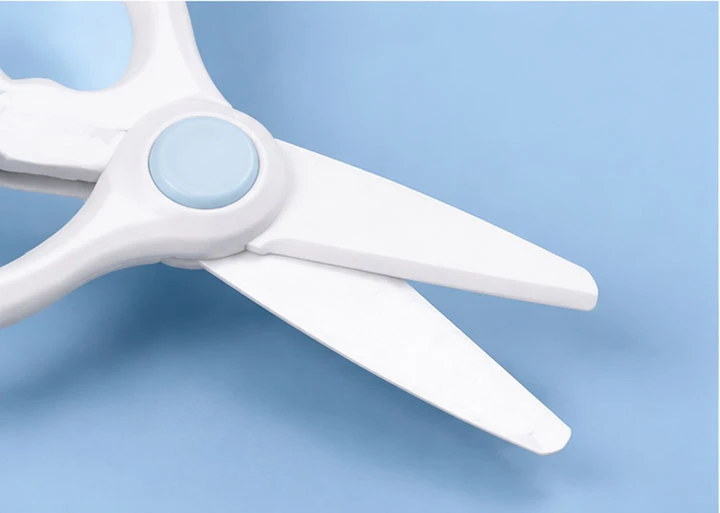
Zirconia ceramic blades are known for their high hardness and resistance to corrosion. Unlike conventional steel blades, ceramic blades do not develop the same type of rust associated with iron-containing metals. This characteristic makes zirconia ceramic an interesting option for feeding accessories that may come into contact with moist food during normal use.
However, high hardness should not be confused with unlimited impact resistance. Ceramic is a hard material but can be brittle under certain impact conditions. Blade geometry, structural support, handling, and product design therefore remain important considerations.
PP handles provide a lightweight plastic structure for holding and operating the scissors. When reviewing a model, buyers should pay attention to the handle shape, surface finish, connection with the blade assembly, and overall ease of handling.
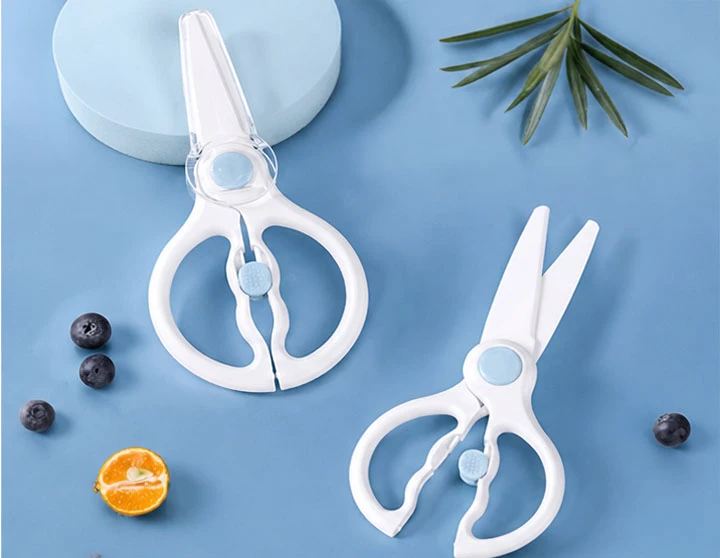
The protective cover is another detail worth checking. A properly fitted cover helps protect the blade during storage and transportation. Buyers should evaluate whether it fits securely and can be removed and replaced as intended.
Choose the Appropriate Blade Size and Product Configuration
Baby food scissors are not all identical in size or configuration. A difference in blade length, handle shape, or cover design can influence how the product is presented and which customer requirements it may suit.
When comparing available models, consider:
Blade dimensions: Review the overall size and cutting length in relation to the intended product specification.
Handle design: Check the shape, grip area, and appearance of the handles.
Protective cover: Determine whether the selected model includes a cover and whether the configuration meets your packaging requirements.
Overall dimensions: Consider storage, retail display, and compatibility with other feeding accessories.
Product appearance: Review the blade finish, handle color, and overall visual consistency.
Some buyers may prefer a compact configuration for a portable feeding accessory collection, while others may prioritize a particular appearance or handle design. These preferences should be discussed before sample development.
Review Existing Models Before Requesting New Development
We generally recommend that first-time buyers review existing ceramic baby food scissors models before requesting extensive structural changes.
There is a practical reason for this. An existing model provides a real reference for dimensions, construction, blade appearance, handle design, and protective cover fit. Buyers can first decide whether the basic product meets their expectations, then identify which details need customization.
For example, a brand may find that an existing model already meets its requirements for blade material and product configuration. The project may then focus on logo placement, handle color, and retail packaging rather than redesigning the entire product.
This approach can make the development process easier to organize and reduce the number of variables that need to be reviewed during sampling.
Buyers interested in comparing available models can visit our ceramic baby food scissors collection to review the product range and identify a suitable starting point.
Step 3 – Confirm Your Customization Requirements
After selecting a suitable model, the project moves into customization. This is where a standard product begins to take on the identity of an individual brand.
For most private-label baby food scissors projects, customization focuses on three main areas: logo, color, and packaging. These elements may appear straightforward, but they require clear specifications and approval before production.
Custom Logo and Brand Identity
A logo is often the most recognizable part of a private-label product. Buyers should therefore consider its position, size, visibility, and application method rather than simply sending a logo file and expecting the manufacturer to decide everything else.
Before preparing a customized sample, we recommend confirming:
The final logo artwork and file format.
The intended logo position on the product or packaging.
The preferred logo size and orientation.
The required appearance and color treatment.
Any restrictions related to the available product surface.
Artwork should be supplied in a clear, usable format. If the logo contains fine details, small text, or multiple colors, its actual appearance should be reviewed carefully during sample evaluation.
At MIDDIA, our standard MOQ for custom logo orders starts from 2,000 pieces. The final arrangement should be confirmed according to the selected model and customization requirements.
Custom Colors for Handles and Accessories
Color is another important part of product identity. Brands with an established visual system may want the baby food scissors to match their existing feeding accessories, packaging, or brand colors.
When discussing custom colors, buyers should provide a clear color reference whenever possible. A Pantone reference or another agreed color standard is more useful than a general description such as light pink, warm beige, or soft green.
It is also important to specify which components require customization. For example, the handle and protective cover may need to use the same color or follow a coordinated color scheme.
Buyers should remember that the appearance of a color on a computer or mobile screen may differ from the actual molded product. A physical sample is a more reliable reference for final approval.
At MIDDIA, our standard MOQ for custom color orders starts from 3,000 pieces. Actual feasibility and color matching should be discussed according to the product configuration.
Custom Retail Packaging
Packaging is not simply a container for the product. It influences how the product is displayed, how customers understand its features, and how it is protected during transportation.
For baby product brands and retailers, common packaging considerations include:
Packaging structure: Whether the product requires an individual retail box or another agreed packaging format.
Brand identity: Logo, brand colors, typography, and overall visual presentation.
Product information: Product name, relevant specifications, instructions, and appropriate warnings.
Retail requirements: Barcode placement, labeling, and other information required by the intended sales channel.
Transportation protection: Packaging strength, internal positioning, and carton arrangements.
Artwork should be checked before printing. Buyers should confirm the final dimensions, text, colors, barcode information, and printing layout to avoid preventable corrections after production has started.
At MIDDIA, our standard MOQ for custom packaging starts from 3,000 pieces. The exact packaging solution depends on the design and production requirements.
Confirm the Complete Customization Specification
Before proceeding to sampling, we recommend consolidating all customization details into one document. This makes it easier for the buyer and manufacturer to work from the same information.
| Customization Area | Details to Approve |
|---|---|
| Logo | Artwork, position, size, and application method |
| Color | Color reference and components to be customized |
| Packaging | Structure, dimensions, artwork, and printing details |
| Accessories | Protective cover and other agreed components |
| Product specifications | Model, materials, dimensions, and configuration |
Not every request is automatically available for every model. Some changes may require additional development, different tooling arrangements, or separate production planning. Confirming feasibility early helps avoid misunderstandings later.
Step 4 – Develop and Review the First Product Sample
Sample development is one of the most important stages in the custom baby food scissors process. It gives buyers an opportunity to examine the actual product rather than relying only on photographs, drawings, or written specifications.
For an OEM project, the sample is also where many customization details become visible. A logo that looks clear in a digital file may appear different on the actual product. A selected color may need adjustment. A protective cover may require closer evaluation for fit and appearance.
What Information Is Needed Before Sample Development?
Before a manufacturer starts preparing a customized sample, buyers should provide the information needed to understand the project.
This normally includes:
The selected baby food scissors model or product reference.
The required product specifications and dimensions.
Logo artwork and placement instructions.
Color references for the handle and other customized components.
Protective cover or accessory requirements.
Packaging structure and artwork, if packaging samples are required.
Any specific modifications that differ from the standard model.
If a buyer has a reference product, technical drawing, or visual example, sharing it can also make communication more precise. However, the manufacturer should confirm whether the requested design can be achieved using the existing product structure.
What Should Buyers Check in a Baby Food Scissors Sample?
Once the sample is ready, buyers should review it systematically. We suggest dividing the evaluation into six areas.
1. Product appearance
Check the overall shape, dimensions, surface finish, and visual consistency with the agreed specifications. Look for visible defects, unexpected color differences, or details that do not match the approved design.
2. Ceramic blade quality
Inspect the blade surface, visible edges, alignment, and overall condition. The blades should be evaluated according to the intended product specification. Buyers should not assume that a smooth-looking blade automatically confirms every aspect of cutting performance or structural quality.
3. Handle construction
Review the handle shape, surface finish, connection points, and overall assembly. Check whether the product matches the agreed configuration and whether there are visible molding or assembly defects.
4. Protective cover
If the model includes a protective cover, check its fit, alignment, and ease of installation and removal. It should match the approved configuration and should not be overlooked simply because it is a small accessory.
5. Branding
Compare the actual logo with the approved artwork. Review its position, size, clarity, orientation, and overall appearance.
6. Packaging
If a packaging sample is available, check its dimensions, printing, product positioning, labeling, and protective function. Confirm that the product fits as intended and that the packaging reflects the approved design.
Why Physical Sample Evaluation Matters
Digital mockups are useful for discussing design ideas, but they cannot fully represent a finished product. Color appearance, surface details, assembly, and the fit of accessories are easier to evaluate with a physical sample.
At MIDDIA, we encourage buyers to review actual samples before approving customized products. This is particularly important for ceramic baby food scissors because the product combines a hard ceramic blade with other structural components.
Sample evaluation also provides an opportunity to discuss any differences between the initial requirements and the actual product. If a change is needed, it is generally easier to address it during development than after mass production has begun.
For existing models, sample preparation may be relatively straightforward. Customized projects involving special colors, logos, or packaging may require additional preparation and confirmation. The actual sample schedule should therefore be agreed according to the project scope.
Step 5 – Conduct Product Testing and Confirm Quality Requirements
Sample approval should not be based on appearance alone. Buyers developing baby feeding accessories should also consider product quality, material suitability, and the supporting documentation available for the product.
At MIDDIA, we understand that quality information is an important part of the purchasing decision. Our ceramic baby food scissors have passed an SGS 1-meter drop test, and we have FDA- and LFGB-related documentation for applicable products or materials. Buyers should review the actual reports to confirm their scope and relevance to the selected product.
SGS 1-Meter Drop Test
A drop test evaluates how a product performs under a specified impact condition. For ceramic baby food scissors, this is particularly relevant because ceramic blades are hard but can be vulnerable to impact under certain conditions.
MIDDIA's ceramic baby food scissors have passed an SGS 1-meter drop test. This provides buyers with a documented reference for the tested product under the conditions stated in the applicable report.
When reviewing a drop-test report, buyers should pay attention to:
Tested product: Confirm the product name, model, and configuration covered by the report.
Test height: Check that the specified drop height is one meter if this is the test being evaluated.
Test conditions: Review the test method, impact surface, orientation, and other conditions described in the report.
Evaluation criteria: Understand which product characteristics were checked after the drop test.
Test result: Confirm the recorded result and any limitations stated in the document.
It is important to interpret this result correctly. Passing a 1-meter drop test does not mean that a ceramic blade is impossible to break or that the product will withstand every type of impact. It means the tested product met the stated evaluation criteria under the specific test conditions.
For buyers, this distinction matters. A test report is most useful when its product scope and test method are clear.
FDA and LFGB-Related Compliance Documentation
For baby feeding products, material suitability and food-contact considerations are important parts of supplier evaluation. Buyers may therefore request FDA- or LFGB-related documents when reviewing a ceramic baby food scissors project.
FDA refers to the United States Food and Drug Administration. Its regulations and requirements may be relevant to materials used in products intended for food contact, depending on the material, application, and applicable regulatory provisions.
LFGB is Germany's Food and Feed Code. Testing and evaluation under relevant LFGB requirements may be requested when assessing materials intended for food-contact applications in certain markets.
These documents should be interpreted according to what was actually tested. A report covering one material or component should not automatically be treated as evidence that every component of the finished product has been evaluated.
When requesting documentation, buyers should confirm:
Which material or product component was tested.
Whether the document identifies the relevant product or material specification.
Which test methods and requirements were applied.
Whether the results cover the intended food-contact application.
Whether the document is current and relevant to the selected product configuration.
At MIDDIA, we can discuss the available FDA- and LFGB-related documentation with buyers and help identify the relevant documents for their product requirements. The exact scope should always be checked against the actual report rather than assumed from a general certification statement.
Establish Product Quality Acceptance Criteria
Testing documents are only one part of product evaluation. Buyers should also establish practical quality acceptance criteria before approving mass production.
For ceramic baby food scissors, the specification may cover:
Product dimensions and agreed tolerances.
Ceramic blade surface condition and alignment.
Handle appearance and assembly quality.
Protective cover fit and condition.
Logo position, size, and appearance.
Color consistency against the approved reference.
Packaging dimensions, printing, and condition.
It is better to define these points in advance than to rely on general instructions such as good quality or same as sample. Clear acceptance criteria give both parties a more objective basis for checking the finished products.
Step 6 – Approve the Final Sample Before Mass Production
After product evaluation and any necessary modifications, the next step is final sample approval. This is a key transition point between product development and manufacturing.
We recommend treating sample approval as a formal confirmation rather than a casual message that the product looks fine. The approved sample should represent the exact configuration that the buyer expects to receive in the production order.
Review the Final Product Configuration
Before approval, review the complete product rather than checking only the part that was recently modified.
The final review should include:
Selected product model and configuration.
Blade and handle specifications.
Product dimensions and agreed details.
Protective cover and other accessories.
Logo artwork, size, and placement.
Handle and accessory colors.
Packaging design and final artwork.
If the product has undergone several rounds of changes, buyers should ensure that the latest version includes all approved modifications. An earlier sample should not accidentally become the reference for mass production.
Consolidate Feedback and Confirm Modifications
During sample review, buyers may identify details that need adjustment. These could involve a logo position, color difference, packaging layout, or a product component that does not match the agreed specification.
We recommend consolidating feedback into one clear list whenever possible. Photos with marked areas, annotated drawings, and written descriptions are often more useful than several separate messages containing incomplete instructions.
For example, instead of writing that the logo needs to look better, specify whether it should move, change size, or use a different application method. Instead of saying that the handle color is not correct, provide the agreed color reference and identify the component that needs adjustment.
This makes it easier for the manufacturer to understand the requested change and prepare the next sample accordingly.
Create an Approved Sample Reference
Once the buyer is satisfied with the sample, the final version should be documented as the production reference.
We recommend keeping the following information together:
The approved physical sample.
The final product specification sheet.
The approved logo artwork.
The agreed color reference.
The final packaging artwork.
Any applicable testing and quality documentation.
This reference is important because mass production involves more units than the sample stage. A documented specification helps the manufacturer understand what needs to remain consistent and gives the buyer a clearer basis for later inspections.
Any changes requested after approval should be discussed and confirmed before they are applied to the production order. Even a small change to a component, color, or package can affect the final product.
Step 7 – Prepare for Mass Production and Quality Inspection
Once the final sample is approved, the project can move toward mass production. However, sample approval does not mean that every production detail is automatically settled.
Order quantity, specifications, customization, packaging, inspection requirements, and delivery arrangements still need to be confirmed. Clear production preparation helps reduce misunderstandings and makes it easier to compare the finished order with the approved reference.
Confirm the Mass Production Order
Before production begins, both parties should confirm the commercial and technical details of the order.
These normally include:
Final product model and order quantity.
Approved blade, handle, and accessory specifications.
Logo and color customization requirements.
Packaging design and required quantities.
Agreed quality inspection criteria.
Production and delivery schedule.
Commercial terms and shipping arrangements.
For customized products, the order details should match the approved sample and specification sheet. This is particularly important when a project involves several customized components or multiple packaging versions.
Maintain Consistency with the Approved Sample
One of the main objectives during mass production is maintaining consistency with the approved sample.
For ceramic baby food scissors, buyers should pay attention to several areas:
Ceramic blade consistency: The blade surface, dimensions, appearance, and alignment should follow the agreed product specification.
Product assembly: The handle and blade assembly should be checked against the approved configuration. Visible assembly defects should be addressed according to the agreed quality criteria.
Handle and protective cover appearance: These components should match the approved color and design references. Buyers should also check for visible surface defects or differences between production units.
Logo application: The logo should maintain the approved position, size, orientation, and appearance.
Packaging consistency: Printed materials, product labels, and packaging structures should correspond to the final approved artwork.
It is worth remembering that consistency does not mean every product can be judged by appearance alone. The agreed specifications and relevant inspection methods should determine how quality is evaluated.
Conduct Quality Checks During Production and Before Shipment
Quality inspection should be planned around the actual product requirements. A useful inspection checklist can cover the following areas:
| Inspection Area | Key Points to Check |
|---|---|
| Product appearance | Visible scratches, stains, surface defects, and appearance differences |
| Ceramic blades | Surface condition, alignment, and conformity to agreed specifications |
| Assembly | Handle and blade connection and overall assembly condition |
| Accessories | Protective cover condition and fit |
| Branding | Logo accuracy, position, and appearance |
| Packaging | Printing, labeling, packing condition, and product protection |
Buyers should agree on the inspection scope before production rather than assuming that every supplier uses the same inspection procedure. Where required, the order can specify inspection methods, sampling arrangements, acceptance criteria, and documentation.
At MIDDIA, we consider quality requirements part of the product specification, not something that should only be discussed when an order is ready to ship. Clear expectations make communication more efficient throughout the manufacturing process.
Step 8 – Final Packaging, Shipment and Delivery
The final stage is preparing the finished products for shipment. Even when the product itself has passed the agreed checks, packaging and delivery preparation still matter. Poor packing can lead to damaged retail boxes, missing accessories, or other problems during transportation.
Confirm Retail Packaging and Product Information
Before packing, buyers should confirm that the final packaging matches the approved design.
Important details include:
Correct product name and brand identity.
Approved logo and printed colors.
Product information and specifications.
Required labels and barcode information.
Instructions and appropriate warnings.
Correct product positioning inside the package.
For baby feeding products, buyers should also check that product information and any use-related statements are appropriate for the target market. Packaging claims should be supported by relevant product information and documentation.
Check Shipment Preparation
Before shipment, the order should be checked against the agreed packing and delivery requirements.
Depending on the order, this may include:
Confirming the finished product quantity.
Checking the condition of retail packaging.
Confirming carton quantities and labeling.
Checking that the correct accessories are included.
Preparing the required shipping and commercial documents.
Confirming the delivery arrangements with the buyer.
For international buyers, shipping requirements and import documentation may vary by destination. These details should be discussed before the order is dispatched, especially when the buyer has specific labeling or documentation requirements.
Plan for Repeat Orders and Product Line Expansion
A custom product project does not necessarily end with the first shipment. If the product performs well in the market, the buyer may need repeat orders or additional variations.
Keeping the approved sample, product specifications, logo files, color references, and packaging artwork makes future orders easier to manage. It also helps both sides identify whether a repeat order should follow the original configuration or include new changes.
Some brands may later expand their baby feeding collections with additional accessories or related products. In these cases, the experience gained from the first project can provide a useful reference for future product development.
What Should You Consider Before Starting a Custom Baby Food Scissors Project?
Understanding the development process is one thing. Deciding how to organize the project commercially is another. Before requesting samples or placing an order, buyers should consider whether an existing model is sufficient, what customization is genuinely necessary, and which costs may influence the final product.
Is an Existing Model Enough for Your Brand?
There are two common approaches to developing custom baby food scissors.
Option 1: Existing model with OEM customization.
This approach starts with an available product model and adds selected private-label elements such as a logo, custom handle color, or retail packaging. It is often a practical choice for brands that want to establish a product line without making extensive structural changes.
It also allows buyers to evaluate the actual product before deciding how much customization is necessary.
Option 2: Customized product development.
This approach may be more suitable for brands with specific requirements that cannot be met by an existing model. For example, the buyer may need a different structure, dimensions, component configuration, or other product changes.
More extensive development normally requires additional technical discussion and feasibility confirmation. Buyers should understand that a request for a completely new product is different from adding a logo or changing the color of an existing model.
For many first-time projects, we suggest evaluating existing models first. If the basic product already meets the main requirements, customization can focus on the brand elements that matter most.
How Much Should You Prepare for Your First Custom Order?
The cost of a custom baby food scissors project depends on several factors. There is no single price that applies to every project because product configuration, customization, quantity, and packaging requirements can vary.
When preparing a project budget, buyers should consider:
Product model: The selected model and its specifications form the starting point for pricing.
Logo customization: Artwork preparation and the selected application method may influence the arrangement.
Custom colors: Special color requirements and the number of customized components should be confirmed.
Packaging: Retail box structure, printing, materials, and artwork affect packaging costs.
Sample development: The type of sample and the extent of customization may influence development arrangements.
Order quantity: Quantity affects production planning and unit-cost calculations.
Testing and documentation: Additional testing or market-specific documentation requirements should be discussed in advance.
Shipping and logistics: Destination, shipment method, carton dimensions, and delivery requirements also affect the total landed cost.
Our recommendation is to define the product configuration before asking for a final quotation. A quotation based on incomplete specifications may need to be revised when the buyer later adds custom colors, packaging, or other requirements.
How to Choose a Reliable Baby Food Scissors Manufacturer
Choosing an OEM supplier is not only about comparing unit prices. The manufacturer should be able to understand the product requirements, communicate clearly, provide suitable samples, and support the project through production.
When evaluating a potential baby food scissors manufacturer, consider the following questions:
Does the manufacturer offer suitable existing models? A relevant product range can provide a practical starting point for development.
Can it support private-label customization? Confirm whether logo, color, and packaging options are available and what MOQ applies to each.
Can it provide physical samples? Buyers should have an opportunity to evaluate the actual product before approving mass production.
Can it provide relevant testing documentation? Ask for reports that match the product, material, and intended application.
Are product inspection requirements clearly defined? A reliable project should have agreed specifications and quality acceptance criteria.
Can it maintain consistency for repeat orders? Approved samples and documented specifications are important references for future production.
It is also worth paying attention to how a supplier responds to questions. A manufacturer that explains limitations, asks for missing specifications, and provides clear answers is generally easier to work with than one that simply promises to meet every requirement.
Frequently Asked Questions About Custom Baby Food Scissors
Q1. How are custom baby food scissors developed?
Custom baby food scissors are generally developed through eight stages: defining product requirements, selecting a suitable model, confirming logo, color, and packaging details, developing a sample, evaluating product quality, approving the final sample, preparing mass production, and arranging shipment. The exact process depends on the complexity of the customization. Starting with an existing model can make the project easier to organize.
Q2. Can I customize baby food scissors with my own brand logo?
Yes. Private-label baby food scissors can be customized with a brand logo, subject to the selected model and available customization method. At MIDDIA, our standard MOQ for custom logo orders starts from 2,000 pieces. Buyers should prepare the logo artwork and confirm the intended position, size, and appearance before sample approval.
Q3. Can I customize the color and packaging of baby food scissors?
Yes. Custom handle colors and retail packaging can be discussed according to the selected model and project requirements. At MIDDIA, our standard MOQ starts from 3,000 pieces for custom colors and 3,000 pieces for custom packaging. Buyers should provide color references and packaging artwork for evaluation before mass production.
Q4. How long does it take to develop a baby food scissors sample?
Sample development time depends on the selected model and the level of customization. Some existing models may be prepared more quickly, while projects involving special colors, logo application, or customized packaging may require additional time. For certain existing models, sample preparation may take approximately 2–3 days. Buyers should confirm the actual schedule with the manufacturer before starting the project.
Q5. What should I check before approving a baby food scissors sample?
Before approving a sample, check the product dimensions, overall appearance, ceramic blade condition and alignment, handle construction, protective cover fit, logo placement, and color consistency. If customized packaging is included, review its dimensions, printing, labeling, and product protection as well. The approved sample should match the final specifications that will be used for mass production.
Q6. Have MIDDIA ceramic baby food scissors passed drop testing?
Yes. MIDDIA ceramic baby food scissors have passed an SGS 1-meter drop test. Buyers can request the applicable test documentation and review the tested model, test conditions, and evaluation criteria. A passing result applies to the conditions described in the report and should not be interpreted as a guarantee that a ceramic blade cannot break under every possible impact.
Q7. Do MIDDIA baby food scissors have FDA and LFGB documentation?
MIDDIA has FDA- and LFGB-related documentation for applicable products or materials. The exact scope depends on the tested material, component, and applicable requirements. Buyers should request the relevant reports and confirm that they cover the materials and product configuration intended for their project. Documentation for one component should not automatically be interpreted as certification of the entire finished product.
Q8. What is the MOQ for custom baby food scissors?
At MIDDIA, our standard customization MOQs are 2,000 pieces for custom logo orders, 3,000 pieces for custom color orders, and 3,000 pieces for custom packaging orders. These are standard starting quantities rather than a universal MOQ for every project. The final requirement should be confirmed according to the selected model, customization combination, and production arrangement.
Develop Your Custom Baby Food Scissors with MIDDIA
Developing a successful private-label baby feeding product requires clear specifications, suitable product selection, careful sample evaluation, and consistent production requirements. A well-organized process helps buyers reduce unnecessary changes and gives both the brand and manufacturer a shared reference throughout the project.
At MIDDIA, we support customers interested in developing ceramic baby food scissors for their own brands and product collections. From selecting an existing model to discussing logo, color, packaging, sample evaluation, and OEM manufacturing arrangements, we aim to make each stage clear before the project moves forward.
Our ceramic baby food scissors have passed an SGS 1-meter drop test, and FDA- and LFGB-related documentation is available for applicable products or materials. We encourage buyers to review the relevant reports and confirm product specifications according to their target market and requirements.
Whether you are a baby product brand, retailer, distributor, or product development manager, you can share your initial product idea with our team. Tell us which model you are considering, your estimated order quantity, and the customization you need.
Discuss Your Custom Product Requirements
Planning to develop custom ceramic baby food scissors for your brand? At MIDDIA, we support baby product brands, retailers, and distributors with product selection, private-label customization, sample development, and OEM manufacturing.
Custom logo from 2,000 pieces
Custom colors and packaging from 3,000 pieces
Product samples for evaluation and approval
SGS 1-meter drop test documentation
FDA- and LFGB-related documentation for applicable products or materials
Whether you already have a product specification or are still comparing available models, share your ideas and estimated order quantity with our team. We will discuss a suitable development solution for your project.
Discuss Your Custom Project →MIDDIA – Ceramic Baby Feeding Scissors OEM & ODM Manufacturing