Choosing a ceramic utility knife manufacturer is not simply a matter of finding a product at the lowest possible price. For distributors, importers, retailers, and private label brands, the right supplier needs to offer more than an attractive product photo or a competitive quotation. Product design, blade material, quality control, production consistency, and customization options all influence whether a product can perform well in the market.
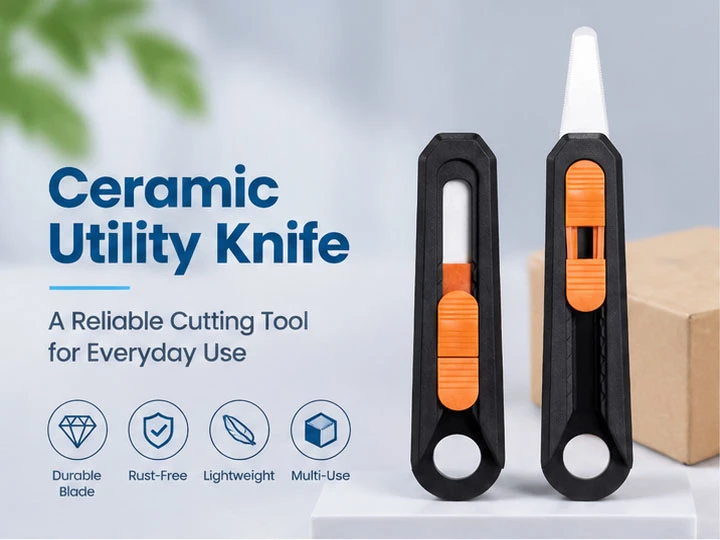
Ceramic utility knives have become an interesting addition to the cutting tool category, particularly for buyers looking for alternatives to conventional steel-blade cutters. Zirconia ceramic blades offer high hardness, excellent corrosion resistance, and useful wear characteristics. At the same time, their material properties require careful consideration when selecting the blade structure and the complete knife design.
At MIDDIA, we work with buyers who are developing or expanding their ceramic cutting tool product ranges. We understand that different customers have different priorities. A tool distributor may be looking for several models at different price points, while a retailer may care more about product appearance and packaging. An importer needs a supplier who can support repeat orders, and a private label brand may need logo and packaging customization.
Our approach is to provide different ceramic utility knife designs for different market requirements, supported by product quality evaluation and OEM cooperation options. In this guide, we explain what B2B buyers should consider before choosing a ceramic utility knife manufacturer and how to evaluate whether a supplier is suitable for a long-term business relationship.
1. Why Are More Buyers Considering Ceramic Utility Knives?
Utility knives are widely used in warehouses, retail operations, offices, packaging facilities, workshops, and everyday cutting tasks. Traditional steel-blade cutters remain common, but buyers are not always looking for another standard metal utility knife. Some want a product with different material characteristics, a more distinctive selling point, or a design that helps their product range stand out.
This is one reason zirconia ceramic utility knives deserve attention from distributors and product sourcing teams. The ceramic blade offers several characteristics that differ from conventional steel. However, understanding both its advantages and limitations is important before adding it to a product catalog.
1.1 Zirconia Ceramic Blades vs. Conventional Steel Blades
Zirconia, also known as zirconium dioxide (ZrO2), is an advanced ceramic material used in various industrial and consumer applications. When properly formulated and processed, zirconia provides high hardness, good wear resistance, and excellent resistance to corrosion.
For utility knife applications, these characteristics can offer practical benefits. Ceramic blades do not rust in the way ordinary steel blades can, and they are not affected by moisture in the same manner as many conventional metal blades. This can be an attractive feature for buyers who want to offer a corrosion-resistant cutting tool.
Nevertheless, ceramic and steel are different materials, not interchangeable versions of the same blade. Steel generally has greater tolerance to bending and impact, while zirconia ceramic is harder but more brittle. The choice should depend on the intended cutting application and the design of the complete product.
| Comparison Factor | Zirconia Ceramic Blade | Conventional Steel Blade |
|---|
| Hardness | High hardness and good wear resistance | Varies depending on steel grade and heat treatment |
| Corrosion Resistance | Excellent resistance to rust and corrosion | Depends on the steel grade and surface treatment |
| Impact Behavior | More brittle and sensitive to improper impact | Generally more tolerant of bending and impact |
| Magnetic Properties | Non-magnetic | Depends on the type of steel |
| Wear Characteristics | Good wear resistance when properly manufactured | Depends on material composition and heat treatment |
| Typical Considerations | Blade geometry, mounting, and impact protection | Corrosion protection, edge retention, and blade replacement |
For buyers, the important question is not whether ceramic is universally better than steel. It is whether a ceramic utility knife is suitable for the applications and customers they serve.
For example, a retailer selling household cutting tools may find corrosion resistance and a distinctive product appearance useful selling points. A distributor serving warehouses may be more interested in the handle structure, blade retraction mechanism, and suitability for regular cardboard cutting.
We believe that explaining these differences honestly is important. A ceramic utility knife should be selected according to its intended use rather than marketed as a replacement for every type of steel cutter.
1.2 What Makes Ceramic Utility Knives Suitable for Different Applications?
The usefulness of a ceramic utility knife depends on the blade geometry, handle design, and cutting task. Different models may be suitable for different materials and working conditions.
Common applications to consider include:
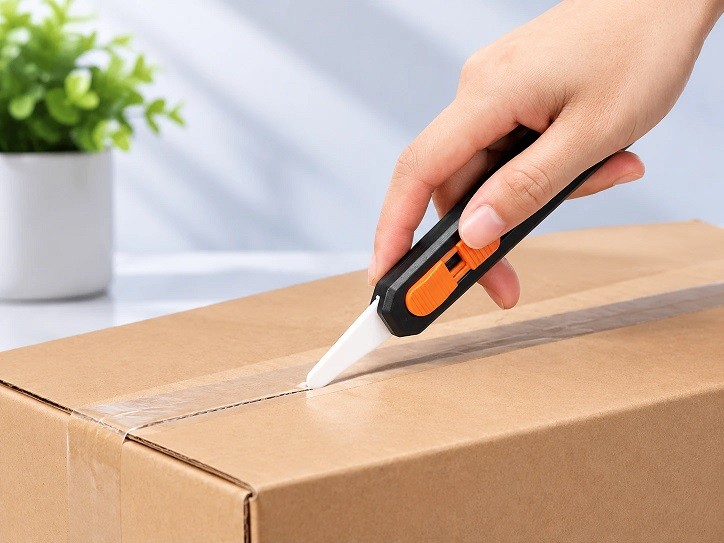
Cardboard boxes: Opening cartons and cutting packaging materials in warehouses, retail stores, and distribution centers.
Paper and paperboard: Cutting paper, labels, and other lightweight materials in offices and packaging environments.
Plastic packaging: Cutting suitable plastic films, ribbons, and packaging components, depending on blade design.
PP strapping: Cutting compatible plastic strapping materials when the blade geometry and product structure are appropriate.
General-purpose cutting: Everyday opening and trimming tasks in retail, home, and workshop environments.
It is important for buyers to evaluate the actual product before assigning it to a particular application. Blade exposure, edge geometry, cutting angle, and handle control all influence the result. A compact paper cutter, for example, may not be the right choice for demanding warehouse work.
When sourcing products for a new market, we recommend testing samples with the materials that end users will actually cut. This gives buyers a more realistic understanding of product performance than relying on specifications alone.
1.3 Why Product Design Matters as Much as Blade Material
A ceramic blade is only one component of a utility knife. The handle, blade holder, slider, locking mechanism, and protective structure all contribute to the user experience.
One issue that deserves particular attention is the way the blade is positioned and supported. Since zirconia ceramic has different impact characteristics from steel, the surrounding structure should hold the blade securely and reduce unnecessary stress during normal use.
Buyers should also examine the following design details:
Blade exposure: Is the cutting edge exposed only as much as the application requires?
Retraction mechanism: Can the blade be moved back into the handle when the tool is not in use?
Slider operation: Does the slider move smoothly and hold its intended position?
Handle ergonomics: Is the handle comfortable to hold and easy to control?
Blade replacement: Is the blade replaceable, and how does the replacement mechanism work?
Protective structure: Does the design help protect the blade during storage and transportation?
In our experience, choosing the right ceramic blade is only one part of developing a useful cutting tool. The handle structure, blade positioning, and retraction mechanism also influence how the product performs during everyday cutting tasks.
This is why we offer different utility knife structures rather than relying on a single design for every customer. Different product categories require different combinations of portability, handle materials, operating mechanisms, and appearance.
2. What Should You Look for in a Ceramic Utility Knife Manufacturer?
Finding a ceramic utility knife supplier is relatively straightforward. Finding a manufacturer who understands the material, offers suitable product designs, maintains consistent quality, and can support your business requirements takes more careful evaluation.
For B2B buyers, we recommend looking beyond the product catalog and examining five important areas: ceramic material experience, product range, quality control, production and supply capability, and customization support.
2.1 Experience with Zirconia Ceramic Blade Materials
Not every cutting tool supplier has the same level of experience with ceramic materials. Some companies mainly source finished products, while others have a deeper understanding of ceramic components and their manufacturing requirements.
When evaluating a ceramic cutter factory, buyers should ask how the supplier handles zirconia ceramic materials and what quality checks are used during blade production.
Several details deserve attention:
Material identification: Does the supplier clearly identify the ceramic material used in the blade?
Material consistency: Are incoming materials checked to maintain consistent product characteristics?
Grinding and finishing: Is the blade processed with appropriate equipment and controlled procedures?
Dimensional accuracy: Are blade dimensions checked against the product requirements?
Edge quality: Is the cutting edge inspected for defects and consistency?
Assembly compatibility: Does the finished blade fit the intended handle and blade holder correctly?
Zirconia ceramic blades require suitable processing and finishing. A supplier should be able to explain how the blade is manufactured and what inspection steps are relevant to the finished product.
At MIDDIA, our work with ceramic cutting products gives us a practical understanding of the relationship between ceramic blade characteristics and product design. We consider the blade and the complete utility knife together, rather than treating the ceramic component as an isolated part.
For buyers, this distinction matters. A supplier who understands ceramic materials and their application can usually provide more useful answers when discussing blade structure, product selection, and customization requirements.
2.2 A Diverse Range of Ceramic Utility Knife Designs
For distributors and wholesalers, product variety can be just as important as the performance of an individual model. A catalog containing only one ceramic box cutter may limit the number of customer groups you can serve.
Different buyers have different expectations. Some prefer compact tools for everyday use, while others want a stronger-looking design for professional tool collections. Retailers may focus on appearance and shelf presentation, whereas warehouse suppliers may prioritize practical operation.
At MIDDIA, we offer several ceramic utility knife designs to help buyers select products according to their target market.
BK2 – Retractable Ceramic Utility Knife
The BK2 is a retractable ceramic utility knife designed for general cutting and packaging applications. Its sliding structure allows the blade to be extended or retracted, while the serrated ceramic blade design provides a distinctive alternative to conventional smooth-edge cutters.
For distributors, BK2 can serve as a practical starting point when introducing ceramic utility knives into an existing cutting tool range. Buyers can evaluate its handle design, blade operation, and available product variations according to their market needs.
SSD01 – Adjustable Retractable Ceramic Cutter
The SSD01 features an adjustable slider structure that allows users to control blade exposure. This design is useful for buyers looking for a retractable ceramic cutter with a straightforward operating mechanism.
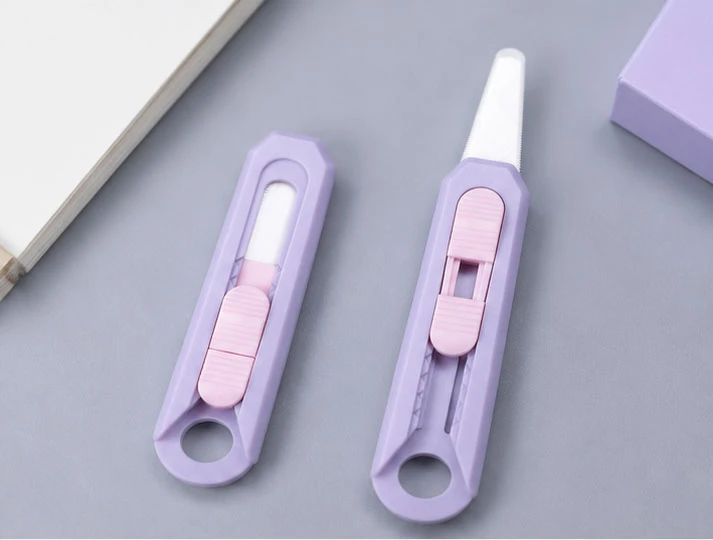
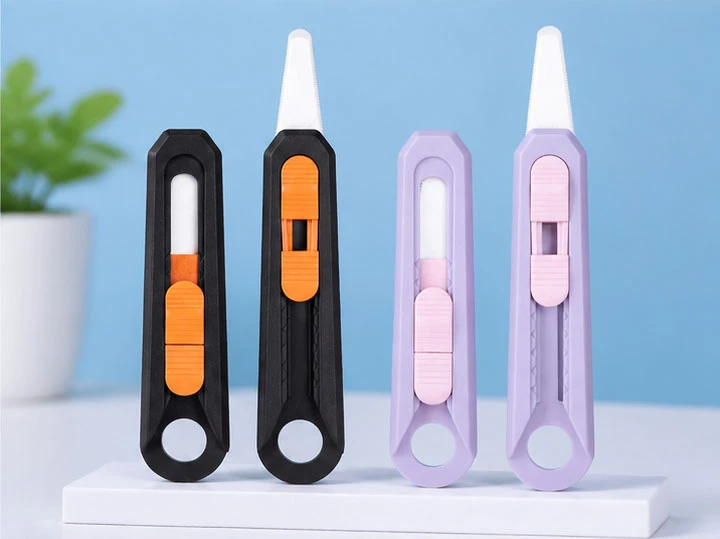
Its product appearance and available color options may also be relevant to retailers and brands that want to develop a more varied product presentation.
BK3 – Mini Retractable Ceramic Utility Knife
Not every customer needs a full-size utility knife. The BK3 uses a compact, lipstick-style design, making it an option for buyers interested in portable cutting tools and smaller retail products.
Its compact format gives distributors another product category to consider alongside conventional box cutters. It may be suitable for everyday paper cutting and other compatible lightweight applications.
BK5 – Folding Pocket Ceramic Utility Knife
The BK5 combines a folding structure with a pocket-oriented design and carabiner clip. Compared with a conventional retractable cutter, a folding utility knife offers a different form factor that may appeal to customers looking for portable tools.
For outdoor accessory retailers, tool distributors, and e-commerce sellers, this type of design can help create a more varied product selection.
BK6 – Heavy-Duty Folding Pocket Ceramic Utility Knife
The BK6 adds another folding design to the MIDDIA utility knife range. Buyers can evaluate this model when they want to offer customers a different handle appearance and folding format.
When comparing folding cutters, we recommend checking the hinge structure, blade positioning, locking mechanism, and overall handling experience. These details are important when evaluating a product for regular retail sales.
BK7 – Automatic Blade Replacement Ceramic Utility Knife
The BK7 features an automatic blade replacement structure, giving it a different product concept from standard retractable cutters. This type of mechanism may be of interest to buyers looking for a more differentiated utility knife for their catalog.
For importers and distributors, the operating mechanism should be evaluated carefully during sample testing. Buyers should understand how the replacement process works, which components are replaceable, and whether the product instructions are suitable for their target market.
BK8 – Heavy-Duty Aluminum Alloy Ceramic Utility Knife
The BK8 combines an aluminum alloy handle structure with a retractable ceramic blade design. Its appearance and construction make it an option for buyers targeting customers who prefer a more substantial utility knife design.
For professional tool distributors and industrial supply retailers, this model can be considered alongside more compact plastic-handle products.
Having different designs allows buyers to build a more complete product range instead of depending on one SKU. A distributor, for example, may choose a compact model for entry-level retail sales, a folding model for portable tool collections, and an aluminum alloy model for a more professional product category.
We encourage buyers to compare the actual product specifications and request samples before deciding which models should be included in their catalog.
2.3 Quality Control and Product Durability Testing
Quality control is especially important for ceramic utility knives because ceramic materials have a different mechanical behavior from conventional metals. High hardness and wear resistance are useful properties, but they do not eliminate the need for appropriate structural design and product testing.
A buyer should not evaluate a ceramic box cutter only by looking at whether the blade appears sharp. The complete product needs to be considered, including the blade, handle, assembly, moving components, and packaging.
At MIDDIA, product durability is an important part of our quality evaluation process. Our ceramic utility knife has undergone a 1-million-cycle drop test verified by SGS. This testing provides an additional reference for buyers evaluating product durability and structural reliability.
For procurement teams, third-party testing can be useful because it provides supporting evidence beyond a manufacturer's general statement about product quality. Buyers who need to evaluate a product for their own market can also request relevant test documentation and confirm the exact test scope.
It is worth remembering that a drop test does not automatically prove performance under every possible condition. The test result should be understood according to the tested model, test method, sample configuration, and acceptance criteria. Buyers should review the relevant report when making technical or compliance decisions.
What Quality Checks Should Buyers Ask About?
When evaluating a ceramic utility knife manufacturer, it is useful to ask how the supplier checks the following product details:
Incoming material inspection: Are the materials and purchased components checked before production or assembly?
Ceramic blade inspection: Are blade dimensions, appearance, and edge condition examined?
Blade sharpness: Is cutting performance evaluated using an appropriate inspection method?
Handle assembly: Are the blade holder, handle, and related components assembled correctly?
Retraction and locking mechanism: Are the slider and locking functions checked for proper operation?
Finished product inspection: Are appearance, assembly, and functional conditions reviewed before shipment?
Packaging inspection: Are products packed in a way that helps protect them during storage and transportation?
Not every buyer will need the same level of technical documentation. A small retailer may mainly need product samples and specifications, while an importer supplying a large retail chain may require more detailed inspection records and test reports.
We recommend discussing these requirements before placing a bulk order. It is much easier to agree on product specifications and inspection expectations at the beginning of a project than to resolve misunderstandings after production has been completed.
2.4 Production Capacity and Supply Reliability
For importers, wholesalers, and established distributors, product quality is only one part of the purchasing decision. The supplier also needs to support the buyer's ordering requirements and provide a reasonable level of supply consistency.
A product may perform well during sample evaluation, but buyers still need to understand whether the manufacturer can support repeat orders, maintain product specifications, and communicate clearly about production schedules.
Before choosing a ceramic utility knife supplier, we suggest reviewing several practical points.
Minimum Order Quantity
MOQ is one of the first details that buyers usually ask about. A lower minimum order quantity can make it easier for retailers and smaller distributors to test a new product category without committing too much inventory at the beginning.
For larger importers, MOQ may be less important than the manufacturer's ability to maintain consistent specifications across repeat orders. The right arrangement depends on the buyer's sales volume, product range, and inventory strategy.
Sample Availability
Samples allow buyers to evaluate the actual product before committing to a larger order. This is particularly useful for ceramic utility knives because the cutting experience, handle comfort, blade operation, and overall construction are not fully represented by product photographs.
We recommend checking the following points during sample evaluation:
Whether the product matches the published specifications.
Whether the blade can be extended and retracted smoothly, where applicable.
Whether the handle feels comfortable during normal use.
Whether the product is suitable for the intended cutting materials.
Whether the packaging and appearance meet the buyer's expectations.
Repeat Orders and Production Consistency
For an importer or wholesale distributor, the first order is only the beginning of a potential business relationship. If a product sells well, the buyer needs to reorder it without facing unnecessary changes in appearance, specifications, or product construction.
Before starting cooperation, it is worth discussing how product specifications are confirmed, how changes are communicated, and how repeat orders are managed.
Lead Time and Order Communication
Production lead time can affect inventory planning, seasonal promotions, and delivery commitments. Buyers should ask the manufacturer to confirm sample arrangements, production schedules, packaging requirements, and shipping preparation before placing an order.
At MIDDIA, we understand that different customers have different purchasing schedules. We encourage buyers to share their estimated quantities, selected models, and customization requirements early so that the project can be evaluated more accurately.
For reference, individual MIDDIA product listings provide model-specific purchasing and sample information. Buyers should confirm the current MOQ, sample lead time, and production schedule for their selected models when requesting a quotation.
2.5 Transparent Communication and Customization Support
Customization is an important consideration for retailers and brands that want to develop products under their own names. A standard ceramic utility knife may be suitable for general wholesale distribution, but private label customers often need additional details to match their brand identity.
Before choosing an OEM ceramic utility knife manufacturer, buyers should understand exactly what can be customized and which options are available for each model.
Custom Logo Options
Adding a company logo can help retailers and private label brands create a more consistent product identity. Depending on the model and production requirements, buyers can discuss available logo customization methods and suitable logo positions.
When requesting a logo customization quotation, it is helpful to prepare the logo artwork, preferred placement, color requirements, and estimated order quantity.
Handle Color Options
Product color can influence how a utility knife is presented in retail stores and online catalogs. Some brands prefer a neutral appearance for professional tools, while others want brighter colors that are easier to distinguish on a retail shelf.
Buyers should ask which existing color options are available and whether additional color customization can be supported for their selected model.
Customized Retail Packaging
Packaging is not just a protective layer around the product. For retailers and e-commerce sellers, it is also part of the product presentation.
Depending on the model and order requirements, buyers can discuss options such as:
Custom printed product boxes.
Private label packaging.
Product specification labels.
Barcode and retail information.
Packaging artwork adapted to the buyer's brand.
Before mass production, buyers should confirm the packaging dimensions, artwork, printing details, and final sample. This helps reduce the possibility of unexpected differences between the approved design and the delivered goods.
We understand that private label customers need more than a standard product with a different logo. At MIDDIA, we support buyers with OEM logo and packaging options, helping them develop ceramic utility knives that better match their brand positioning and target market.
3. How to Choose the Right Ceramic Utility Knife for Your Business
Even when two buyers are sourcing the same category of product, their purchasing priorities can be quite different. A tool distributor may want a broad selection of products, while an importer may focus on landed cost and repeat supply. A retailer may care more about product presentation, and a private label brand may need a supplier who can support customization.
For this reason, we do not recommend selecting a ceramic utility knife based on price alone. Start by identifying your sales channel and the type of customer you want to reach. Then compare the models according to their design, application, and purchasing requirements.
3.1 For Tool Distributors: Build a Competitive Product Range
Tool distributors often serve several types of customers, including hardware stores, professional tool retailers, packaging suppliers, and industrial product dealers.
Offering only one ceramic utility knife may limit the number of customers who find something suitable in your catalog. A selection of different designs can help distributors serve more market segments and create a clearer product range.
For example, a distributor may consider:
BK2: A retractable ceramic utility knife for general cutting and packaging applications.
BK5: A folding pocket design for customers interested in portable cutting tools.
BK7: An automatic blade replacement design for a more differentiated product offering.
BK8: An aluminum alloy retractable model for buyers who prefer a more substantial tool structure.
Instead of purchasing several models without a clear plan, distributors should consider the expected customer group, target retail price, product positioning, and demand in their existing sales channels.
A well-organized product range can also make it easier for sales teams to explain the differences between models and recommend the right product to each customer.
3.2 For Retailers: Focus on Shelf Appeal and Product Presentation
Retailers usually have a different set of requirements. The product needs to be easy to understand, visually appealing, and suitable for the store's existing product category.
For ceramic utility knives, several details can influence the retail presentation:
Handle color and overall appearance.
Compact or portable product designs.
Clear product descriptions and specifications.
Retail packaging that protects and presents the product.
Product information that helps customers understand the intended application.
For retailers introducing ceramic utility knives for the first time, models such as BK2, SSD01, and BK3 may be worth evaluating because they offer different form factors within the same product category.
Packaging deserves particular attention for e-commerce sellers. Product images and descriptions should accurately represent the actual model, including the blade structure, handle design, and operating mechanism. Clear product information helps reduce customer confusion and unnecessary returns.
3.3 For Importers and Wholesalers: Evaluate Total Procurement Costs
For importers and wholesalers, the lowest factory unit price does not always result in the lowest total purchasing cost.
When comparing quotations from different ceramic box cutter suppliers, buyers should consider the complete cost structure rather than focusing on one number.
Important factors include:
Product unit price: Compare quotations for the same model and equivalent specifications.
Minimum order quantity: Check whether the MOQ fits your inventory and purchasing plan.
Packaging cost: Confirm whether standard packaging or customized packaging is included.
Shipping volume: Consider carton dimensions, packing quantity, and transportation costs.
Production lead time: Understand how long the supplier needs to prepare the order.
Product consistency: Evaluate whether specifications can be maintained across repeat orders.
After-sales communication: Confirm how product issues and order questions will be handled.
It is also useful to compare quotations using the same purchasing conditions. A quotation for a basic model with standard packaging should not be directly compared with a customized model that includes additional printing and packaging requirements.
At MIDDIA, we encourage buyers to provide the model number, estimated quantity, destination market, and customization requirements when requesting a quotation. This allows us to discuss a more relevant purchasing solution instead of providing a price without enough context.
3.4 For Private Label Brands: Look for Flexible OEM Solutions
Private label brands are often looking for more than a product they can resell. They want to create a product that fits their own brand positioning, packaging style, and customer expectations.
When choosing an OEM ceramic utility knife manufacturer, buyers should first understand which parts of the product can be customized and which options are available for existing models.
Common OEM considerations include:
Logo placement and printing requirements.
Available handle colors.
Customized retail packaging.
Product model and design selection.
Sample approval before bulk production.
Product specifications and packaging information.
For a new private label project, we suggest starting with an existing model that is close to the intended product positioning. This can help buyers evaluate market response before investing in a more complicated product development project.
For example, a brand focused on compact everyday tools may prefer a mini ceramic cutter, while a brand serving professional tool users may be more interested in an aluminum alloy or folding design.
At MIDDIA, we can discuss suitable existing models, logo options, and customized packaging according to the customer's requirements. We believe a practical OEM project should begin with a clear understanding of the target market, expected order quantity, and product specifications.
4. What Questions Should You Ask Before Choosing a Ceramic Box Cutter Supplier?
Before placing a wholesale or OEM order, buyers should prepare a few basic questions. These questions can help identify whether a supplier understands the product category and whether its capabilities match the purchasing requirements.
1. Does the Manufacturer Have Experience with Zirconia Ceramic Blades?
Ask what ceramic material is used, how the blade is processed, and how its dimensions and edge quality are inspected. A supplier should be able to explain the basic characteristics of the material and its application in the finished product.
2. What Types of Ceramic Utility Knives Are Available?
Check whether the supplier offers retractable, folding, compact, or other utility knife designs. A wider product selection may help distributors and retailers build a more complete catalog.
3. What Materials Are Used for the Blade and Handle?
Ask for the material specifications of the ceramic blade and the handle. If the product uses aluminum alloy or other structural materials, request the relevant information for the selected model.
4. Has the Product Undergone Durability Testing?
Ask whether the supplier can provide relevant testing information or documentation. For products claiming third-party testing, buyers should confirm the tested model, test method, and report scope.
5. What Quality Inspection Procedures Are Performed?
Discuss blade inspection, assembly checks, slider operation, appearance inspection, and packaging checks. The inspection requirements should match the product and the buyer's quality expectations.
6. What Is the MOQ for Wholesale Orders?
Ask whether MOQ differs between models and whether different colors or packaging options affect the minimum quantity. This is particularly important for distributors testing several SKUs.
7. Can the Manufacturer Provide OEM Logo and Custom Packaging?
Confirm which logo methods and packaging options are available. Also ask whether artwork approval and packaging samples can be arranged before bulk production.
8. What Are the Sample and Mass Production Lead Times?
Ask for the sample preparation time and estimated production schedule for your selected model and quantity. If you have a planned launch date, communicate it early.
We encourage buyers to request product specifications, samples, and relevant test documentation before placing their first bulk order. Clear communication at this stage can prevent many avoidable problems later.
5. Why Work with MIDDIA as Your Ceramic Utility Knife Manufacturer?
Choosing a supplier is ultimately about finding a company whose product range and working approach match your business requirements. At MIDDIA, we aim to support customers who are sourcing ceramic utility knives for distribution, retail, wholesale, and private label projects.
5.1 A Range of Ceramic Utility Knife Designs
Our ceramic utility knife collection includes different product structures, from retractable cutters to folding pocket designs, compact models, and aluminum alloy utility knives.
This variety gives buyers more flexibility when developing a product catalog. Rather than selecting a single design for every customer group, distributors can compare several models and choose products according to their target market.
For buyers who are new to ceramic utility knives, our product range also provides a practical starting point for evaluating different form factors and applications.
5.2 Experience with Ceramic Cutting Products
Ceramic blades have different characteristics from conventional metal blades. Material hardness, wear behavior, impact sensitivity, blade geometry, and assembly structure all need to be considered when developing a finished cutting tool.
Our experience with ceramic cutting products helps us understand these requirements when discussing product selection and OEM projects. We believe that a good manufacturer should be able to explain not only what a product looks like, but also why its material and structural design are suitable for the intended application.
5.3 Product Durability Testing
Quality evaluation is an important part of our product development and supply process. Our ceramic utility knife has passed a 1-meter drop test conducted by SGS, providing third-party testing support for its drop resistance under the specified test conditions.
For distributors, importers, and private label brands, product durability is an important consideration when evaluating a new cutting tool. We understand that buyers need more than product specifications and attractive product images. They also want confidence in the quality and reliability of the products they source.
We recommend that B2B buyers review the relevant SGS test documentation when evaluating the product for their own markets. The actual test results should be considered together with the tested model, test conditions, and applicable acceptance criteria.
5.4 Wholesale and OEM Customization Options
Different customers need different purchasing arrangements. Some buyers prefer standard models for immediate catalog expansion, while others need logo customization and packaging that reflects their own brand.
We can discuss wholesale supply, product selection, OEM logo options, and customized packaging according to the selected model and order requirements.
For a more efficient quotation, buyers can share the following information:
Preferred ceramic utility knife model or product design.
Estimated order quantity.
Logo requirements.
Preferred handle color, if customization is required.
Packaging requirements.
Destination country or market.
Providing these details helps us understand the project and recommend suitable options.
5.5 Support for Different Business Models
We work with customers who have different business objectives. A distributor may want to add ceramic cutters to an existing tool catalog. An importer may need a reliable source for regular bulk purchasing. A retailer may be looking for a product with attractive packaging, while a private label brand may want to develop a more distinctive product range.
Our goal is to understand the buyer's actual requirements before recommending a product. A suitable model, clear specifications, and realistic purchasing arrangements are more useful than simply offering the largest possible product list.
6. Frequently Asked Questions About Ceramic Utility Knife Manufacturers
Q1: What Is the Difference Between a Ceramic Utility Knife and a Steel Utility Knife?
The main difference is the blade material. Zirconia ceramic blades offer high hardness, good wear resistance, and excellent corrosion resistance. Steel blades generally provide greater tolerance to bending and impact. Ceramic cutters can be suitable for many everyday cutting tasks, but the right choice depends on the application and product design.
Q2: Are Zirconia Ceramic Utility Knife Blades Durable?
Zirconia ceramic is a hard material with good wear resistance. However, ceramic blades are more brittle than conventional steel blades and can be damaged by improper impact or unsuitable use. Blade geometry, mounting structure, and proper handling all influence product durability.
Q3: Can Ceramic Utility Knives Be Customized with a Private Label?
Yes. Private label options may include logo customization and customized retail packaging. Handle color options may also be available depending on the model and order requirements. Buyers should confirm the available customization methods and MOQ before starting a project.
Q4: What Is the MOQ for Wholesale Ceramic Utility Knives?
The minimum order quantity depends on the selected model and purchasing requirements. Some MIDDIA product listings show a reference MOQ of 100 pieces. Buyers should confirm the current MOQ for each selected model, particularly when ordering multiple designs or customized packaging.
Q5: Can I Request Samples Before Placing a Bulk Order?
Yes. Requesting samples is a practical way to evaluate blade performance, handle design, product operation, and packaging before placing a bulk order. Sample preparation time depends on the selected model and availability, so it is best to confirm the schedule when making an inquiry.
Q6: What Materials Can Ceramic Utility Knives Cut?
Depending on the blade design and product structure, ceramic utility knives can be used for cardboard, paper, paperboard, and certain plastic packaging materials. Buyers should test the selected model with their intended cutting materials rather than assuming that every ceramic cutter is suitable for every application.
Q7: How Can I Evaluate a Ceramic Utility Knife Manufacturer?
Start by checking the supplier's experience with zirconia ceramic materials, product range, quality inspection procedures, durability testing, production arrangements, and OEM capabilities. Request product specifications and samples, and confirm the purchasing terms before placing a bulk order.
Q8: Does MIDDIA Provide OEM Ceramic Utility Knife Manufacturing?
MIDDIA supports OEM cooperation for ceramic utility knives, including logo and packaging customization options. Available choices depend on the selected model, order quantity, and project requirements. Buyers can contact our team to discuss suitable products and request a quotation.
Request a Wholesale Quote from MIDDIA
Looking for a ceramic utility knife manufacturer for your distribution, retail, or private label business?
At MIDDIA, we offer a range of zirconia ceramic utility knife designs for different market requirements, together with wholesale supply and OEM customization options.
Whether you are expanding an existing cutting tool catalog, sourcing products for retail, or developing your own private label collection, our team can help you evaluate suitable models and discuss your purchasing requirements.
Send us your preferred model, estimated quantity, logo requirements, and packaging preferences. We will be glad to discuss the available options and provide product information for your evaluation.
Looking for a Reliable Ceramic Utility Knife Manufacturer?
Whether you are a tool distributor, wholesaler, importer, or private label brand, MIDDIA offers zirconia ceramic utility knives in multiple designs, with wholesale supply and OEM customization options to support your business.
Explore our product range, request samples, or discuss custom logos and packaging for your next order.
Request a Wholesale Quote
Explore Our Ceramic Utility Knives →
