
Choosing the right material is one of the most important decisions when developing or sourcing baby food scissors. Although ceramic and stainless steel blades may look similar in a finished product, their material properties are quite different. These differences affect corrosion resistance, cutting performance, durability, maintenance requirements, manufacturing costs, and ultimately how a product fits into the baby feeding market.
Ceramic baby food scissors are increasingly interesting to brands and retailers looking for rust-resistant food preparation tools with a non-metallic cutting surface. Zirconia ceramic offers excellent hardness, wear resistance, and chemical stability. Stainless steel, on the other hand, has greater toughness and impact resistance, making it a practical option for products designed for more demanding handling conditions.
So, which is better for preparing baby food? There is no universal answer. Ceramic can be an excellent choice for buyers who prioritize corrosion resistance, low-maintenance blade surfaces, and differentiated product positioning. Stainless steel remains attractive when mechanical toughness, versatility, and flexible manufacturing costs are the main considerations.
For baby product retailers, distributors, brand owners, and purchasing managers, understanding these differences is more useful than simply comparing which blade is harder or sharper. This guide examines both materials from a practical product development and sourcing perspective, helping buyers decide which type of baby food scissors makes more sense for their target market.
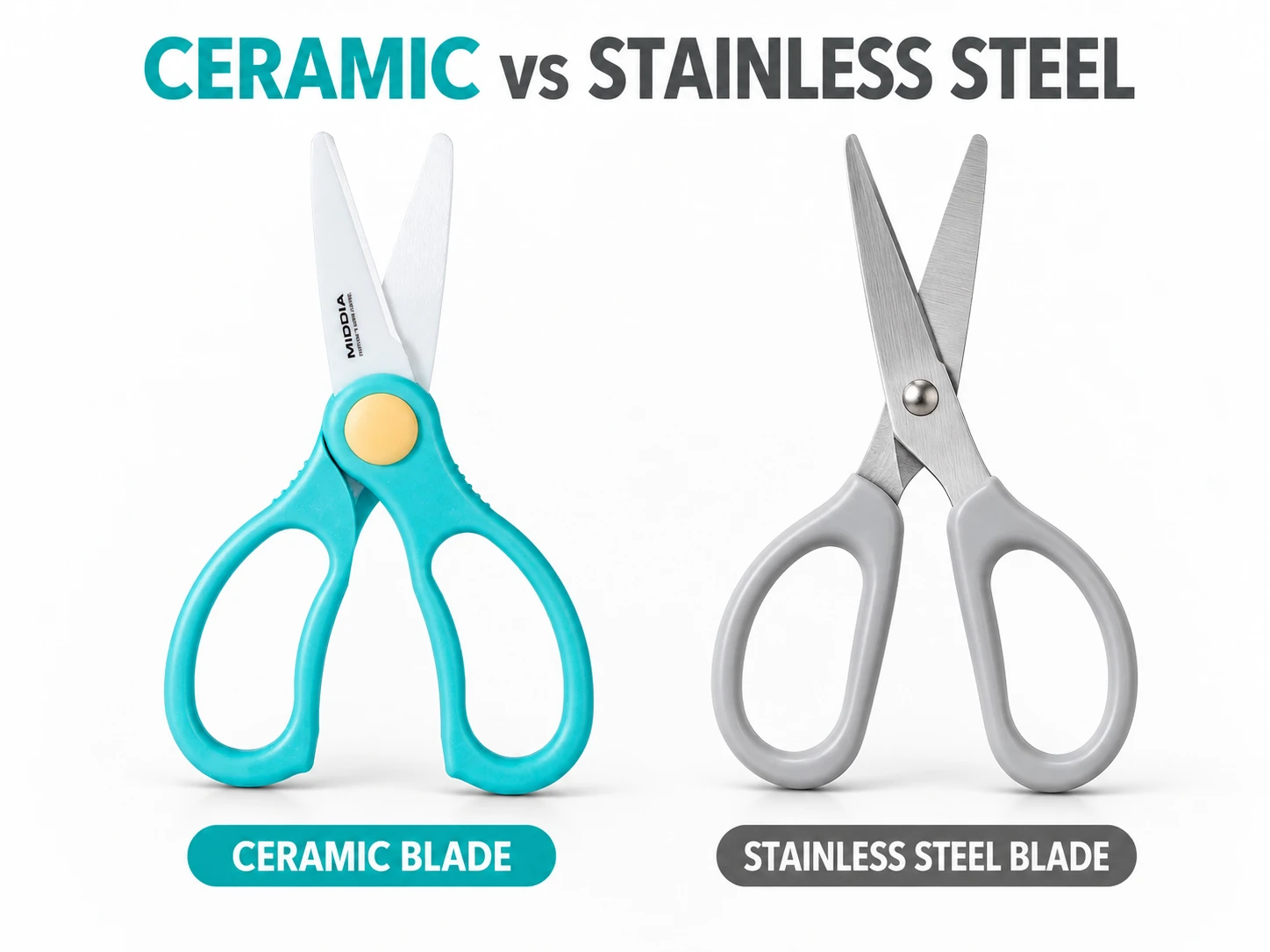
1. Understanding the Materials: Ceramic vs Stainless Steel Blades
Before comparing performance, it is worth understanding what these two materials actually are. The term ceramic can refer to many different materials, just as stainless steel includes numerous grades with different properties. For baby food scissors, the distinction between zirconia ceramic and conventional stainless steel is particularly relevant.
What Are Zirconia Ceramic Baby Food Scissors?
Zirconia ceramic is an advanced technical ceramic made primarily from zirconium dioxide (ZrO₂). Unlike traditional pottery or household ceramics, zirconia is engineered for applications that require high hardness, wear resistance, dimensional stability, and reliable mechanical performance.
The manufacturing process is also different from that of a conventional metal blade. Zirconia powder is prepared and processed into a suitable shape, followed by forming, high-temperature sintering, and precision grinding. Sintering allows the ceramic particles to bond into a dense structure, while subsequent grinding establishes the final blade geometry and cutting edge.
Several material characteristics make zirconia suitable for small food preparation tools:
High hardness: Zirconia is significantly harder than most conventional stainless steels. This contributes to its resistance to surface wear and edge degradation.
Good wear resistance: Under appropriate cutting conditions, a zirconia blade can maintain its cutting characteristics over repeated use.
Excellent corrosion resistance: Zirconia is an oxide ceramic rather than an iron-based metal, so it does not develop conventional iron rust.
Chemical stability: It offers good resistance to many substances encountered during ordinary food preparation.
Non-metallic cutting surface: The blade does not introduce an exposed metallic cutting surface to the food.
These properties make zirconia ceramic interesting for products used around moist food ingredients, including cooked vegetables, fruits, noodles, and other suitable soft foods.
In a finished pair of ceramic baby food scissors, the blade is only one part of the construction. The handle, connecting components, pivot, and protective cover may use different materials. For example, a lightweight PP handle can provide a comfortable grip while keeping the overall product compact.
Buyers should therefore evaluate the complete product rather than assume that the properties of the ceramic blade automatically apply to every component of the scissors.
What Are Stainless Steel Baby Food Scissors?
Stainless steel is an iron-based alloy containing chromium. The chromium content helps create a thin, protective passive layer on the metal surface. This layer is responsible for much of stainless steel's corrosion resistance.
Different stainless steel grades have different compositions and mechanical properties. Some are selected for their corrosion resistance, while others offer a particular balance of hardness, strength, formability, and manufacturing cost.
Stainless steel blades are commonly produced through processes such as stamping, forming, heat treatment, grinding, and polishing. These manufacturing methods allow manufacturers to produce a wide variety of blade shapes and thicknesses.
For baby food scissors, stainless steel offers several practical advantages:
Higher toughness: Stainless steel can generally withstand impact and mechanical deformation better than zirconia ceramic.
Design flexibility: Metal blades can be produced in different geometries and thicknesses to suit various cutting applications.
Mechanical durability: Stainless steel is more forgiving when subjected to accidental bending or twisting.
Wide manufacturing options: Different grades and production methods provide flexibility for different product price ranges.
Established production processes: Stainless steel cutting tools are supported by mature manufacturing and finishing technologies.
However, stainless steel is not completely immune to corrosion. Its performance depends on the steel grade, surface condition, manufacturing quality, and exposure to moisture, salts, and food residues.
Why Does Blade Material Matter in Baby Food Preparation?
Baby food scissors are often used in environments where moisture and food residues are unavoidable. Unlike some general-purpose scissors, they may come into contact with cooked vegetables, fruit pieces, noodles, meat, and other ingredients several times a day.
After cutting, small amounts of food can remain around the blade joint or connecting area. If the scissors are not cleaned properly, these residues may accumulate. Moisture can also remain around the pivot or between closely fitted components.
This makes several material and product design considerations particularly important:
How well does the blade resist corrosion during repeated contact with moist food?
Can food residues be removed easily from the blade and connecting area?
Does the blade maintain its cutting performance after repeated use?
Can the product withstand normal handling and accidental drops?
Is the complete construction suitable for the intended cleaning and storage conditions?
Material selection should never be separated from product design. A well-made stainless steel product may perform better than a poorly designed ceramic one, and the same is true in the opposite direction.
2. Ceramic vs Stainless Steel Baby Food Scissors: A Side-by-Side Comparison
When comparing ceramic and stainless steel baby food scissors, buyers should look beyond a single feature. Hardness, corrosion resistance, toughness, cleaning requirements, and manufacturing cost all influence the finished product.
Key Differences Between Ceramic and Stainless Steel Blades
The following table provides a practical overview of the main differences between zirconia ceramic and stainless steel blades.
| Comparison Factor | Zirconia Ceramic | Stainless Steel |
|---|---|---|
| Main Material | Zirconium dioxide (ZrO₂) | Iron-based chromium alloy |
| Hardness | Very high | Varies by grade and heat treatment |
| Wear Resistance | Generally excellent | Depends on steel grade and heat treatment |
| Rust Resistance | Does not rust like iron-based steel | Corrosion-resistant but not completely rustproof |
| Toughness | Relatively brittle | Generally higher |
| Impact Resistance | Requires careful handling | Generally better |
| Flexibility | Limited; should not be bent or twisted | Can tolerate more deformation |
| Cutting Edge | Can maintain a sharp edge under suitable conditions | Performance depends on steel grade and edge treatment |
| Food Contact Surface | Non-metallic ceramic surface | Metallic surface |
| Cleaning | Smooth blade surface is generally easy to rinse | Easy to clean, with attention to joints and drying |
| Maintenance | Avoid impact and hard materials | Clean and dry after use |
| Manufacturing Cost | Precision ceramic processing may increase cost | Wide range of production costs |
| Typical Application | Rust-resistant food preparation tools | Versatile everyday cutting tools |
One important point: these comparisons describe general material characteristics, not guaranteed performance for every finished product. The actual results depend on material grade, blade thickness, geometry, manufacturing precision, and assembly quality.
Which Material Is Better for Everyday Baby Food Preparation?
For everyday food preparation involving suitable soft ingredients, both materials can work well. The better option depends on what the product is expected to do and how it will be used.
Ceramic is particularly attractive when the product concept emphasizes corrosion resistance, a non-metallic cutting surface, and a blade that requires relatively little attention to rust prevention. This can be useful for compact feeding accessories that are frequently washed and stored between meals.
Stainless steel is more suitable when the product is expected to encounter greater mechanical stress. Its toughness makes it more tolerant of accidental impacts, bending forces, and less careful handling.
It is also worth considering that baby food scissors are not intended to replace kitchen shears or heavy-duty food cutting tools. Their primary purpose is to cut suitable prepared ingredients into smaller portions. Cutting bones, frozen food, hard shells, and other rigid materials is not an appropriate use for either material unless the specific product has been designed and tested for that purpose.
For buyers developing a baby feeding product line, the decision should start with the intended application rather than the assumption that one material is universally superior.
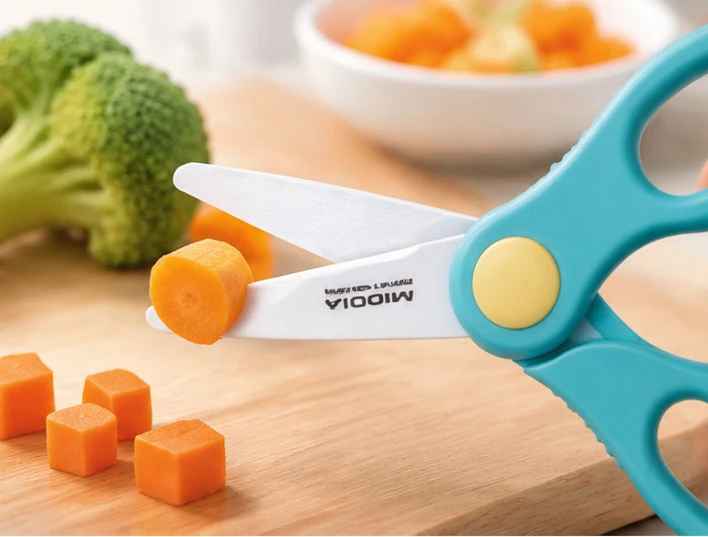
3. Rust Resistance and Food Contact: Does Ceramic Have an Advantage?
Corrosion resistance is one of the clearest differences between zirconia ceramic and stainless steel. It is also an important consideration for products used frequently in kitchens and feeding environments.
Why Zirconia Ceramic Blades Do Not Rust
Zirconia ceramic is chemically different from conventional steel. Its main component, zirconium dioxide, is already an oxide compound. It does not contain an iron-based metallic structure that can undergo the conventional oxidation process responsible for rust formation.
This means a zirconia ceramic blade does not develop the familiar reddish-brown iron rust that may appear on susceptible steel surfaces.
For baby food scissors, this characteristic offers several practical advantages:
The ceramic cutting surface does not require protection against conventional iron rust.
Repeated contact with water does not create the same rusting concern associated with ordinary iron-based metal surfaces.
Moist fruit and vegetable residues are less likely to create rust-related problems on the ceramic blade itself.
The blade surface can be rinsed after food preparation without the same concern about iron oxidation.
However, buyers should distinguish between the ceramic blade and the complete scissors. Metal pins, connecting components, springs, or other exposed parts may still require corrosion-resistant materials and suitable surface treatment.
Good product construction remains important even when the main blade is ceramic.
Can Stainless Steel Baby Food Scissors Rust?
Stainless steel is designed to resist corrosion, but the word stainless does not mean that the material can never rust.
Its corrosion resistance comes largely from the chromium-rich passive layer on the surface. Under normal conditions, this layer helps protect the underlying metal. However, certain environments can reduce its effectiveness or cause localized corrosion.
Several factors may affect the corrosion resistance of stainless steel baby food scissors:
Steel grade: Different grades have different alloy compositions and corrosion resistance.
Salt exposure: Chloride-containing substances can increase the risk of localized corrosion.
Food residues: Some acidic or salty food residues may affect the blade surface if left for extended periods.
Surface condition: Scratches, damaged finishes, and surface contamination can influence corrosion behavior.
Moisture retention: Water trapped around blade joints and connecting components may create unfavorable conditions.
Cleaning practices: Improper cleaning and prolonged wet storage can contribute to corrosion problems.
High-quality stainless steel with an appropriate grade and finish can provide excellent corrosion resistance. The point is not that stainless steel is unsuitable for baby food scissors, but that its corrosion resistance depends on material selection and maintenance.
Does Blade Material Affect Food Preparation?
Both zirconia ceramic and stainless steel can be used in food-contact applications. However, the material name alone does not establish that a finished product is suitable for every food-contact application.
For ceramic blades, buyers should consider the composition and quality of the ceramic material, manufacturing consistency, surface condition, and the possibility of physical damage.
For stainless steel blades, the steel grade, surface finish, corrosion resistance, and manufacturing quality are important considerations.
The complete product may also include plastic handles, connecting components, coatings, adhesives, and protective covers. These parts should be evaluated separately according to their intended contact with food and applicable regulatory requirements.
For brands selling baby feeding accessories, relevant documentation is an important part of product evaluation. Depending on the destination market, buyers may need to review food-contact material reports, applicable migration testing, and other product compliance documents.
MIDDIA provides FDA- and LFGB-related documentation for its relevant product offerings. Buyers can request the applicable reports to check the tested materials, product components, and scope of the documentation before placing an order.
It is important to distinguish between regulatory compliance, material testing, and product certification. They are not interchangeable terms, and the exact claims used on packaging or marketing materials should match the available documentation.
4. Hardness vs Toughness: Is a Ceramic Blade More Fragile?
This is probably the most important technical question when comparing ceramic and stainless steel baby food scissors.
Many buyers associate high hardness with high durability. That assumption is understandable, but it is not technically correct. Hardness and toughness measure different material properties.
A material can be extremely hard and resistant to scratching while still being relatively vulnerable to impact or sudden fracture. This is one of the main characteristics buyers need to understand when considering zirconia ceramic blades.
Why Zirconia Ceramic Is Extremely Hard
Zirconia is known for its high hardness and resistance to abrasive wear. These properties make it suitable for precision cutting applications where maintaining the condition of the cutting edge is important.
Compared with many conventional stainless steels, zirconia ceramic has a much harder surface. This can help reduce gradual edge wear when the blade is used under appropriate conditions.
For baby food scissors, this is useful because the cutting edge is relatively small and designed for repeated cutting of suitable food ingredients.
However, high hardness should not be interpreted as an ability to cut every type of material. A ceramic blade is not designed for unrestricted use against hard or rigid objects.
Why Ceramic Blades Need Careful Handling
The main limitation of zirconia ceramic is its relatively low fracture toughness compared with stainless steel.
Unlike metal, which can deform to absorb some impact energy, ceramic materials generally have less capacity to undergo plastic deformation before fracture. A sufficiently strong impact or concentrated stress can cause cracking or chipping.
Several situations may increase the risk of ceramic blade damage:
Dropping the scissors onto a hard tile or concrete floor.
Twisting the blades while cutting food.
Using the scissors on bones, hard shells, frozen ingredients, or other unsuitable materials.
Applying excessive sideways pressure to the cutting edge.
Storing the product without adequate blade protection.
These limitations do not make ceramic unsuitable for baby food scissors. They simply mean the product must be designed for its intended use and accompanied by clear handling instructions.
For everyday feeding preparation, users generally need a compact tool for cutting suitable cooked or soft ingredients into smaller portions. Heavy-duty cutting is a different application and should not be expected from a small ceramic baby food scissors design.
How Does Stainless Steel Compare in Toughness?
Stainless steel has a significant advantage in mechanical toughness. Its metallic structure allows it to absorb more energy through deformation before failure.
This makes stainless steel blades more tolerant of accidental bending, twisting, and impact. If a pair of scissors is dropped or subjected to mechanical stress, a stainless steel blade is generally less likely to fracture suddenly than a comparable ceramic blade.
Metal blades can also be manufactured with different thicknesses and geometries to balance cutting performance and structural strength.
However, stainless steel is not indestructible. A thin or poorly manufactured blade may bend, become misaligned, or suffer damage. Its cutting edge can also become dull through repeated use.
In other words, greater toughness does not automatically mean better cutting performance or longer edge life in every application. Buyers should consider the entire performance profile.
What Does SGS 1M Drop Testing Mean for Ceramic Baby Food Scissors?
For a product containing a ceramic blade, structural durability deserves particular attention. A ceramic cutting edge may offer excellent hardness, but the finished scissors must also withstand the handling conditions expected during normal use.
This is why product-level testing can provide useful information for buyers.
MIDDIA's ceramic baby food scissors have undergone an SGS 1-meter drop test. This provides an additional reference point for evaluating product durability under the specified test conditions.
Drop testing is relevant to portable baby feeding accessories because these products may be handled frequently, carried in feeding bags, or accidentally dropped during everyday use.
When reviewing a drop-test result, buyers should pay attention to several details:
The exact product model covered by the report.
The specified drop height and test method.
The number of drops and tested orientations.
The condition of the product after testing.
The acceptance criteria used in the test.
A passed 1-meter drop test should be understood within the scope of the actual test report. It does not mean that a ceramic blade is unbreakable or that the scissors can withstand every possible impact.
For distributors and baby product brands, the availability of relevant third-party test documentation makes it easier to evaluate a product before adding it to a commercial range.
Buyers interested in MIDDIA ceramic baby food scissors can request the relevant SGS test report and confirm the applicable product model and testing scope during sample evaluation.
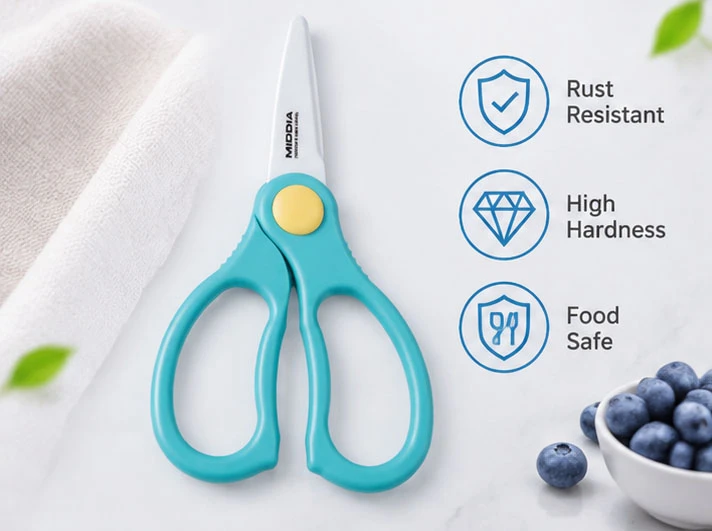
5. Cleaning and Maintenance: Which Baby Food Scissors Are Easier to Maintain?
Cleaning requirements are sometimes overlooked during product selection. Yet for a tool used around food, daily maintenance can influence customer satisfaction just as much as the blade material itself.
Both ceramic and stainless steel baby food scissors can be cleaned relatively easily when they are designed properly. The main differences relate to corrosion concerns, handling requirements, and the construction of the blade joint.
Cleaning Zirconia Ceramic Baby Food Scissors
Zirconia ceramic has a smooth, non-metallic surface that can generally be rinsed easily after cutting food. Food residues should still be removed promptly, especially around the blade connection and pivot.
For normal cleaning, users should follow the manufacturer's instructions. In general, the following practices are useful:
Rinse the blades after each use to remove food residues.
Pay attention to the area around the pivot and connecting parts.
Use a suitable cleaning method without striking the ceramic blade against hard surfaces.
Dry the product before storing it.
Use the protective cover when the scissors are not in use, if one is provided.
Although zirconia itself has good heat resistance, the complete scissors may contain plastic handles, adhesives, connecting parts, or other components with different temperature limitations.
For this reason, buyers should not assume that every ceramic baby food scissors product is suitable for boiling-water sterilization, steam sterilization, or dishwasher cleaning. The approved cleaning methods depend on the complete product construction.
Cleaning Stainless Steel Baby Food Scissors
Stainless steel scissors are also relatively straightforward to clean. Their metallic blades can be rinsed with water and cleaned using a suitable detergent.
However, cleaning should include the areas where food residues may accumulate. The blade joint is particularly important because small particles can remain trapped between closely fitted components.
For better long-term maintenance:
Remove food residues soon after use.
Clean around the blade joint and pivot.
Rinse away cleaning products thoroughly.
Dry the scissors before storage.
Avoid leaving the product submerged in water for extended periods.
These steps help maintain the surface condition and reduce unnecessary corrosion risks, even when the scissors are made from corrosion-resistant stainless steel.
What Should Buyers Consider When Evaluating Maintenance Requirements?
For retailers and product developers, ease of cleaning is not determined by blade material alone. The design of the complete scissors has a major influence.
For example, a product with a narrow connecting gap may be more difficult to clean than one with an accessible pivot. A detachable design may offer additional cleaning convenience, but it also introduces assembly and component-retention considerations.
When evaluating samples, buyers should examine:
Whether food particles can accumulate around the pivot.
Whether the blades open sufficiently for cleaning.
Whether the handle has grooves or recesses that trap food residues.
Whether a protective blade cover is included.
Whether the complete product has clear washing and storage instructions.
A well-designed product should make routine cleaning simple without requiring users to understand complicated maintenance procedures.
6. Cost and Product Positioning: Which Material Fits Your Baby Product Market?
For baby product brands, distributors, and purchasing managers, material selection is also a commercial decision. The final product must fit the intended retail price, target customer, distribution channel, and expected product features.
It is tempting to compare ceramic and stainless steel based only on raw material prices. In reality, the manufacturing processes and quality requirements are different, so the finished product cost depends on several factors.
Cost Factors of Ceramic Baby Food Scissors
Zirconia ceramic blades require specialized manufacturing processes. The cost of a finished blade is influenced by more than the price of the raw powder.
Important cost factors include:
Raw material quality: Zirconia powder specifications and material consistency influence the quality of the finished ceramic component.
Forming and sintering: Ceramic production involves controlled processing and high-temperature sintering.
Precision grinding: The blade geometry and cutting edge require suitable grinding and finishing processes.
Quality inspection: Dimensional consistency, surface defects, and blade quality need to be controlled.
Product assembly: The ceramic blade must be integrated properly with the handle and connecting structure.
Testing and documentation: Relevant product testing and compliance documentation may add to development and quality assurance costs.
These processes can make zirconia ceramic products more specialized than conventional metal cutting tools. However, actual pricing depends on product design, production volume, quality requirements, and the manufacturer's manufacturing capabilities.
For brands targeting customers who value rust resistance and differentiated product features, the additional manufacturing requirements may be justified by the overall product positioning.
Cost Factors of Stainless Steel Baby Food Scissors
Stainless steel manufacturing is supported by mature industrial processes, but product costs can still vary significantly.
Some of the main factors include:
Stainless steel grade and material thickness.
Stamping, cutting, and forming processes.
Heat treatment and hardness requirements.
Blade grinding and polishing.
Corrosion-resistance requirements and surface finishing.
Handle materials and assembly complexity.
A basic stainless steel product may be relatively economical to produce, while a precision-designed model using a higher-grade steel and more elaborate finishing can have a substantially different cost structure.
Therefore, buyers should compare products with similar specifications rather than assuming that every stainless steel scissors product is less expensive than a ceramic alternative.
Which Material Fits Different Baby Product Market Segments?
Different retail markets have different priorities. Some focus on affordable everyday feeding accessories, while others emphasize premium materials, appearance, and product differentiation.
The following table provides a starting point for product positioning.
| Target Market | Potential Material Choice | Product Positioning |
|---|---|---|
| Everyday baby feeding accessories | Ceramic or stainless steel | Practical food preparation and ease of use |
| Premium baby care products | Zirconia ceramic | Rust-resistant, non-metallic cutting surface |
| Portable feeding kits | Both | Compact design and convenient storage |
| Value-oriented retail products | Stainless steel or ceramic | Balance between cost and product features |
| Premium gift and feeding sets | Both | Appearance, packaging, and product differentiation |
| Products intended for heavier cutting tasks | Stainless steel | Greater mechanical toughness |
These are general positioning suggestions rather than fixed rules. A ceramic product does not automatically belong in a premium category, and stainless steel is not limited to entry-level products.
Brand identity, handle design, packaging, product testing, distribution costs, and retail strategy all influence the final market position.
For example, a baby feeding brand may choose ceramic scissors as part of a coordinated feeding accessory collection, using the non-metallic blade and rust-resistant properties as product differentiators. Another brand may prefer stainless steel because it already has an established range of metal feeding tools and wants to maintain consistency across its products.
Both strategies can make commercial sense when the material matches the target customer and product concept.
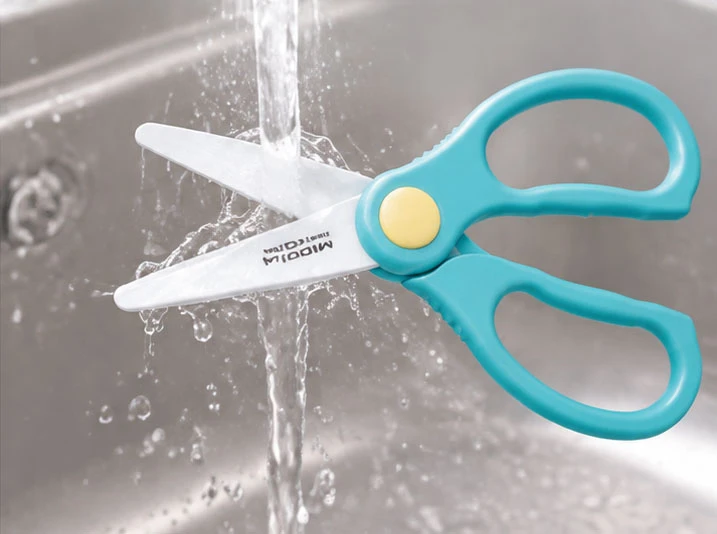
7. How to Choose the Right Material for Your Baby Food Scissors Product Line
Once the material differences are clear, the next step is to evaluate them against your actual product requirements. For distributors and brand owners, this is more useful than selecting a material simply because it is currently popular.
Choose Ceramic When Your Priorities Include:
Rust resistance: You want a blade material that does not develop conventional iron rust during normal food preparation.
Non-metallic cutting surfaces: Your product concept emphasizes zirconia ceramic rather than a conventional metal blade.
Moisture-related applications: The product will frequently come into contact with water, fruits, vegetables, and other moist ingredients.
Wear resistance: You want a hard cutting material with good resistance to abrasive wear.
Product differentiation: Your brand wants to offer an alternative to the many conventional stainless steel feeding accessories on the market.
However, ceramic should be selected with a clear understanding of its impact limitations. The product design, protective cover, user instructions, and testing program should reflect the characteristics of the material.
Choose Stainless Steel When Your Priorities Include:
Mechanical toughness: The scissors may experience more frequent impact or mechanical stress.
Greater deformation tolerance: The blade needs to withstand more bending and twisting than a ceramic blade can reasonably tolerate.
Broader cutting applications: The product is intended for a wider range of cutting tasks, within the limits of its design.
Manufacturing flexibility: You want to explore different metal blade thicknesses, shapes, and finishing options.
Cost planning: Your product line needs a particular balance of material cost, production volume, and retail pricing.
Stainless steel is not automatically the better choice for every everyday feeding accessory. Its suitability still depends on the grade, surface quality, and overall construction.
Questions Buyers Should Ask Before Selecting a Supplier
Regardless of the material, a supplier should be able to explain how the product is made and what evidence supports its quality claims.
Before evaluating a baby food scissors supplier, buyers should ask:
What material and grade are used for the blades?
Can the supplier provide relevant food-contact material or product test documentation?
Has the finished product undergone appropriate durability testing?
Are samples available for cutting, cleaning, and construction evaluation?
Can the supplier support different handle colors, packaging, and private-label requirements?
These questions help establish whether the supplier can provide a product that meets your requirements, rather than simply offering an attractive catalog image.
For an initial evaluation, requesting physical samples is often the most useful step. Buyers can inspect the blade finish, handle construction, opening and closing action, cutting performance, and cleaning accessibility before making a sourcing decision.
8. Why Consider MIDDIA Ceramic Baby Food Scissors?
For brands and distributors considering zirconia ceramic baby food scissors, product construction and manufacturing consistency deserve as much attention as the material itself.
MIDDIA focuses on ceramic cutting products and offers ceramic baby food scissors designed for compact, everyday food preparation. The product range provides an alternative to conventional stainless steel baby feeding scissors, particularly for buyers interested in rust-resistant ceramic blades and differentiated product features.
Zirconia Ceramic Blades for Everyday Food Preparation
MIDDIA ceramic baby food scissors use zirconia ceramic blades, offering the material advantages discussed throughout this guide.
The ceramic cutting surface is resistant to conventional rust formation and provides high hardness and good wear resistance. These characteristics make it suitable for cutting appropriate soft food ingredients into smaller portions during routine food preparation.
Depending on the selected model, buyers can evaluate different blade sizes and product configurations. Compact designs are particularly relevant for baby feeding accessories that need to fit into kitchen storage areas or portable feeding kits.
The handle and connecting structure also play an important role. A comfortable grip, practical opening and closing action, and suitable blade protection contribute to the overall user experience.
Product Testing and Food-Contact Documentation
Material properties are important, but professional buyers also need evidence that supports the product's quality and intended use.
MIDDIA's relevant ceramic baby food scissors products have undergone an SGS 1-meter drop test. This provides buyers with a reference for evaluating the tested product's durability under the conditions specified in the report.
In addition, MIDDIA provides FDA- and LFGB-related documentation for relevant products and materials. Buyers can request the applicable reports to review the tested components, test items, and scope before making a purchasing decision.
For baby product brands, having these documents available can support internal product evaluation and help identify which additional testing or compliance steps may be required for the destination market.
It is important to evaluate documentation at the correct level. A report covering a particular plastic component, for example, should not be interpreted as proof that every component of the finished scissors has been tested under the same conditions.
Product Options for Retailers, Distributors and Baby Brands
Different markets often require different product appearances and packaging formats. Retailers may need a simple retail-ready product, while established baby brands may want a model that fits an existing product collection.
Depending on the selected model and order requirements, MIDDIA can discuss product options such as:
Different handle color selections.
Protective blade covers.
Compact product configurations.
Customized logo applications.
Retail and private-label packaging options.
For buyers who are still comparing ceramic and stainless steel products, starting with a sample is a practical way to assess whether the ceramic option fits their market.
Rather than making a decision based entirely on specifications, evaluate the actual scissors, review the relevant test documents, and consider how the product will be presented to your customers.
If you are developing a new baby feeding accessory range or looking for a ceramic alternative to conventional metal scissors, MIDDIA can help you explore suitable product options.
9. Frequently Asked Questions About Ceramic vs Stainless Steel Baby Food Scissors
Q1. Are Ceramic Baby Food Scissors Better Than Stainless Steel?
Neither material is universally better. Ceramic offers excellent rust resistance, high hardness, and a non-metallic cutting surface. Stainless steel provides greater toughness and impact resistance. The right choice depends on the intended food preparation tasks, product construction, maintenance expectations, and target market.
Q2. Do Ceramic Baby Food Scissors Rust?
Zirconia ceramic does not rust like iron-based steel because it is an oxide ceramic rather than a conventional metal. However, the complete scissors may contain other metal components. Buyers should evaluate the corrosion resistance of the entire product, not only the ceramic blade.
Q3. Are Zirconia Ceramic Scissors Safe for Cutting Baby Food?
Zirconia ceramic can be used in food-contact cutting applications when the material and finished product meet the relevant requirements. Buyers should review applicable food-contact documentation, manufacturing quality, blade design, and product testing. Correct use and cleaning instructions are also important.
Q4. Can Ceramic Baby Food Scissors Break Easily?
Ceramic is very hard but has lower fracture toughness than stainless steel. It can be damaged by strong impact, twisting, or cutting unsuitable hard materials. Product-level testing, appropriate blade construction, protective covers, and correct handling instructions help manage these risks.
Q5. Can Ceramic Baby Food Scissors Be Sterilized?
It depends on the complete product construction. Although zirconia ceramic itself has excellent heat resistance, plastic handles, adhesives, and connecting components may have different temperature limitations. Always follow the manufacturer's instructions for boiling, steam sterilization, dishwasher cleaning, or other disinfection methods.
Q6. Are Stainless Steel Baby Food Scissors Rustproof?
Stainless steel is corrosion-resistant, but it is not completely immune to rust. Its performance depends on the steel grade, surface condition, exposure to moisture and salts, and maintenance practices. Cleaning and drying the scissors after use help maintain their condition.
Q7. Which Is More Suitable for Baby Food Scissors: Ceramic or Stainless Steel?
Ceramic is a good option when rust resistance, a non-metallic cutting surface, and wear resistance are important priorities. Stainless steel is generally more suitable when impact resistance and mechanical toughness are more important. Buyers should select the material according to the product's intended application rather than relying on hardness alone.
Q8. Can Retailers and Baby Product Brands Request Ceramic Baby Food Scissors Samples?
Yes. Retailers, distributors, and baby product brands can contact MIDDIA to discuss available ceramic baby food scissors models and sample arrangements. Samples allow buyers to inspect product construction, cutting performance, handle design, and packaging options before proceeding with a larger sourcing decision.
Choosing the Right Blade Material for Your Baby Food Scissors Range
The comparison between ceramic and stainless steel baby food scissors is not simply a question of which material is stronger, sharper, or more expensive. Each material offers a different combination of properties, and those differences should guide product development and purchasing decisions.
Zirconia ceramic stands out for its high hardness, wear resistance, chemical stability, and resistance to conventional rust formation. These characteristics make it an attractive option for baby food preparation tools where a non-metallic cutting surface and low-maintenance blade material are valued.
Stainless steel remains a practical choice because of its toughness, impact resistance, and broad manufacturing flexibility. It may be more appropriate for products that need to tolerate greater mechanical stress or serve a wider range of cutting applications.
For baby product retailers, distributors, and brand owners, the best approach is to evaluate the material alongside the complete product design, test documentation, cleaning requirements, and intended retail positioning.
If you are considering adding ceramic baby food scissors to your product range, MIDDIA welcomes sample inquiries from international buyers. You can review the available models, evaluate their construction, and request relevant SGS drop-test and FDA/LFGB-related documentation before deciding whether they fit your market.
Request Ceramic Baby Food Scissors Samples
Looking for a rust-resistant alternative to conventional stainless steel baby food scissors? Explore MIDDIA's zirconia ceramic baby food scissors and evaluate their blade quality, product construction, and everyday food preparation performance.
We welcome inquiries from baby product retailers, distributors, brand owners, and importers interested in product samples, relevant test documentation, and private-label options.
Zirconia ceramic blade options
SGS 1-meter drop-test results for the applicable tested model
FDA- and LFGB-related documentation for relevant products and materials
Handle color, logo, and packaging customization discussions