
Preparing meals for a baby often involves more than cooking healthy ingredients. Food needs to be served in a texture, shape, and portion size that match the child's current eating abilities. A piece of steamed carrot that is easy for an adult to eat may still need to be cut into smaller portions before it is served to a baby. The same applies to cooked vegetables, fruit, pasta, fish, and other everyday foods.
So, what are baby food scissors used for? They are compact food preparation tools designed to cut suitable foods into smaller portions for babies and toddlers. Parents and caregivers commonly use them when preparing homemade meals, adjusting food at the dining table, or serving meals away from home. Compared with carrying a large kitchen knife and cutting board, a dedicated pair of baby food cutting scissors can make small, everyday food preparation tasks more convenient.
Some models use stainless steel blades, while others feature zirconia ceramic blades. Ceramic baby food scissors offer a non-metallic, rust-resistant cutting alternative, which may appeal to families looking for practical feeding accessories with different material characteristics.
In this guide, we will look at what baby feeding scissors actually do, which foods they can cut, where they are useful, and what parents and product buyers should consider when choosing a suitable model. We will also introduce the material features and product testing considerations behind MIDDIA ceramic baby food scissors.
1. What Are Baby Food Scissors?
1.1 Understanding Baby Food Cutting Scissors
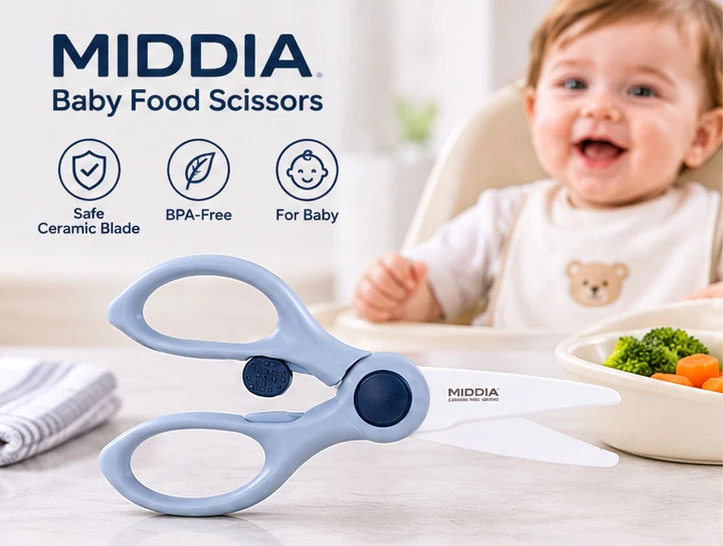
Baby food scissors are small scissors designed to help adults prepare food for babies and young children. Their main purpose is simple: cutting suitable cooked or soft foods into smaller, manageable portions before serving.
For example, a parent may prepare steamed broccoli for lunch but find that some florets are still too large for the baby's current feeding stage. A pair of baby food cutting scissors can be used to divide the florets into smaller pieces. The same tool can be useful for shortening soft noodles, cutting cooked vegetables, or portioning tender fish after all bones have been removed.
Most baby food scissors have two cutting blades, finger handles, and, depending on the design, a protective cover or sheath. Some products are made with stainless steel blades, while ceramic versions use zirconia blades. Handle materials also vary. Food-contact-grade plastics such as PP and PBT are commonly used in compact feeding accessories because they allow manufacturers to develop lightweight handles in different shapes and colors.
One point is worth making clear: baby food scissors are normally operated by an adult. They are not toys and should not be handed to a baby as a self-feeding utensil. Their purpose is to help caregivers prepare food more conveniently, not to replace adult supervision or appropriate food preparation practices.
1.2 How Are Baby Food Scissors Different from Regular Kitchen Scissors?
Regular kitchen scissors can certainly cut many types of food. In fact, some families already use them for preparing noodles, herbs, or cooked vegetables. The difference is that dedicated baby food scissors are designed with smaller-scale food preparation and convenient storage in mind.
A full-size kitchen scissors may be unnecessarily large for cutting a few pieces of soft food at a restaurant table. A compact feeding scissors model is easier to keep in a baby feeding bag, provided it has a suitable protective cover and is stored properly.
| Comparison | Baby Food Scissors | Regular Kitchen Scissors |
|---|---|---|
| Primary purpose | Preparing smaller portions of suitable baby and toddler foods | General kitchen cutting tasks |
| Size and handling | Often compact and lightweight | Varies from small to full-size |
| Blade materials | May use stainless steel or zirconia ceramic | Commonly stainless steel or other metals |
| Protective cover | Available on many portable models | Less common |
| Portability | Often designed for feeding bags and travel | Depends on the individual design |
| Typical application | Cutting suitable cooked foods into smaller portions | General food preparation and household use |
Neither type automatically makes food safer. The actual safety of a meal depends on the ingredients, cooking method, texture, portion size, the child's developmental stage, and how an adult prepares and serves it. A dedicated pair of baby feeding scissors is primarily a convenience tool with a more specific application.
1.3 Who Uses Baby Feeding Scissors?
Parents preparing homemade baby food are the most obvious users, but they are not the only ones.
Parents and caregivers: For preparing daily meals, adjusting food portions, and handling suitable foods at the dining table.
Families with toddlers: For cutting pasta, cooked vegetables, pancakes, and other foods into manageable portions.
Traveling families: For preparing suitable meals at restaurants, hotels, relatives' homes, or outdoor dining locations.
Daycare and childcare providers: Where permitted by their food preparation procedures, dedicated scissors can be part of an adult-operated meal preparation kit.
Baby product retailers and distributors: For expanding their product selection with practical feeding accessories.
For baby care brands, the category also has a clear product positioning. Baby food scissors complement feeding bowls, plates, spoons, food storage containers, and other weaning accessories. They address a specific everyday task that parents can easily understand.
2. What Are Baby Food Scissors Used For?
The most common use of baby food scissors is cutting suitable foods into smaller portions during meal preparation. However, not every food is appropriate for scissors, and not every food becomes safe simply because it has been cut into small pieces. Softness, shape, preparation method, and the baby's feeding abilities all matter.
2.1 Cutting Cooked Vegetables into Small Pieces
Vegetables are an important part of many homemade baby meals. Depending on the child's age and developmental stage, parents may serve steamed, boiled, or otherwise properly cooked vegetables in different textures.
Baby food cutting scissors can help with foods such as:
Steamed carrots that have been cooked until appropriately soft.
Cooked broccoli florets without tough stems.
Soft potatoes and sweet potatoes.
Cooked pumpkin or squash.
Well-cooked zucchini.
Other vegetables prepared to a suitable texture.
Consider steamed carrots as an example. A whole cooked carrot may still be difficult for a young child to manage. An adult can use feeding scissors to cut it into smaller portions or suitable shapes according to the child's feeding development. The same approach works for soft broccoli florets, cooked pumpkin, and other vegetables.
The advantage is not that scissors make cooking unnecessary. Vegetables still need to be washed and cooked appropriately. Scissors simply provide another way to adjust their size after cooking.
2.2 Cutting Soft Fruits for Baby Meals
Fruit is another common part of baby meals and snacks. Soft fruit can be easier to prepare with compact scissors than with a larger kitchen knife, especially when only a small portion is needed.
Examples include:
Ripe bananas.
Soft, properly prepared pears.
Ripe peaches without pits.
Cooked apples that have softened sufficiently.
Other soft fruits suitable for the child's feeding stage.
For instance, a caregiver may want to divide a ripe banana into smaller portions for a meal. A compact pair of baby feeding scissors can handle this type of task without requiring a large preparation area.
However, fruit preparation still requires attention. Some fruits have skins, pits, seeds, or firm textures that need to be removed or handled separately. Grapes and similar round foods require particular care because their shape can present a choking risk. Simply cutting them with scissors does not guarantee a safe serving. Follow age-appropriate food preparation guidance and check the final texture and shape before serving.
2.3 Snipping Pasta, Noodles, and Other Cooked Foods
Pasta and noodles can be awkward to serve to young children. Long strands may need to be shortened, and some pasta shapes may be easier to manage when divided into smaller portions.
Baby food scissors can be useful for:
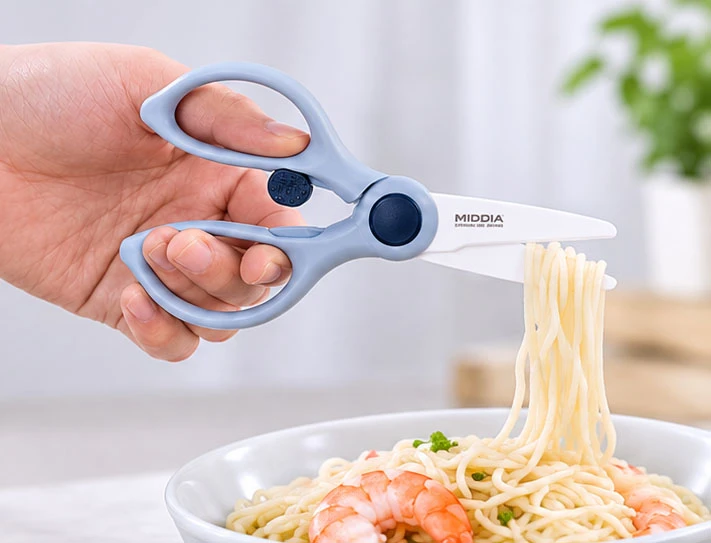
Shortening soft cooked noodles.
Cutting well-cooked pasta into smaller portions.
Dividing soft pancakes into strips or manageable pieces.
Preparing suitable rice-based foods.
Adjusting the portion size of other soft cooked dishes.
This is particularly convenient when a family is eating together. Instead of preparing a separate meal with entirely different equipment, an adult can sometimes adapt part of the family's food for the child, provided the ingredients, seasoning, texture, and shape are appropriate.
For foods with sticky or dense textures, it is useful to clean the blades promptly after cutting. Food residue can collect around the blade connection or other small spaces. Proper cleaning is part of normal maintenance, especially when scissors are used several times a day.
2.4 Preparing Fish, Meat, and Other Protein Foods
Protein foods can also be prepared with baby food scissors, but this is an area where adults should be especially careful about the condition of the ingredients.
Examples of suitable foods may include:
Fully cooked fish after all bones have been carefully removed.
Tender, fully cooked chicken.
Soft, well-cooked meat.
Other appropriately prepared protein foods.
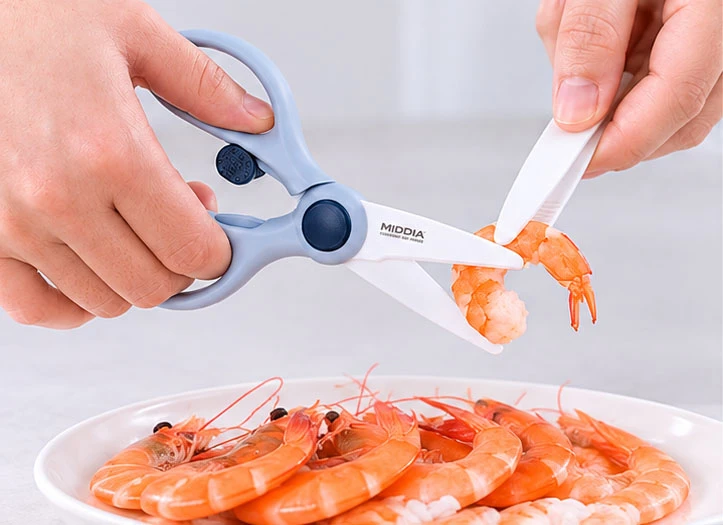
A caregiver may use scissors to divide a small portion of cooked chicken into manageable pieces. Soft cooked fish can also be separated into smaller portions after checking it thoroughly for bones.
Do not use ordinary compact feeding scissors to cut through bones, shells, hard cartilage, or frozen food. These materials may damage the cutting edges or cause the tool to slip. If the food is too firm for the scissors to cut comfortably, use an appropriate kitchen tool before serving.
It is also important to distinguish between cutting and checking. Scissors can divide food, but they cannot reliably identify every hidden bone or hard fragment. Adults must inspect the food before it reaches the child's plate.
2.5 Adjusting Food Portions During Different Feeding Stages
Babies do not all develop feeding skills at exactly the same pace. Their ability to handle different food textures and shapes changes over time. This is why food preparation should be based on the child's individual development rather than a single fixed portion size.
When introducing solid foods, caregivers should follow appropriate professional feeding guidance and prepare foods in suitable textures. As the child develops, the way food is served may change. Some meals may require softer textures, while others may be prepared in shapes that support developing self-feeding skills.
Baby food scissors offer flexibility during these changes. A parent can use the same tool to shorten noodles, divide soft vegetables, or prepare a small portion of cooked food for a toddler.
Still, smaller pieces do not automatically mean lower choking risk. Food shape, firmness, stickiness, and the child's ability to chew and swallow are all relevant. Always supervise children while eating and use recognized age-appropriate food preparation recommendations.
3. Where Can Baby Food Scissors Be Used?
Baby food scissors are not limited to the home kitchen. Their compact size and protective storage design make them practical for families who prepare meals in different places.
3.1 At Home: Everyday Baby Meal Preparation
Home is where most baby food scissors are used. Parents may prepare several ingredients at once, then use the scissors to adjust individual portions before serving.
For example, a family may cook carrots, broccoli, potatoes, and chicken for dinner. Adults can serve their own portions while preparing a separate, age-appropriate portion for the baby. A compact pair of feeding scissors makes it easier to handle small cutting tasks without taking out a large kitchen knife every time.
They can also be useful at the dining table when a toddler needs a little help with suitable food portions. However, food should be placed on a stable surface, and the scissors should remain under adult control throughout the process.
3.2 At Restaurants: Preparing Food While Dining Out
Eating outside the home can make baby meal preparation less convenient. Restaurant meals are usually prepared for adults, so the food may need to be adjusted before a young child can eat it.
Portable baby food scissors can help caregivers shorten suitable noodles, divide soft cooked vegetables, or prepare smaller portions of tender foods. This can be more convenient than carrying a full set of kitchen utensils.
A protective cover is particularly useful in this situation. When the scissors are not being used, the blades can be covered before the tool is returned to a feeding bag. The cover also helps reduce contact between the blades and other stored items.
Parents should still check restaurant ingredients carefully. Foods that are heavily seasoned, very hot, too firm, or unsuitable for the child's developmental stage should not be served simply because they can be cut into smaller pieces.
3.3 During Travel and Outdoor Activities
Family trips, picnics, hotel stays, and visits to relatives often involve meals prepared away from the usual kitchen. A compact pair of baby food scissors can be a useful addition to a travel feeding kit.
Some practical situations include:
Preparing suitable food portions during a family holiday.
Adjusting soft foods at a picnic or outdoor meal.
Preparing a toddler's portion while visiting relatives.
Keeping a compact feeding tool in a properly organized baby care bag.
When choosing a travel model, consider the blade cover, overall size, handle design, and cleaning requirements. A protective cover is useful, but it does not replace proper cleaning. Scissors should be cleaned and dried according to the product instructions before being stored for the next use.
For parents who frequently travel with young children, portability is not just a marketing feature. It is a practical part of deciding whether a feeding accessory will actually be used regularly.
4. Why Choose Ceramic Baby Food Scissors?
Not all baby food scissors use the same blade material. Stainless steel is a familiar option in kitchen tools, but zirconia ceramic has become an alternative for products designed around non-metallic cutting surfaces.
Ceramic baby food scissors combine a zirconia blade with a handle structure designed for everyday food preparation. The material has several characteristics worth understanding before choosing a product.
4.1 Zirconia Ceramic Blades: A Non-Metallic Cutting Alternative
Zirconia is a technical ceramic material used in a range of precision components and cutting applications. When processed and finished appropriately, zirconia ceramic can provide a hard, wear-resistant cutting edge.
For baby food scissors, one of its most recognizable characteristics is that the blade is non-metallic. Unlike conventional steel blades, zirconia ceramic does not form iron-based rust. This makes it an interesting option for buyers who prefer a rust-resistant cutting material.
There are also practical differences in everyday food preparation:
Non-metallic blade: The cutting edge is made from zirconia ceramic rather than a metal alloy.
Rust resistance: The ceramic blade does not develop iron-based rust in the way ordinary steel can.
Low metallic interaction: The blade does not introduce metallic taste from an oxidizing steel cutting surface.
Hard cutting surface: Zirconia ceramic offers good hardness and wear resistance when manufactured to suitable specifications.
Lightweight product design: Ceramic blades can be incorporated into compact feeding scissors with lightweight handles.
These characteristics do not mean ceramic is indestructible. Zirconia ceramic is hard, but it can be brittle under impact or improper loading. It should not be used to cut bones, frozen foods, or other hard materials outside the product's intended application. Avoid twisting the blades or using them as a lever.
For families, the key point is that ceramic offers a different combination of material properties. For retailers and baby product brands, it also creates a clear product distinction within a feeding accessories category that often contains conventional metal scissors.
4.2 Rust Resistance and Everyday Food Preparation
Food preparation tools are exposed to moisture, food residue, and repeated cleaning. These conditions make blade material an important consideration.
Because zirconia ceramic is not an iron-containing steel, the ceramic blade itself does not rust in the conventional sense. This is one reason ceramic cutting tools are often considered by people looking for a low-rust-maintenance alternative.
For everyday baby meal preparation, this can be convenient. Parents may use the scissors to cut cooked vegetables at breakfast, prepare fruit later in the day, and clean the tool again after dinner. A rust-resistant ceramic blade is well suited to this type of repeated food preparation, provided the entire product is maintained according to its instructions.
It is worth distinguishing blade material from the complete product. The handles, connecting parts, and protective cover may use different materials. Their cleaning and moisture resistance depend on their own specifications. Buyers should therefore review the full product construction rather than assuming that every component has the same material properties as the blade.
4.3 Lightweight Handles and Comfortable Operation
Blade material is only one part of a pair of baby food scissors. Handle shape and material also affect how the product feels during use.
Compact feeding scissors commonly use molded plastic handles to keep the overall weight manageable. For example, MIDDIA's CS4 model uses food-grade PP handles, while the CS5 Tiny Bite model uses food-grade PBT handles. These materials allow different handle shapes, colors, and product configurations.
A comfortable handle should provide enough room for an adult to hold and operate the scissors with reasonable control. The finger loops should suit the intended user, and the handle should not feel awkward when making repeated small cuts.
For product buyers, it is useful to assess the handle as part of the complete product rather than focusing only on the blade. Material documentation, surface finish, assembly quality, and the consistency of the handle structure all deserve attention.
4.4 Protective Covers for Storage and Portability
A protective blade cover is a useful feature for baby food scissors, especially when the product is carried outside the home.
After cleaning and drying the scissors, the cover can be fitted over the blades before storage. This helps prevent direct contact between the cutting edges and other items in a feeding bag, kitchen drawer, or travel case.
Depending on the model, the cover may be detachable. A removable design can make it easier to access the blade area during cleaning and to inspect the scissors before storage.
Some product designs also include additional locking or protective features. Buyers should check how the cover fits, whether it stays in position during normal storage, and whether it can be removed without unnecessary difficulty.
For parents, a cover is a practical storage feature. For retailers and distributors, it is also an easy-to-explain product benefit that helps distinguish a dedicated feeding accessory from ordinary scissors.
4.5 Easy Cleaning and Hygiene Maintenance
Any tool used for food preparation needs to be cleaned properly. Baby food scissors are no exception, particularly because soft foods can leave residue around the blades and connecting areas.
After use, remove visible food particles and wash the product according to its care instructions. If the model has a detachable protective cover, remove it where the design allows and clean the relevant surfaces. Dry the product thoroughly before fitting the cover and storing it.
Some MIDDIA ceramic baby food scissors are designed to support boiling-water or steam sterilization. However, buyers and end users should follow the instructions for the specific model. The sterilization compatibility of a complete product depends not only on the ceramic blade but also on the handle material, connecting parts, and protective cover.
Do not assume that every ceramic scissors model can be placed in boiling water, a dishwasher, or a steam sterilizer. The product manual should always take priority over general assumptions about the blade material.
5. Product Safety: What Should Parents and Buyers Look For?
When a product is designed for baby feeding, the quality discussion should go beyond appearance. Blade construction, handle materials, protective features, durability, and supporting test documentation all deserve attention.
Parents need a tool that can be handled and maintained correctly. Retailers, distributors, and baby product brands also need reliable information that helps them evaluate a product before introducing it to their customers.
5.1 Rounded Blade Tips and Protective Blade Covers
Blade design is one of the first details worth checking. Some baby food scissors use rounded blade tips rather than pointed ends. This design can reduce the presence of sharp pointed corners, although it does not remove the cutting risk associated with scissors.
A protective blade cover provides another practical layer of protection when the scissors are not in use. It helps keep the blades covered during storage and reduces the chance of accidental contact when the product is carried in a bag.
For MIDDIA models such as CS3 and CS4, the product design includes rounded blade edges and a detachable protective cover. The CS5 Tiny Bite model also features a compact design with a protective cover.
These features should be understood correctly. A cover is not a childproof guarantee, and rounded tips do not make the scissors harmless. Keep the product away from children when it is not being used, and always allow an adult to operate it.
5.2 SGS 1-Meter Drop Test: An Important Product Durability Check
Drop testing is one way to evaluate how a product responds to an impact under defined test conditions. This is relevant for compact products that may be carried in a bag, moved between locations, or accidentally dropped during normal handling.
MIDDIA's baby food scissors have undergone an SGS 1-meter drop test. This provides buyers with a product durability reference beyond a simple visual inspection.
For purchasing teams, the test report is more useful than a general statement that a product is durable. When reviewing the documentation, it is worth checking:
The exact model or sample configuration tested.
The specified drop height and test procedure.
The surfaces or orientations included in the test.
The condition of the product after testing.
The acceptance criteria and recorded results.
The report date and identifying information.
A drop test should not be interpreted as proof that a product can never break. Ceramic is a hard material with different impact behavior from flexible metals and plastics. The test result applies to the tested configuration and conditions, not every possible accident or misuse scenario.
For baby product brands and distributors, having a third-party test record available can support supplier evaluation and internal quality review. It also provides a more specific basis for discussing durability with a manufacturer.
5.3 FDA and LFGB: Understanding Food-Contact Compliance
Food-contact material requirements are another important part of baby feeding product evaluation. A product may have an attractive design and a suitable cutting function, but buyers also need to understand which materials come into contact with food and what supporting documentation is available.
FDA-related food-contact requirements
In the United States, food-contact materials are subject to applicable requirements under the Federal Food, Drug, and Cosmetic Act and relevant FDA regulations. The specific requirements depend on the material, intended conditions of use, and the substances involved.
When evaluating a baby food scissors product, buyers should identify which components are covered by the available documentation. This may include the handle material or other food-contact components, depending on the test scope and product construction.
It is important not to confuse compliance with applicable FDA food-contact requirements with a general FDA certification of the complete scissors. FDA does not issue one universal product approval for every type of baby food scissors. The actual documentation should be reviewed to understand what was tested and which regulatory provisions apply.
LFGB testing
LFGB is associated with German food and feed law and is commonly referenced in the evaluation of food-contact products intended for the German or wider European market. Relevant testing may examine properties such as migration or other material-related requirements, depending on the material and test program.
For buyers, an LFGB test report can provide useful evidence when assessing whether the tested materials are appropriate for their intended food-contact application. However, the report must be checked carefully. Its conclusions apply to the samples, materials, conditions, and test items actually covered.
What should purchasing teams request?
Applicable FDA-related food-contact test documentation.
Relevant LFGB test reports.
Identification of the tested materials and product components.
Testing standards, conditions, and results.
Model information that connects the report to the product being purchased.
For baby product brands, this documentation can support supplier qualification, product file preparation, and market-specific compliance reviews. It should not replace an independent assessment of the requirements in the destination market.
5.4 Why Documentation Matters to Baby Product Buyers
When a retailer or distributor evaluates a new baby feeding accessory, the product sample is only one part of the decision. A well-made sample is useful, but purchasing teams also need information that can be reviewed, recorded, and shared internally.
Supporting documents help buyers understand the product's material composition, test scope, and quality characteristics. They also make it easier to compare different suppliers using the same evaluation criteria.
For example, a brand comparing two ceramic baby food scissors suppliers may look at the zirconia blade specifications, handle material, protective cover construction, and available test reports. A supplier that can explain these details clearly gives the purchasing team a better basis for making a decision.
For this reason, product documentation should be treated as part of the product offering rather than an afterthought. It helps connect design claims with evidence that buyers can actually review.
6. How to Choose the Right Baby Food Scissors for Everyday Use
There is no single design that suits every family or every product range. Some buyers prioritize a compact travel model, while others prefer a slightly larger handle or a particular protective cover design. The right choice depends on how the scissors will be used and what features matter most to the intended customer.
6.1 Choose the Right Blade Material
Stainless steel and zirconia ceramic are two common blade material options worth comparing.
Stainless steel is familiar, widely used, and available in different grades and finishes. Its corrosion resistance depends on the alloy and maintenance conditions.
Zirconia ceramic provides a non-metallic cutting surface with strong rust resistance and high hardness. It can be a good alternative for buyers who want to offer something different from conventional steel feeding scissors.
However, ceramic blades require sensible handling because they can chip or fracture under impact or improper use. The material decision should take account of the intended application, product design, and maintenance instructions.
6.2 Check Blade Size and Cutting Design
Blade size affects how a pair of scissors feels and what kinds of cutting tasks it can handle conveniently. A compact blade is often suitable for small food preparation tasks and portable feeding kits.
For example, MIDDIA offers 2.5-inch ceramic baby food scissors such as CS3 and CS4, as well as the 2-inch Tiny Bite CS5 model. These different sizes allow buyers to consider more than one product configuration within a baby feeding accessories range.
Do not select a product based on blade length alone. Also consider the cutting alignment, opening and closing movement, handle proportions, and the type of food the product is intended to cut.
6.3 Look for a Practical Protective Cover
A protective cover should fit securely and be easy for an adult to remove when the scissors need to be used or cleaned. It should also be practical to store without adding unnecessary bulk.
Transparent covers can make it easier to see whether the blades are covered, while color-matched designs may create a more coordinated product appearance. For travel-oriented models, overall storage size is also worth considering.
6.4 Consider Handle Material and Ergonomics
The handle should feel comfortable in an adult's hand and provide reasonable control during small cutting tasks. Finger loops that are too tight or awkwardly shaped can make a compact scissors difficult to operate.
Buyers should also check the handle material and request relevant food-contact documentation. For example, MIDDIA CS4 uses food-grade PP handles, while CS5 uses food-grade PBT handles. These material choices can help brands develop different product specifications and visual styles.
6.5 Review Cleaning and Maintenance Requirements
Cleaning instructions should be clear and realistic for everyday use. Buyers should confirm whether the cover can be detached, how the blade connection should be cleaned, and whether the complete product is compatible with boiling water or steam sterilization.
If sterilization is an important selling point, ask for documentation that supports the claim for the exact model. A ceramic blade's heat resistance does not automatically establish the heat resistance of the plastic handle or cover.
6.6 Check Safety Testing and Compliance Documents
Before choosing a product for regular use or adding it to a retail range, review the available quality documentation. Depending on the target market, this may include:
SGS drop-test reports and the relevant test conditions.
FDA-related food-contact material documentation.
LFGB test reports for applicable materials.
Material specifications for blades, handles, and covers.
Cleaning, maintenance, and sterilization instructions.
For distributors and brand owners, it is sensible to match every document to the actual model being evaluated. This avoids relying on a report that covers a different material or product configuration.
7. How to Use Baby Food Scissors Safely
Baby food scissors can make food preparation more convenient, but the way they are handled matters. They contain cutting blades and should always remain under adult control.
7.1 Always Let an Adult Handle the Scissors
Baby food scissors are adult-operated feeding tools, not toys. Keep them out of children's reach when preparing food is finished. Never leave the scissors open or uncovered on a dining table where a child can reach them.
7.2 Cut Food on a Stable Surface
Whenever possible, place the food on a clean, stable cutting surface. Keep fingers away from the blades and avoid cutting food while holding it close to the baby's mouth.
Do not rush the process. If the food is difficult to cut, stop and choose a more suitable preparation method. Forcing the blades through hard food can damage the scissors or cause them to slip.
7.3 Check Food Texture and Remove Hard Parts
Before serving, check that the food has been cooked appropriately and is suitable for the child's current feeding abilities. Remove bones, pits, hard seeds, and other unsuitable parts before cutting.
Inspect the final portion rather than assuming that the scissors have made every piece safe. Some foods remain unsuitable because of their firmness, shape, stickiness, or other choking hazards even after cutting.
7.4 Clean and Store the Scissors Properly
Wash the scissors after use and remove food residue from the blade area. Follow the product's cleaning instructions, dry the tool properly, and fit the protective cover before storage.
Keep the scissors in a clean place and away from children's reach. If the ceramic blade is chipped, cracked, or otherwise damaged, stop using the product and follow the manufacturer's replacement or disposal guidance.
7.5 Remember: Small Pieces Do Not Automatically Mean Safe Food
Cutting food into smaller portions is only one part of preparing a meal for a baby. Food texture, shape, cooking method, and developmental suitability are equally important. Children should always be supervised while eating, and parents should follow trusted pediatric feeding and choking-prevention guidance.
8. Why Baby Food Scissors Are a Valuable Addition to Baby Feeding Product Lines
Although parents are the end users, baby food scissors are also an interesting category for retailers, distributors, importers, and baby product brands. They solve a recognizable everyday problem and fit naturally alongside other feeding accessories.
8.1 A Practical Accessory for Baby Feeding and Weaning Products
Baby feeding product ranges often include plates, bowls, spoons, cups, food storage containers, bibs, and meal preparation accessories. Baby food scissors can complement these products by addressing a task that happens after cooking: adjusting food portions before serving.
This makes the category relatively easy to explain in a product listing. A customer does not need to understand a complicated technical function. The basic purpose is clear: an adult uses the scissors to prepare suitable foods in manageable portions.
For retailers, the product can be positioned as a practical feeding accessory. For distributors, it offers another item to include in a baby care or weaning product assortment. For brands, it creates an opportunity to develop a coordinated feeding accessories range.
8.2 Product Features That Matter to Retailers and Distributors
When evaluating baby food scissors for resale, buyers should look beyond the retail appearance. Product features that may influence the purchasing decision include:
Zirconia ceramic blades: A non-metallic, rust-resistant alternative to conventional steel blades.
Protective blade covers: Useful for storage, travel, and product presentation.
Compact sizes: Different blade lengths can support different product positioning.
Handle material options: PP and PBT configurations offer different design possibilities.
Cleaning requirements: Clear care instructions help customers understand product maintenance.
Supporting test documentation: Relevant drop-test and food-contact material reports support supplier evaluation.
Packaging is also worth considering. A product displayed in a retail box may need a different presentation from one sold as part of a feeding accessories kit. Buyers should consider how the product will be displayed, explained, and stored in their target market.
8.3 What Baby Product Brands Should Evaluate Before Adding a New SKU
Adding a new baby feeding accessory to an existing product line involves more than choosing a design from a catalog. Product teams normally need to review specifications, samples, materials, quality requirements, and packaging before confirming a new SKU.
For baby food scissors, a sensible evaluation process may include:
Reviewing blade size, blade material, handle design, and cover structure.
Confirming the materials used in each product component.
Requesting samples to assess handling, cutting performance, and assembly quality.
Checking the relevant SGS drop-test and food-contact material documentation.
Confirming cleaning and sterilization instructions for the selected model.
Discussing logo placement, packaging, and color options where customization is required.
Evaluating production capacity, lead times, and quality control arrangements.
These details help a purchasing team understand whether a product is suitable for its intended customers and sales channel. They also create a useful starting point for discussions with a baby feeding products manufacturer or OEM supplier.
For buyers who are moving beyond product research and comparing suppliers, a more detailed review of manufacturing capability, private-label services, sampling procedures, and order requirements will be the next step.
9. Explore MIDDIA Ceramic Baby Food Scissors
MIDDIA develops ceramic cutting products, including compact baby food scissors designed for everyday food preparation. The baby food scissors range combines zirconia ceramic blades with lightweight handles and protective covers, giving retailers, distributors, and baby product brands several product configurations to consider.
For example, the CS4 2.5-inch ceramic baby food scissors feature a zirconia ceramic blade and food-grade PP handle. The CS3 model offers another 2.5-inch configuration with a protective blade cover, while the CS5 Tiny Bite uses a compact 2-inch blade with a food-grade PBT handle.
Depending on the selected model, buyers can evaluate blade size, handle material, protective cover design, product color, and packaging options. MIDDIA also provides OEM logo and packaging customization for customers developing their own baby feeding product ranges.
Product quality evaluation can be supported by available documentation, including the SGS 1-meter drop-test information and applicable FDA-related and LFGB food-contact material testing documents. Buyers are encouraged to confirm the report scope and the exact model covered before placing an order.
Whether you are a baby product retailer looking for a new feeding accessory, a distributor expanding your catalog, or a brand developing a private-label product, reviewing the product specifications and samples is a practical place to start.
Explore MIDDIA Ceramic Baby Food Scissors
Looking for ceramic baby food scissors for your baby care product range? Explore MIDDIA's zirconia ceramic models, compare blade sizes and handle options, and discuss product specifications, OEM logo, and packaging requirements with our team.
Our product range includes compact 2-inch and 2.5-inch designs, with protective covers and different handle configurations for various market needs.
Explore Ceramic Baby Food ScissorsFor product specifications, samples, or customization inquiries, contact the MIDDIA team.
Frequently Asked Questions About Baby Food Scissors
1. What Are Baby Food Scissors Used For?
Baby food scissors are used by adults to cut suitable cooked foods into smaller portions for babies and toddlers. Common examples include soft vegetables, ripe fruits, cooked pasta, noodles, boneless fish, and tender cooked meat. They are designed to make everyday food preparation more convenient, particularly when only a small amount of food needs to be adjusted before serving.
2. Can You Use Regular Scissors to Cut Baby Food?
Regular kitchen scissors can cut many types of food, but dedicated baby food scissors are often more compact and may include a protective blade cover for storage. They are designed around small food preparation tasks and portability. Whichever type is used, it should be clean, suitable for food preparation, and operated by an adult.
3. What Foods Can Baby Food Scissors Cut?
Depending on the scissors design and the food's texture, they can cut properly cooked vegetables, soft fruits, noodles, pasta, pancakes, boneless fish, and tender cooked meat. Avoid using compact baby food scissors on bones, hard shells, frozen foods, or other materials outside their intended cutting application. Always prepare food according to the child's developmental stage.
4. Are Ceramic Baby Food Scissors Better Than Stainless Steel?
Neither material is automatically better for every user. Stainless steel is a familiar option with different available grades and corrosion-resistance properties. Zirconia ceramic offers a non-metallic cutting surface, high hardness, and strong rust resistance. However, ceramic can be brittle under impact, so it needs appropriate handling. The right choice depends on product design, intended use, maintenance preferences, and quality documentation.
5. Are Ceramic Baby Food Scissors Safe for Food Preparation?
Ceramic baby food scissors can be suitable for food preparation when the complete product is appropriately designed, manufactured, tested, and maintained. Buyers should review the zirconia blade specifications, handle material, food-contact documentation, and product care instructions. The scissors should always be operated by an adult and kept away from children when not in use.
6. Can Baby Food Scissors Be Sterilized?
Some models are designed to support boiling-water or steam sterilization, but this depends on the materials used throughout the complete product. The ceramic blade may tolerate high temperatures, while the handle, connecting components, and protective cover have their own temperature limits. Always follow the manufacturer's instructions for the exact model rather than assuming every pair of ceramic baby food scissors can be sterilized in the same way.
7. Can Baby Food Scissors Be Used When Traveling?
Yes. Compact baby food scissors with a protective cover can be convenient for restaurant meals, family trips, hotel stays, and outdoor dining. The cover helps keep the blades protected during storage, while the small size makes the scissors easier to carry in a feeding bag. Clean and dry the product properly before storing it, and keep it out of children's reach.
8. What Should Buyers Look for in Baby Food Scissors?
Buyers should consider blade material, blade size, handle ergonomics, protective cover design, cleaning requirements, and the product's intended application. For commercial sourcing, it is also important to review material specifications, SGS drop-test documentation, applicable FDA-related food-contact reports, LFGB testing, sample quality, packaging options, and the supplier's production capabilities.