
Baby feeding accessories are a competitive product category, and having a recognizable product range can make a real difference for brands, retailers, and distributors. For companies looking to expand beyond standard feeding spoons, bowls, and plates, baby food scissors offer another practical product to include in their collections.
However, launching a new product under your own brand does not necessarily mean developing everything from the beginning. For many baby product businesses, working with an experienced manufacturer that already offers established product models is a more practical way to enter the category. You can start with an existing design, add your brand identity, choose suitable colors, and develop packaging that matches your target market.
At MIDDIA, we work with baby product brands, retailers, distributors, and e-commerce sellers who want to develop their own baby food scissors. Our private label service focuses on three main customization options: product logo, colors, and packaging. We also help customers evaluate suitable existing models and review product requirements before moving into mass production.
In this guide, we explain how private label baby food scissors customization works, what can be customized, how our minimum order quantities are structured, and what buyers should consider when evaluating samples and product documentation. Whether you are adding baby feeding accessories to an existing brand or preparing to launch a new product line, understanding these details can help you make a more informed purchasing decision.
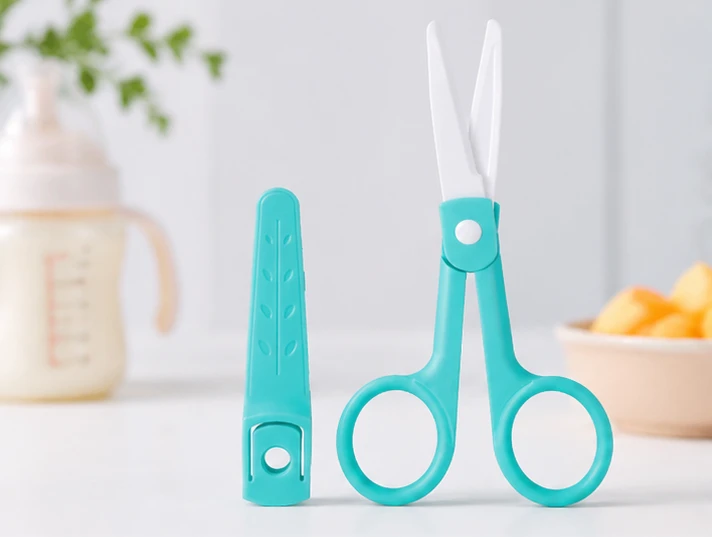
Why Choose Private Label Baby Food Scissors for Your Brand?
When developing a baby product collection, businesses usually have two options. They can develop a completely new product with a manufacturer, or they can select an existing product and customize it under their own brand.
Both approaches have their place. A completely new product may be appropriate when a brand has very specific structural or functional requirements. However, it can also involve additional development work, tooling considerations, product evaluation, and a longer preparation process.
Private labeling an existing baby food scissors model offers a different starting point. Instead of beginning with a blank design, buyers can focus on the parts that matter most to their market: branding, appearance, packaging, and product selection.
Build Your Own Brand Identity
For a baby product brand, product recognition is not created by the product name alone. The logo, color scheme, packaging, and overall presentation all contribute to how customers recognize a product.
Consider a brand that already sells baby feeding bowls, silicone spoons, and tableware. Adding a baby food scissors product with the same brand logo and coordinated colors can make the new item feel like a natural extension of the existing collection.
This is one of the main reasons buyers consider custom logo baby scissors instead of purchasing unbranded products. A consistent brand identity makes it easier to organize a product range and present it across retail stores, online marketplaces, and the company's own website.
At MIDDIA, we help customers evaluate how their brand identity can be incorporated into our existing baby food scissors models. We discuss logo placement and presentation before production so that the finished product can be reviewed against the customer's expectations.
Expand Your Baby Feeding Product Range
Baby food scissors may not be the first product a new feeding accessories brand considers, but they can complement several existing product categories.
For example, a brand selling baby feeding sets may want to introduce a food preparation accessory. A retailer specializing in infant and toddler products may be looking for additional items to complete its feeding section. An online seller may want to offer a more focused selection of feeding tools rather than competing only on generic products.
Private label baby feeding accessories give these businesses more flexibility when planning their product collections. Rather than introducing an entirely unrelated item, they can choose a product that fits the same general purchasing needs as their existing range.
For distributors and wholesalers, a consistent product collection can also simplify product presentation and brand communication across different sales channels.
Start with Existing Models Instead of Developing from Scratch
One practical advantage of working with an existing product range is that buyers have actual models to evaluate before making a customization decision.
At MIDDIA, we offer several baby food scissors models with different designs and product configurations. Depending on the selected model, buyers can evaluate differences in appearance, dimensions, handle design, protective covers, and other available features.
This gives brands a starting point for selecting a product that fits their market instead of spending the initial stage discussing an entirely new design.
Our recommendation is to begin by reviewing the available models and identifying the one that best matches your intended customer group. Once the product selection is clearer, we can discuss the available logo, color, and packaging options.
You can explore our existing collection here: MIDDIA Ceramic Baby Food Scissors.
What Can You Customize on Private Label Baby Food Scissors?
Private label customization is not limited to printing a company name on a product. For baby product brands, the appearance of the scissors and the way they are presented to customers are equally important.
At MIDDIA, our main customization options include custom logos, product colors, and branded packaging. The available details depend on the selected model, materials, and production requirements. We recommend confirming the feasibility of each request before approving a sample.
Custom Logo Baby Scissors
A brand logo is often the first customization detail that buyers want to discuss. It identifies the product as part of a particular brand and helps distinguish it from similar items in the market.
When developing custom logo baby scissors, there are several details worth considering:
Logo placement: Decide where the logo should appear on the product, based on the available surface area and the model design.
Logo size: The logo should be recognizable without making the product look visually crowded.
Artwork quality: Clear artwork makes it easier to evaluate the final logo presentation.
Brand consistency: The logo should follow the same visual standards used on your other baby feeding accessories.
We normally recommend that customers provide their logo artwork in a high-quality digital format. Our team can then review the available application area and discuss suitable branding options according to the product material and surface.
The process generally follows four steps:
The customer provides the brand logo and preferred placement.
We review the artwork and evaluate the available customization method.
A logo mockup or customized sample is prepared for review, depending on the project requirements.
The customer confirms the final appearance before mass production.
One detail we always encourage buyers to consider is logo visibility. A logo that is too small or placed in an unsuitable position may not provide the brand recognition they expect. Reviewing the actual sample is therefore more useful than making a decision based only on a digital image.
Our current MOQ for custom logo baby food scissors is 2,000 pieces, subject to the selected model and final customization requirements.
Custom Color Baby Food Scissors
Color is another important part of private label product development. Two baby food scissors models with similar functions can create quite different impressions depending on their colors and overall appearance.
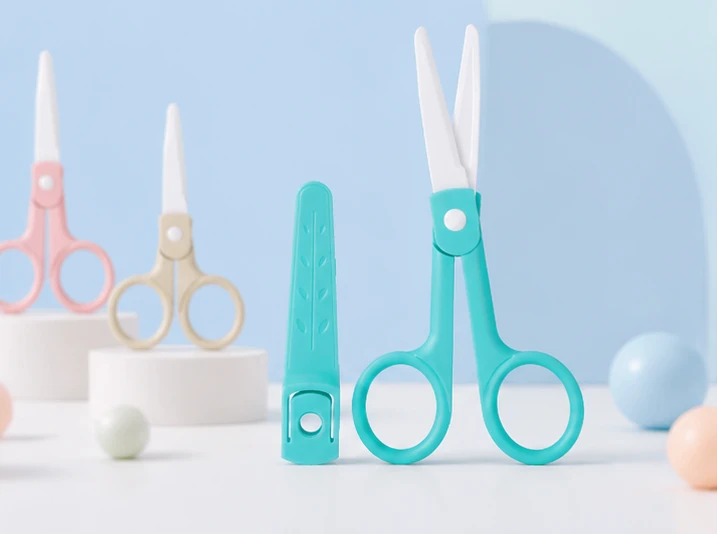
Some brands prefer soft, understated colors that fit a minimalist baby product collection. Others may use brighter colors to make their products easier to identify on retail shelves or in online product listings.
For custom color baby scissors, customers can discuss their preferred colors based on the available product materials and manufacturing process.
Common considerations include:
Custom handle colors based on the selected model.
Matching or coordinated colors for available protective covers.
Color combinations that follow the brand's existing visual identity.
Different color references for planned product variations.
Consistent color presentation between the approved sample and bulk production.
We recommend that customers provide a Pantone reference or another clear color reference whenever possible. This gives both parties a more specific starting point than descriptions such as light pink, warm beige, or pastel green.
However, a digital color reference should not be treated as an exact representation of the final physical product. Material characteristics, production conditions, and surface appearance can influence the final result. For this reason, color approval should be based on an actual sample whenever the project requires custom colors.
Our typical custom color process is straightforward:
The customer shares the preferred color reference.
We review whether the selected model and material can support the requested color.
Color samples or other suitable confirmation materials are arranged according to the project.
The customer reviews and approves the color before bulk production.
The current MOQ for custom color baby food scissors is 3,000 pieces.
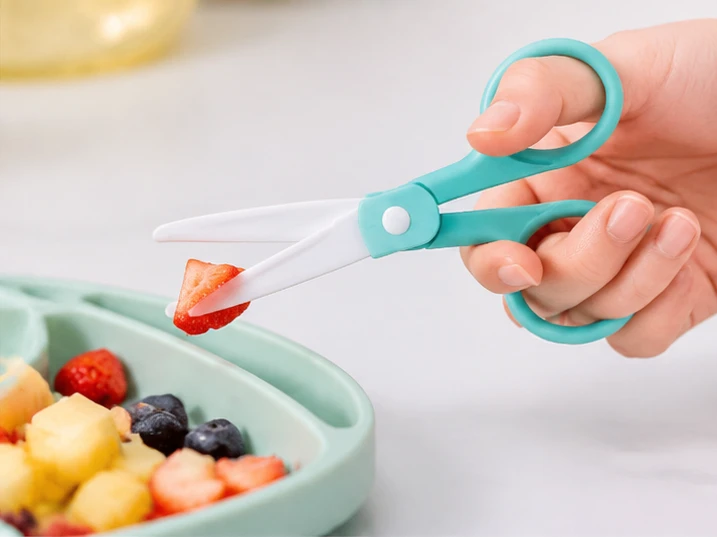
Baby Food Scissors Custom Packaging
Packaging deserves as much attention as the product itself, particularly for brands selling through retail stores and e-commerce platforms.
Customers usually encounter the packaging before they have an opportunity to examine the product closely. It communicates the brand name, provides product information, and influences how the item is presented in the marketplace.
For baby food scissors custom packaging, the right design depends on the target sales channel and the type of customer the brand wants to reach.
1. Retail Packaging
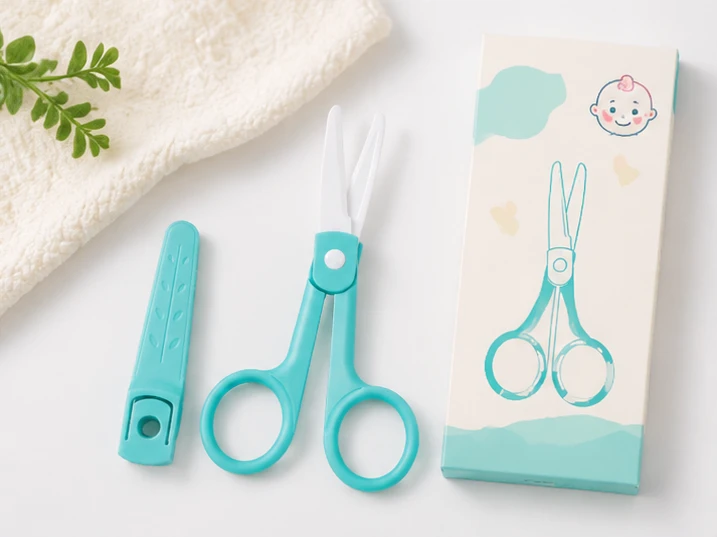
Retail packaging should make the product easy to identify and present clearly. Brands may consider printed boxes or other suitable packaging formats that include their logo, product name, product images, and relevant product information.
The packaging design should also leave enough space for required product information and any applicable market-specific labeling requirements.
2. E-commerce Packaging
Online sellers have slightly different considerations. The packaging needs to support a good product presentation while also providing appropriate protection during storage, handling, and transportation.
Product images, brand identification, and clear packaging information can all contribute to a more consistent customer experience.
3. Wholesale and Distributor Packaging
For distributors and wholesalers, packaging may need to support larger quantities, organized storage, and easier product identification. Carton markings, product references, and packing information should be considered during order planning.
4. Gift-Oriented Packaging
Some baby product brands position their accessories as part of gift sets or coordinated feeding collections. In these cases, packaging may need a more unified appearance, with coordinated colors, brand graphics, and a presentation that fits the rest of the collection.
We recommend discussing the target market and sales channel before finalizing a packaging design. A package intended for a physical retail shelf may require a different structure and presentation from one designed primarily for online fulfillment.
Our current MOQ for custom baby food scissors packaging is 3,000 pieces.
Combining Logo, Color and Packaging into One Brand Identity
The strongest private label products are usually those where the different customization elements work together rather than being selected independently.
For example, imagine a baby feeding brand that uses cream, sage green, and soft neutral colors across its product collection. The brand could select a suitable MIDDIA baby food scissors model, apply its logo, coordinate the available product colors, and develop packaging that follows the same visual direction.
The result is not simply a generic product with a logo added. It becomes a product that visually belongs to the brand's wider collection.
We encourage customers to consider the product, logo, colors, and packaging as one complete project. This makes the sample review process more useful because all major visual elements can be evaluated together.
Customization Options and MOQ for Private Label Baby Food Scissors
Minimum order quantity is one of the first questions buyers ask when considering a private label project. It affects inventory planning, product launch budgets, and the number of variations a brand can introduce.
At MIDDIA, our current minimum order quantities for the main customization options are structured as follows:
| Customization Option | Available Service | MOQ |
|---|---|---|
| Custom Logo | Add your brand logo to an existing baby food scissors model. | 2,000 pcs |
| Custom Color | Customize available product colors based on approved requirements. | 3,000 pcs |
| Custom Packaging | Develop branded packaging for your baby food scissors. | 3,000 pcs |
These quantities provide a starting reference for buyers planning a private label project. The final MOQ should be confirmed according to the selected model, customization combination, materials, and production requirements.
Why Does MOQ Differ Between Customization Options?
Not all customization requests involve the same preparation work. This is one reason why the MOQ for logo customization may differ from the MOQ for product colors or packaging.
Logo customization: Logo application generally requires artwork review, positioning confirmation, and preparation of the selected application process. For existing models, this can be a relatively direct way to introduce a brand identity without changing the overall product design.
Color customization: Custom colors may require additional material or production preparation. Color matching and sample confirmation also need to be considered. The requirements can vary depending on the selected product and material.
Packaging customization: Printed packaging involves its own artwork and production preparation. Packaging materials, printing arrangements, and order quantities can influence the final requirements.
From a purchasing perspective, it is important to understand that MOQ is not simply a number attached to a product. It is connected to how the product and its customized components are prepared for production.
Can You Combine Different Customization Options in One Order?
Yes, buyers can discuss combining multiple customization options in one private label project. In fact, combining logo, color, and packaging customization is a common approach for brands that want to launch a more complete product collection.
However, combining customization options does not automatically mean that all MOQ requirements can be added together or shared across different models.
For example, a buyer may want to order one model with a custom logo and another model with a different color. Whether these quantities can be arranged within one order depends on the production requirements and the specific customization plan.
Before confirming an order, we recommend discussing the following details with our team:
Which baby food scissors models are included?
Does each model require a different logo or color?
Will all products use the same packaging design?
Are there multiple colors or packaging variations?
What is the estimated total order quantity?
At MIDDIA, we evaluate combined orders according to the selected models, materials, colors, and packaging requirements. Our team can review your proposed order plan and confirm the applicable MOQ before sample development.
If your brand is planning to introduce several product variations, sharing the complete plan at the beginning is usually more efficient than discussing each customization request separately.
Quality Assurance for Private Label Baby Food Scissors
When purchasing baby food scissors for a private label brand, appearance and branding are only part of the evaluation. Buyers also need to consider product durability, material suitability, and the documentation available for their target market.
This is particularly important for baby feeding accessories because customers expect products in this category to be designed and manufactured with appropriate attention to quality and intended use.
At MIDDIA, we understand that quality documentation is also an important part of supplier evaluation. Our baby food scissors have undergone an SGS 1-meter drop test, and we can provide relevant FDA and LFGB documentation for buyer review, subject to the applicable product materials and specifications.
SGS 1M Drop Test: An Additional Reference for Product Durability
Product durability is one of the practical considerations when evaluating baby food scissors. During normal product handling, accessories may be moved, stored, packed, or accidentally dropped.
A 1-meter drop test provides a defined testing condition for evaluating how a product responds to a drop from a specified height. It gives buyers an additional reference when reviewing the product's physical durability.
Our baby food scissors have passed an SGS 1-meter drop test. For private label customers, this provides additional information to consider during product evaluation and supplier selection.
However, it is important to understand what this test does and does not establish. Passing a specified drop test does not mean that a product cannot be damaged under every possible impact condition. It also does not replace product safety assessments or other applicable testing requirements.
We recommend that buyers review the relevant SGS test documentation and confirm that the tested sample and product specifications correspond to the model they intend to purchase.
For brands preparing to sell in different markets, maintaining appropriate test records can also help with internal quality documentation and supplier evaluation.
FDA and LFGB Related Compliance Documentation
Food-contact material requirements are another important consideration for baby feeding accessories. Buyers selling into the United States, Germany, and other international markets may need to review different regulatory requirements depending on the product materials, intended use, and applicable market regulations.
FDA-related requirements for the US market
In the United States, the FDA regulates food-contact substances under the applicable provisions of federal food law. The suitability of a material depends on its composition, intended conditions of use, and the relevant regulatory provisions.
For buyers sourcing baby food scissors, it is important to understand which product components may come into contact with food and what supporting documentation is available for those materials.
Rather than relying only on a general statement about FDA compliance, purchasing teams should review the relevant material information and supporting documents for the specific product.
LFGB-related requirements for the European market
LFGB is the German Food and Feed Code. It is an important part of the regulatory framework considered when evaluating food-contact products for the German market.
For products intended for food contact, buyers may need to consider relevant migration testing, material suitability, and other applicable requirements. The exact assessment depends on the material and intended conditions of use.
For MIDDIA customers, we can provide relevant FDA and LFGB testing or compliance documentation for review, according to the applicable materials and product specifications.
We encourage purchasing teams to review the actual documentation rather than treating the names of regulatory frameworks as a substitute for product-specific evidence.
What Should Buyers Check Before Approving a Private Label Product?
Even when a supplier provides relevant test documents, buyers should still evaluate the actual product and customized sample before approving a bulk order.
We recommend checking the following details:
Product model and specifications: Confirm that the sample matches the selected model and agreed product requirements.
Logo placement: Check whether the logo is clear, correctly positioned, and consistent with the approved artwork.
Color consistency: Compare the physical sample with the approved color reference.
Protective cover fit: Where the selected model includes a protective cover, check that it fits as intended.
Product assembly and operation: Examine the product's construction and normal operation according to its intended use.
Packaging details: Review the artwork, product information, packaging structure, and final presentation.
Supporting documentation: Check the applicable SGS, FDA-related, LFGB-related, or other relevant records.
We believe that a clear sample approval process is valuable for both the manufacturer and the buyer. It gives both parties a shared reference for the final product and helps reduce misunderstandings during mass production.
How Our Private Label Baby Food Scissors Customization Process Works
For brands that have not worked with a private label baby food scissors manufacturer before, the process may seem more complicated than it actually is. In practice, most projects can be organized into a series of manageable steps.
Step 1: Choose an Existing Baby Food Scissors Model
Start by reviewing the available models and selecting one that matches your product positioning.
Consider the product dimensions, design, handle appearance, available protective covers, and other relevant features. If you are unsure which model is suitable, share your target market and product requirements with our team.
Choosing the right existing model at the beginning helps make the later customization discussions more focused.
Step 2: Submit Your Customization Requirements
Once you have selected a model, prepare the information needed for branding and packaging.
This may include:
Your company logo and preferred logo placement.
Preferred product colors or Pantone references.
Packaging design references or existing brand packaging.
Target market and intended sales channel.
Estimated order quantity and required product variations.
You do not need to have every design detail finalized before the first discussion. If you already have a brand identity but are still developing the packaging, we can review the available information and identify the next steps.
Step 3: Review MOQ and Customization Feasibility
After receiving your requirements, we review the selected model and the requested customization options.
At this stage, we confirm the applicable MOQ, evaluate the feasibility of the requested logo and colors, and discuss packaging requirements.
If a request involves a structural change or a specification outside the existing model, it may require additional evaluation. We prefer to clarify these points before sampling rather than leave important details unresolved until production.
Step 4: Sample Development and Approval
Sample evaluation is an important part of private label development. It gives buyers an opportunity to examine the product and its branding before committing to a bulk order.
Depending on the project, the sample review may cover:
Product appearance and selected model.
Logo placement and presentation.
Color and visual consistency.
Protective cover and product details.
Packaging artwork and presentation.
We recommend recording any required adjustments clearly and confirming the final sample before moving forward.
Step 5: Confirm Specifications and Bulk Production
After the sample has been approved, the next step is to confirm the final product and order specifications.
These should include the model, logo artwork, colors, packaging, order quantity, and other agreed requirements.
For brands ordering multiple variations, it is especially useful to maintain a clear record of the approved specifications for each version. This helps avoid confusion between different product colors or packaging designs.
Step 6: Quality Inspection and Shipment
Before shipment, the order should go through the agreed quality inspection and packaging checks.
Buyers should confirm the inspection requirements in advance, including the product details to be checked and any specific packaging or labeling requirements for the target market.
Once the agreed inspection and shipping arrangements have been completed, the products can be prepared for delivery according to the order terms.
For us, the goal of this process is to make sure that both parties have a clear understanding of the product before the order moves from sample approval to bulk production.
How to Develop a Differentiated Baby Food Scissors Product Line
Private label customization should not be treated as a one-time exercise in adding a logo to an existing product. For a brand that wants to build a recognizable baby feeding collection, it is worth considering how the product will fit into the wider product range.
Match Product Designs with Your Target Customers
Different businesses may have different priorities when choosing baby food scissors.
A premium baby product brand may pay more attention to coordinated colors and packaging presentation. A retailer may focus on a product that fits its existing feeding accessories category. An e-commerce seller may be more concerned with how clearly the product can be presented in product photographs and online listings.
Distributors and wholesalers may place greater emphasis on product specifications, order quantities, packaging arrangements, and documentation.
There is no single customization combination that works for every business. The right approach depends on the product category, target customers, and sales channel.
Build a Consistent Product Collection
If your brand already offers several baby feeding products, consistency between items can make the collection easier to recognize.
For example, you may want to coordinate the baby food scissors with your existing feeding bowls, spoons, or other accessories through a similar color palette and packaging style.
For brands planning to introduce more than one product variation, it is also worth thinking about how different models will appear together. A consistent logo position and a recognizable packaging design can help maintain a unified product identity.
Start with a Practical Customization Plan
Not every brand needs a large collection of customized models at the beginning. In many cases, starting with one suitable product and a clearly defined branding plan is a more manageable approach.
For example, a new baby feeding brand might begin with:
One existing baby food scissors model.
One customized brand logo.
One approved product color.
One branded packaging design.
After the initial product is established and market feedback becomes available, the brand can evaluate whether additional models, colors, or packaging variations are worthwhile.
This approach allows businesses to develop their product range in stages instead of making every customization decision at the same time.
Frequently Asked Questions About Private Label Baby Food Scissors
1. What Is the MOQ for Private Label Baby Food Scissors?
At MIDDIA, the current MOQ for custom logo baby food scissors is 2,000 pieces. The MOQ for custom product colors and custom packaging is 3,000 pieces respectively. The final quantity depends on the selected model and customization requirements, so buyers should confirm the details before placing an order.
2. Can I Add My Own Logo to Existing Baby Food Scissors?
Yes. We support custom logo options for selected existing baby food scissors models. Customers can provide their logo artwork and preferred placement, and we will review the available application options according to the product material and surface. The logo appearance should be confirmed before mass production.
3. Can I Customize the Color of Baby Food Scissors?
Yes. Custom color options can be discussed according to the selected model and available materials. We recommend providing a Pantone reference or another clear color sample so that the preferred appearance can be evaluated before production. The current MOQ for custom colors is 3,000 pieces.
4. Can I Customize Both the Scissors and the Packaging?
Yes. Buyers can discuss a combined customization project that includes product branding, colors, and branded packaging. The feasibility and MOQ depend on the selected model and the specific combination of requirements. We recommend sharing the complete project plan so that the details can be reviewed together.
5. Do You Provide Samples Before Mass Production?
Sample evaluation can be arranged before mass production. The sample requirements, available customization details, fees, and preparation arrangements depend on the project. We recommend reviewing the product, logo, color, and packaging details before approving the final specifications.
6. Have Your Baby Food Scissors Passed a Drop Test?
Yes. MIDDIA baby food scissors have passed an SGS 1-meter drop test. This provides an additional reference for buyers evaluating product durability. Customers can contact our team to discuss the relevant test documentation and confirm its applicability to the selected product model.
7. Do You Provide FDA and LFGB Documentation?
We can provide relevant FDA and LFGB testing or compliance documentation for buyers to review, depending on the applicable product materials and specifications. Because requirements can differ according to the destination market and intended food-contact conditions, buyers should review the actual documentation for their selected product.
8. Can I Order Different Models for My Baby Product Brand?
Yes. Buyers can discuss orders involving different baby food scissors models. The applicable MOQ and customization arrangements depend on the individual models, colors, logo requirements, and packaging specifications. We recommend submitting the planned product combinations and estimated quantities for evaluation before confirming the order.
Customize Your Baby Food Scissors with MIDDIA
Developing a private label baby food scissors product does not have to start with a completely new design. By selecting a suitable existing model and planning the right branding, colors, and packaging, your business can build a product that fits its own baby feeding accessories collection.
At MIDDIA, we work with baby product brands, retailers, distributors, and e-commerce sellers to explore practical private label solutions. From custom logos and product colors to branded packaging, we help customers review available options and prepare their products for their target markets.
If you are planning a new product launch or expanding your existing baby feeding range, tell us about your preferred model, branding requirements, target market, and estimated order quantity. Our team can help you evaluate the customization options and discuss the next steps.
Customize Your Baby Food Scissors with MIDDIA
Looking to develop your own private label baby food scissors? MIDDIA helps baby product brands, retailers, distributors, and e-commerce sellers customize existing models with their own logos, product colors, and branded packaging.
Whether you are launching a new baby feeding accessory or expanding your existing product range, our team can help you review suitable models, customization options, MOQ requirements, and sample arrangements.
Tell us about your brand and customization requirements. Let's discuss your private label project.
Request a Customization QuoteCustom Logo: MOQ 2,000 pcs | Custom Color: MOQ 3,000 pcs | Custom Packaging: MOQ 3,000 pcs