Developing your own fishing scissors can be a valuable opportunity for a fishing tackle brand, distributor, or private-label business looking to build a more distinctive product line. Rather than selling another generic pair of fishing scissors, you can create a product that reflects your brand, meets the needs of your target anglers, and offers features that are difficult to find in standard market products.
However, turning an idea into a finished fishing tool involves more than choosing a blade material and adding a logo to the handle. You need to consider the type of fishing lines your customers use, the cutting performance they expect, the blade structure, handle ergonomics, product dimensions, packaging, and manufacturing requirements. These decisions are closely connected. A design that looks attractive in a product photograph may not perform well when cutting braided PE line, while a technically capable blade may not be suitable for the price range you have in mind.
For businesses considering ceramic fishing scissors, material selection adds another important dimension. Zirconia ceramic offers excellent hardness, wear resistance, and corrosion resistance, making it an interesting alternative to conventional metal blades for fishing environments where moisture and saltwater are common. Yet the final performance still depends on blade geometry, manufacturing precision, assembly, and practical testing.
This guide explains how to develop your own fishing scissors, from defining the initial product concept to preparing specifications, evaluating samples, and working with an OEM/ODM manufacturer. Whether you are launching a new fishing tackle brand or expanding an existing product range, understanding these steps will help you make better development decisions before committing to bulk production.
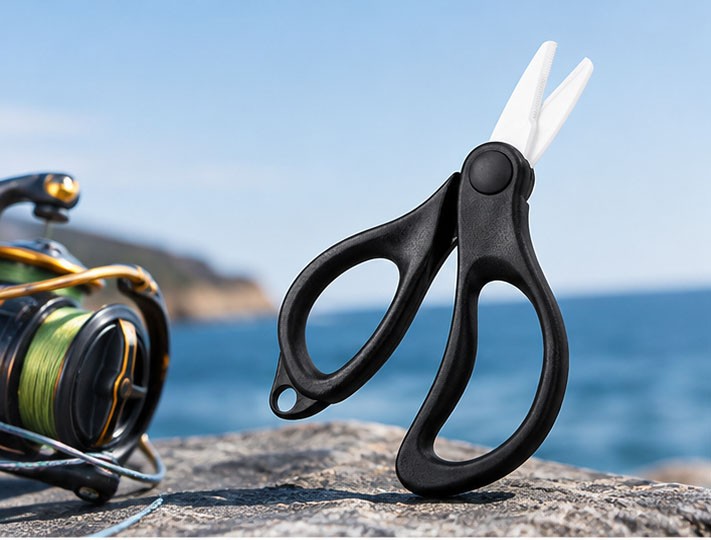
One of the most common mistakes in developing a new fishing accessory is starting with the appearance before understanding the customer. A compact pair of scissors with an attractive handle may look good, but that does not automatically make it the right product for your market.
Before discussing blade dimensions or requesting a sample, take some time to define who will buy the product, where it will be used, and what problem it should solve. This early planning can prevent unnecessary design changes later.
Fishing scissors serve several types of anglers, and their requirements are not always the same.
For example, freshwater anglers may mainly need a compact tool for cutting braided line, monofilament, and fluorocarbon during regular tackle preparation. Saltwater anglers, on the other hand, may pay closer attention to corrosion resistance, easy cleaning, and the durability of exposed metal components. Boat and kayak anglers often prefer a portable design that can be attached to a tackle bag, fishing vest, or other accessible location.
Professional guides and frequent anglers may also have different expectations from occasional users. They tend to use cutting tools more frequently and may place greater value on consistent cutting performance, comfortable handling, and dependable construction.
When defining your target customer, consider the following groups:
Freshwater anglers: Often need versatile scissors for braided line, monofilament, and general tackle preparation.
Saltwater fishing enthusiasts: May prioritize rust resistance, practical storage, and components suitable for wet environments.
Bass and lure anglers: Often value compact tools that can handle braided PE line and fit easily into a tackle system.
Boat and kayak anglers: Usually benefit from lightweight, portable designs with practical attachment options.
Professional fishing guides: May require reliable cutting performance and comfortable operation during repeated use.
You do not need to design one product for every group. In fact, trying to satisfy all possible users with a single configuration can make the product unnecessarily complicated. It is often better to select one primary customer group and build the initial product around its most important requirements.
Your target retail price and sales channel will influence nearly every development decision. A basic fishing scissors product intended for high-volume distribution will have different requirements from a premium ceramic line cutter sold under a specialist fishing brand.
For planning purposes, fishing scissors can be divided into three broad positioning levels:
Entry-level: Focuses on essential cutting functionality, practical construction, and competitive purchasing costs. The design should remain simple and easy to understand.
Mid-range: Places more emphasis on comfortable handling, dependable blade performance, corrosion-resistant materials, and useful accessories.
Premium: May incorporate zirconia ceramic blades, specialized edge configurations, refined handle finishes, and more distinctive retail packaging.
These categories are not strict technical classifications. Their purpose is to help you establish a clear product direction before discussing the details with a manufacturer.
For instance, a premium ceramic fishing scissors product should offer more than a higher price and a different color. Its material selection, cutting performance, product presentation, and overall user experience should support that positioning.
Product differentiation is particularly important for brands selling through online marketplaces or competing with established fishing tackle retailers. If your product looks and performs exactly like dozens of existing models, customers may have little reason to choose it.
There are several ways to create a more distinctive fishing scissors product:
Use zirconia ceramic blades instead of conventional stainless steel cutting edges.
Develop a blade configuration intended for slippery braided PE fishing line.
Choose a compact or specialized handle structure for a particular fishing application.
Offer distinctive handle colors that match your brand identity.
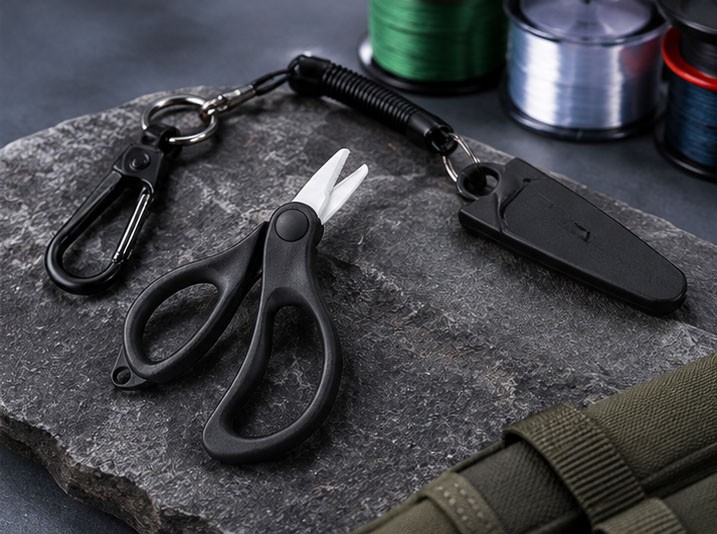
Include practical accessories such as a protective cover, tether, or attachment clip where suitable.
Develop packaging that communicates the product's material and intended applications clearly.
The important point is to connect each feature with a real customer benefit. A serrated blade, for example, should be selected because it helps engage certain braided fibers during cutting, not simply because it makes the product look more technical.
Likewise, a ceramic blade should be supported by a clear explanation of its material advantages and suitable applications. Customers are more likely to appreciate a product when they understand why its design choices matter.
The blade is the working part of fishing scissors, so material selection deserves careful attention. Stainless steel remains widely used in conventional fishing tools, but zirconia ceramic provides another option for brands interested in corrosion resistance, high hardness, and a different product positioning.
Neither material automatically guarantees better cutting performance. The final result depends on the material grade, blade dimensions, edge geometry, manufacturing process, and quality of assembly. The right choice should be based on the intended application rather than a material name alone.
Stainless steel is familiar to most fishing tackle buyers. It offers a range of available grades, mechanical properties, and manufacturing options. Depending on the selected grade and surface treatment, stainless steel can provide useful corrosion resistance for fishing applications.
Zirconia ceramic is different. It is a high-performance ceramic material with very high hardness and excellent resistance to corrosion. Unlike steel, the ceramic cutting edge does not rust when exposed to water or salt. This makes it an attractive option for fishing scissors designed for wet environments.
The following comparison highlights the main differences relevant to product development:
| Factor | Stainless Steel | Zirconia Ceramic |
|---|---|---|
| Material hardness | Depends on the steel grade and heat treatment | Very high hardness |
| Corrosion resistance | Depends on alloy composition, finish, and maintenance | Excellent resistance to corrosion |
| Wear resistance | Varies with material grade and processing | High wear resistance |
| Saltwater exposure | Requires suitable material selection and maintenance | The ceramic blade itself does not rust |
| Mechanical characteristics | Generally offers greater ductility and impact tolerance | Hard but relatively brittle under impact or bending stress |
| Product positioning | Conventional and versatile cutting tools | Specialized, corrosion-resistant cutting tools |
There is one detail worth remembering: the corrosion resistance of a ceramic blade does not mean the entire scissors assembly is rustproof. Pivot pins, springs, screws, and other metal components still need appropriate material selection and construction. If your product is intended for saltwater fishing, these parts should be considered during the design stage rather than treated as an afterthought.
Zirconia, or zirconium dioxide (ZrO2), is widely used in technical ceramic applications where hardness, wear resistance, and corrosion resistance are important. In fishing scissors, these properties offer several potential advantages.
First, zirconia ceramic provides high hardness. A properly manufactured ceramic cutting edge can maintain its edge characteristics through repeated use. This is particularly relevant for compact cutting tools that are expected to perform consistently over time.
Second, ceramic does not rust like metal. Fishing tools are frequently exposed to water, damp tackle boxes, and salt spray. A zirconia ceramic blade is naturally resistant to rust and many forms of chemical corrosion. This can be a useful selling point for customers who fish in saltwater environments.
Third, ceramic offers a distinctive product identity. Many fishing scissors on the market use conventional metal blades. Introducing a zirconia ceramic cutting edge gives brands an opportunity to develop a product with a more specialized material story.
However, ceramic also has limitations. High hardness does not mean unlimited toughness. Zirconia ceramic can be damaged by excessive impact, bending forces, or improper handling. The blade geometry and supporting structure therefore need to be designed with the material's mechanical characteristics in mind.
For this reason, developing ceramic fishing scissors is not simply a matter of replacing a steel blade with a ceramic one. Material processing, forming, sintering, precision grinding, edge finishing, and final assembly all influence the quality of the finished product.
Before choosing a blade material, consider the actual environment and cutting tasks the product will face.
If your target market mainly needs an economical, general-purpose cutting tool, stainless steel may be a practical option. If you want to develop a product positioned around rust-resistant cutting performance and high-hardness ceramic technology, zirconia deserves serious consideration.
For a ceramic fishing scissors project, several specifications should be discussed early:
The intended fishing line materials and diameter range.
The required blade length and thickness.
The desired cutting-edge geometry.
The expected frequency of use.
The structure used to support and protect the ceramic blade.
The corrosion resistance requirements of the complete scissors assembly.
These details will help the manufacturer evaluate whether the proposed material and product structure are suitable for the intended application.
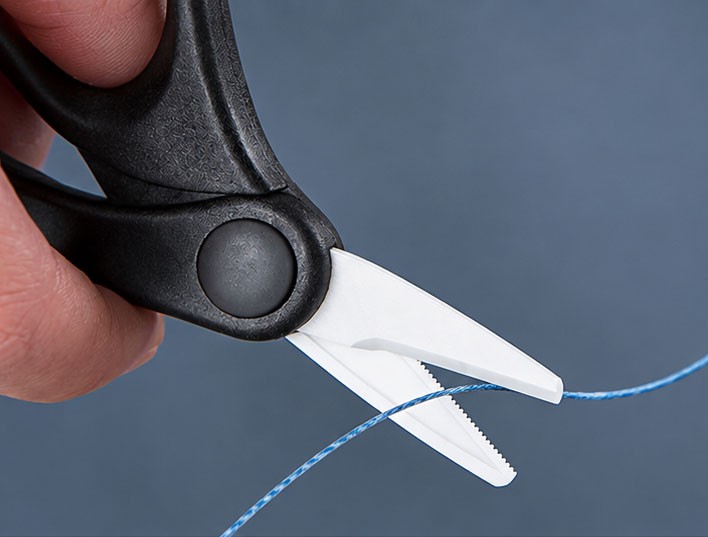
Choosing a blade material is only part of the development process. Two scissors made from the same zirconia ceramic can deliver different cutting results if their blade shapes, edge angles, alignment, and serration patterns are different.
This is especially important when the product is designed for fishing line. Braided PE line, monofilament, and fluorocarbon have different physical characteristics. A blade that performs well on one material may not provide the same result on another.
Braided PE line is popular because of its high strength relative to its diameter and low stretch. However, its braided fiber construction creates a particular challenge for cutting tools.
Unlike a single solid strand, braided line consists of multiple fibers woven together. When the cutting edges do not engage the line properly, the fibers may move or spread rather than being cut cleanly. This can result in a frayed end, repeated cutting attempts, or an inconsistent cutting experience.
A serrated cutting edge can help address this problem by improving the blade's engagement with braided fibers. The small tooth-like structure provides additional contact points that can help prevent slippery line from moving away from the cutting area.
When developing scissors for PE line, consider:
The number of strands in the target braided line, such as 8-strand or 12-strand PE.
The typical line diameter used by your target customers.
The depth and spacing of the serrations.
The relationship between the two blade edges during closing.
The ability to maintain consistent contact along the cutting area.
There is no universal serration pattern that works best for every fishing line. A finer structure may behave differently from a more pronounced serration, and the final choice should be evaluated through cutting tests using representative line samples.
Monofilament and fluorocarbon lines have different cutting characteristics from braided PE. Both are commonly used in fishing leaders and mainline applications, but their stiffness, diameter, and surface properties can vary considerably.
Monofilament is generally more flexible, while fluorocarbon is often selected for its abrasion resistance and other application-specific characteristics. Depending on the diameter and construction, both materials may require a different blade contact and cutting action from braided line.
For these applications, the scissors should provide reliable blade alignment and sufficient contact throughout the intended cutting area. If the edges do not meet properly, the line may be pushed aside instead of being severed cleanly.
During development, test several line diameters rather than relying on a single thin sample. This gives a more realistic picture of how the product will perform in actual fishing situations.
Blade geometry should reflect the product's main purpose. Straight and serrated edges each have practical applications, and the choice should be made according to the intended fishing line types and cutting performance requirements.
A straight edge provides a relatively continuous cutting surface and can be suitable for versatile line-cutting applications. A serrated edge is designed to improve engagement with materials that may otherwise slip during cutting, including certain braided fishing lines.
For fishing scissors intended primarily for PE braid, a serrated design is worth evaluating. For a more general-purpose product, a straight edge or a carefully developed combination of edge configurations may be considered.
Another important design detail is the location of the serrations. Some scissors use serrations on only one blade, while others use different edge arrangements. For ceramic fishing scissors, the exact configuration should be confirmed in the product drawing and prototype. A one-sided serrated structure, for example, should be clearly specified so that the sample and subsequent production follow the intended design.
Do not assume that adding more or deeper teeth will automatically improve cutting. Excessive serration can affect the contact between the cutting edges and may create undesirable results with certain line types. Practical testing remains the most reliable way to select the right configuration.
Once the target application and edge configuration have been established, the next step is to translate the design into measurable specifications.
A useful blade specification should include:
Blade length: Determines the available cutting area and influences the overall product size.
Blade thickness: Affects structural support, weight, and the design of the blade assembly.
Blade shape: Defines the tip, cutting profile, and intended application.
Serration pattern: Specifies tooth arrangement, spacing, and which blade carries the serrations.
Edge geometry: Includes the cutting-edge profile and relevant grinding requirements.
Blade alignment: Ensures that the two blades meet correctly during operation.
These specifications do not need to be fully finalized before the first discussion with a manufacturer. In many cases, a brand has an initial product idea but needs technical input to turn it into a workable design. What matters is providing enough information to begin a meaningful development conversation.
A fishing scissors product is not judged by its blade alone. Users also notice how it feels in the hand, how easily it can be carried, and whether its overall structure suits their fishing habits.
For brands developing a private-label product, handle design is also one of the most visible ways to create a recognizable appearance. A carefully selected handle shape and color can help distinguish your product from standard market models without introducing unnecessary complexity.
The handle should provide a stable grip while supporting the overall structure of the scissors. Material selection depends on the intended price range, weight requirements, production method, and desired appearance.
When discussing handle design with an OEM/ODM manufacturer, consider the following:
Grip comfort: The handle should be comfortable to hold during normal cutting tasks.
Anti-slip characteristics: The surface should offer practical grip, particularly when hands are wet.
Structural strength: The handle should support normal operating forces without becoming loose or unstable.
Weight: A compact, lightweight design may be preferable for anglers who carry several tools.
Assembly: The connection between the handle and blade components should remain stable during repeated use.
Ergonomics should not be evaluated from a drawing alone. A handle that looks comfortable on a computer screen may feel too small or awkward when held. This is one reason prototype evaluation is important before final approval.
For private-label brands, visual consistency is part of the product identity. Handle colors, surface finishes, logo placement, and packaging can all contribute to a more recognizable product range.
You may want to use your existing brand colors or develop a different appearance for a premium fishing accessory line. For example, a minimalist dark handle may support a professional product identity, while brighter colors may improve visibility inside a tackle box.
When selecting colors, consider the actual sales environment. Product images on an online marketplace, retail shelf presentation, and the physical appearance under natural light can differ. It is therefore useful to review the color on an actual sample before confirming bulk production.
Logo placement also deserves attention. Depending on the handle structure and manufacturing process, branding may be applied through printing, marking, or another suitable method. The available approach should be confirmed with the manufacturer based on the selected material and surface.
Accessories can make a fishing scissors product more convenient, but every additional component should serve a clear purpose.
Some options worth considering include:
Retractable tether: Helps keep the cutting tool accessible and reduces the chance of losing it during use.
Carabiner attachment: Provides a convenient way to connect the scissors to a tackle bag or other compatible attachment point.
Protective blade cover: Helps protect the blade and nearby items during storage.
Compact storage design: Makes the product easier to carry in a tackle box, pocket, or fishing vest.
Not every model needs all these features. A compact braid cutter may benefit from a simple attachment system, while a larger pair of fishing scissors may be better suited to a protective cover.
Additional accessories also affect the total product cost, assembly requirements, and packaging dimensions. It is better to decide which features are essential during the concept stage rather than adding them after the main design has been completed.
If you are planning to develop more than one fishing scissors SKU, think about how the models will work together as a product range.
For example, a fishing tackle brand could develop:
A standard ceramic fishing scissors model for general line-cutting applications.
A serrated ceramic braid scissors model focused on PE fishing line.
A compact retractable fishing line cutter for portable use.
A specialized ceramic cutting tool positioned for saltwater fishing environments.
These products can share a consistent brand identity while serving different customer needs. They may also allow distributors and retailers to offer several price points rather than relying on a single product configuration.
Once the main product direction has been established, it is time to organize the requirements into a specification sheet. This document is one of the most useful tools in the development process because it helps both the brand and the manufacturer understand what needs to be produced.
Without a clear specification, discussions can easily become confusing. A customer may request a compact ceramic scissors with a serrated blade, while the manufacturer interprets the request differently in terms of blade length, handle structure, or cutting-edge configuration.
A specification sheet does not need to be a complicated engineering document at the beginning. It should simply record the important product requirements in a clear and organized way.
The following table provides a practical starting point for an OEM/ODM fishing scissors project:
| Specification | Information to Define |
|---|---|
| Product Type | Fishing scissors, braided line cutter, or compact line cutter |
| Blade Material | Zirconia ceramic or selected stainless steel grade |
| Blade Design | Straight edge, serrated edge, or specified combination |
| Target Line | PE braided line, monofilament, fluorocarbon, or multiple types |
| Blade Dimensions | Length, thickness, shape, and other relevant dimensions |
| Handle | Material, color, shape, grip, and surface finish |
| Accessories | Tether, clip, protective cover, or other components |
| Branding | Logo position, marking method, and brand colors |
| Packaging | Retail box, blister packaging, printed card, or bulk packaging |
| Order Requirements | Estimated quantity, target market, and expected purchasing schedule |
Not all specifications need to be fixed immediately. For example, if you are unsure whether a straight or serrated edge will perform better, you can discuss alternative configurations with the manufacturer and evaluate them through samples.
It is useful to divide your requirements into three categories before requesting a quotation.
Essential product requirements include the features that directly affect the product's intended function. For fishing scissors, these may include blade material, cutting-edge configuration, target line types, and basic dimensions.
Appearance and branding requirements include handle color, logo placement, surface finish, and packaging. These elements are important for market positioning, but they should not compromise the basic cutting performance.
Optional features include additional accessories, special packaging details, or secondary design elements that can be considered if the budget and production plan allow.
This separation helps prevent a common development problem: spending too much time discussing cosmetic details before confirming whether the product itself performs as intended.
Manufacturers also need to understand the commercial side of the project. A product designed for a low-cost promotional bundle will require a different development approach from a premium ceramic fishing scissors intended for specialist tackle retailers.
Before requesting a quotation, prepare some basic information:
Your expected retail price or target wholesale price.
Your estimated initial order quantity.
The countries or regions where you plan to sell the product.
Your preferred product positioning.
The level of customization you require.
Your expected launch schedule, if already known.
These details do not need to be exact at the first discussion. An estimated purchasing range is often enough to help the manufacturer understand the project and suggest a suitable starting point.
It is also important to distinguish between the cost of an existing model with a customized logo and the cost of developing a new product structure. A project involving a new blade configuration, special handle design, or additional tooling may require a different quotation and development process.
For brands that are new to ceramic fishing tools, starting with an existing product configuration can sometimes be a more practical way to evaluate market demand before investing in a completely new design.
Once the product requirements are organized, you will have a much clearer basis for discussing samples, manufacturing feasibility, and the next development steps with an OEM/ODM partner.
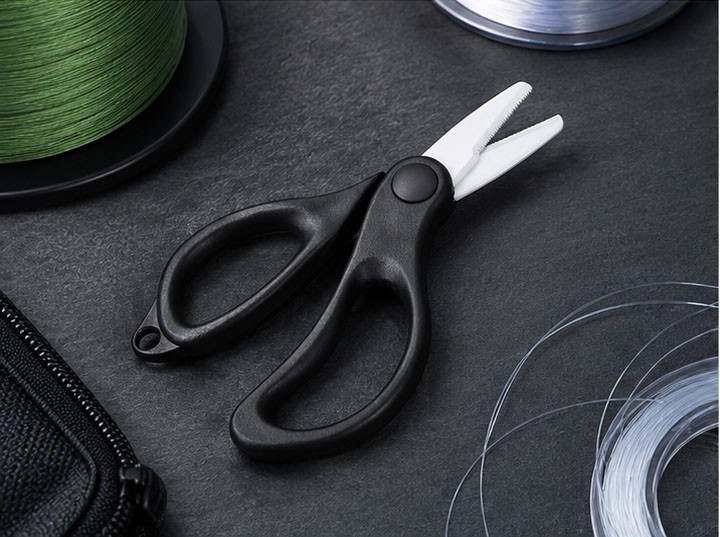
After preparing the product specifications, the next step is sample development. This is where an initial concept starts becoming a physical product that can be evaluated, adjusted, and eventually approved for production.
For fishing scissors, sample testing is particularly important because cutting performance cannot be judged reliably from product drawings or photographs. Blade geometry, alignment, handle movement, and the interaction between the cutting edges all influence the final result.
A product specification may look complete on paper, but certain details only become clear when you hold and use the actual sample.
For example, a ceramic fishing scissors design may have the correct blade dimensions but still require adjustments to the closing action. A serrated blade may appear suitable for braided PE line, yet its actual performance can vary depending on the line diameter and serration configuration.
Samples also allow your team to evaluate the overall product experience. Is the handle comfortable? Can users operate the scissors easily with one hand? Is the blade protected during storage? Does the product fit the intended packaging?
These questions are easier to answer with a physical sample than through extended discussions about design drawings.
For a new product, it is worth treating sample development as an evaluation stage rather than simply a formality before placing an order. Identifying problems early can reduce the risk of expensive changes after production has started.
A useful sample evaluation should cover both cutting performance and the complete product structure. The following areas are worth including in your testing process.
1. Cutting performance on target fishing lines
Test the scissors using the actual fishing line types your customers are likely to use. This may include braided PE line, monofilament, and fluorocarbon. If your product is designed specifically for braided line, include different PE strand constructions and representative line diameters.
Pay attention to whether the line is cut cleanly, whether fibers are left hanging, and whether the user needs to reposition the line or make repeated cutting attempts.
2. Cutting consistency
A single successful cut does not establish consistent performance. Repeat the cutting test several times under similar conditions. This helps reveal whether the blade maintains reliable contact and whether the scissors operate smoothly throughout repeated use.
3. Blade alignment and closing action
Inspect how the two blades meet during operation. Poor alignment can create gaps or uneven contact, which may reduce cutting efficiency. The scissors should also open and close smoothly without excessive looseness or unnecessary resistance.
4. Handle comfort and grip
Evaluate the handle in realistic conditions. Consider whether the fingers have enough space, whether the grip feels secure, and whether the scissors remain comfortable during repeated cutting tasks.
5. Portability and attachment usability
If the product includes a tether, clip, or protective cover, test these accessories as part of the complete product. A useful accessory should make the tool easier to carry or store rather than simply increase the number of components.
6. Corrosion resistance of metal components
For products intended for saltwater environments, pay particular attention to the pivot, fasteners, springs, and other exposed metal parts. The ceramic blade itself does not rust, but the performance and appearance of the complete scissors still depend on the materials used in the assembly.
7. Appearance and assembly quality
Check the handle finish, logo position, color consistency, blade installation, and overall assembly. These details matter because customers evaluate the complete product, not just the cutting edge.
Sample evaluation should produce useful feedback that can be translated into specific design changes.
If the scissors do not cut braided line cleanly, review the blade engagement, serration pattern, alignment, and cutting-edge geometry. If the product feels uncomfortable, examine the handle shape and grip dimensions. If the scissors are difficult to carry, consider whether the attachment system or protective cover needs adjustment.
It is generally more efficient to identify the most important performance problems first rather than changing several unrelated design elements at once.
For a ceramic fishing scissors project, any proposed adjustment to the blade structure should also be evaluated in relation to the properties of the ceramic material. A design that works for a metal blade cannot automatically be transferred to a ceramic blade without considering its mechanical characteristics.
Before moving to mass production, both the brand and manufacturer should have a clear understanding of what constitutes an approved sample.
The approved sample should reflect the agreed specifications, including blade configuration, dimensions, handle design, logo placement, accessories, and packaging where applicable.
It is also useful to document the results of the main cutting tests. For example, if the product is designed for PE braided line, specify the target line types and diameters used during evaluation. This gives both parties a clearer reference when reviewing subsequent production batches.
Once the final sample is approved, it can serve as an important reference for production inspection. This does not replace formal quality control, but it helps reduce misunderstandings about the expected product configuration.
A good product concept and a successful sample are important milestones, but they do not automatically guarantee a consistent finished product. The next challenge is finding a manufacturing partner that understands the product requirements and can support the transition from development to production.
This is especially relevant for ceramic fishing scissors. Ceramic components require different processing methods from conventional metal parts, and the quality of the finished blade depends on several manufacturing stages.
Zirconia ceramic fishing scissors are not produced in exactly the same way as ordinary stainless steel scissors. The ceramic blade starts with a material preparation process and goes through forming, sintering, precision grinding, and edge finishing before it can be assembled into a finished cutting tool.
Each stage influences the characteristics of the final component.
Material preparation: The ceramic powder and material formulation influence the properties of the finished component.
Forming: The desired blade shape and dimensions need to be considered during the forming process.
Sintering: Controlled high-temperature processing develops the ceramic's final material structure.
Precision grinding: Grinding establishes the required dimensions and cutting-edge geometry.
Edge finishing: The cutting edge needs to be processed according to the intended blade design.
Assembly and inspection: The finished blade must be properly integrated into the scissors structure and checked against the agreed requirements.
These processes require relevant material knowledge and manufacturing experience. A supplier that mainly handles conventional metal scissors may not have the same technical background as a manufacturer with established ceramic processing experience.
For brands developing ceramic fishing scissors, it is therefore worth asking about the manufacturer's experience with zirconia materials and precision ceramic cutting components, rather than evaluating suppliers only by their finished product photographs.
Not every manufacturer offers the same level of product development support. Some suppliers mainly provide existing products with customized logos, while others may be able to discuss product configuration, material selection, sample development, and additional customization.
Before choosing a manufacturing partner, consider asking the following questions:
Does the manufacturer have experience with zirconia ceramic processing?
Can it discuss blade geometry and different cutting-edge configurations?
Can it support sample evaluation and design adjustments?
What handle, color, logo, and packaging options are available?
How are product dimensions and assembly quality checked?
Can the manufacturer explain its inspection process for bulk orders?
What information is needed to prepare a quotation for your project?
You do not necessarily need a manufacturer that offers every possible customization option. What matters is whether its actual capabilities match the requirements of your project.
For example, if your main objective is to develop a ceramic braid scissors product, experience with zirconia blade manufacturing and cutting-edge processing may be more important than a supplier's ability to offer dozens of unrelated handle styles.
Commercial terms should be discussed before finalizing the development plan. Minimum order quantity, sample costs, production lead time, and customization expenses can all influence whether a project is commercially practical.
For an existing fishing scissors model, adding a logo or changing selected appearance details may involve a relatively straightforward process. Developing a completely new product configuration can require additional design work, sample adjustments, or tooling, depending on the structure.
When requesting a quotation, clarify the following:
Minimum order quantity: The required quantity for the selected product and customization level.
Sample costs: Whether samples are available, whether customization affects the sample price, and how sample charges are handled.
Sample lead time: The expected time needed to prepare the requested sample.
Mass production lead time: The estimated production schedule after sample approval and order confirmation.
Customization costs: Any additional charges for logo application, special components, packaging, or tooling.
Shipping arrangements: Packaging requirements, shipping method, and delivery responsibilities.
One point worth clarifying is the difference between a sample from an existing model and a newly developed prototype. The two may involve very different development requirements. A quotation should clearly explain which stage and services are included.
If your initial purchasing quantity is limited, you can also ask whether an existing product configuration could meet your main requirements. Starting with an established model and making selected customizations may provide a more practical route to market testing.
Product quality should not be evaluated only during the first sample stage. If you plan to build a long-term fishing tackle product line, consistency across production batches is equally important.
Several controls are worth discussing with the manufacturer:
Use the approved sample and specifications as production references.
Confirm the ceramic blade material and relevant dimensions.
Check blade alignment and closing action.
Inspect the handle finish, logo, and assembly.
Evaluate cutting performance according to the agreed test requirements.
Verify accessories and packaging before shipment.
These measures help establish a more consistent product standard. They also make it easier to identify differences between the approved sample and subsequent production batches.
For a brand, repeat-order consistency is not a minor detail. Retailers and end customers expect the product they purchase today to deliver a similar experience to the one they purchased previously.
Once the product design and manufacturing requirements are established, attention can shift toward commercialization. Developing a good fishing scissors product is only one part of the project. It also needs a clear brand identity, suitable packaging, and a product presentation that helps customers understand its value.
For fishing tackle brands and private-label businesses, these details can make a meaningful difference in how the product is positioned within an existing product range.
Private-label customization should be approached as more than placing a logo on an existing product. The overall appearance should be consistent with your brand and the customers you want to reach.
Consider the relationship between handle colors, logo placement, product naming, and packaging design. A premium ceramic fishing scissors product, for example, may benefit from a clean visual presentation that highlights the zirconia ceramic blade and its intended applications.
Product information should also be clear and specific. Rather than using vague statements such as "professional quality" or "super sharp," explain the actual product features, including blade material, cutting-edge configuration, and suitable fishing line applications.
This gives distributors and end customers a better understanding of what they are purchasing.
If your brand already sells fishing accessories, developing a small range of related cutting tools may provide more opportunities than launching only one model.
For example, you could consider a product structure such as:
Standard Ceramic Fishing Scissors: A general-purpose model for anglers who want a corrosion-resistant ceramic cutting edge.
Premium Serrated Braid Scissors: A model focused on braided PE line applications.
Compact Retractable Line Cutter: A portable product for anglers who prefer a small tool with an attachment system.
Specialized Saltwater Fishing Scissors: A product configuration developed with attention to wet environments and the corrosion resistance of the complete assembly.
The exact product range should depend on your market research and customer demand. There is little value in launching several models that offer almost identical functionality.
A more practical approach is to identify distinct customer needs and create products with clear differences in application, configuration, or price positioning.
The same fishing scissors product may need different presentation strategies depending on where it is sold.
Fishing tackle retail stores often need packaging that communicates the main product features quickly. Material information, intended line types, and product dimensions should be easy to understand.
Online marketplaces depend heavily on product photography, clear specifications, and informative descriptions. Customers cannot physically inspect the scissors before purchasing, so close-up images of the blade and realistic application photographs become important.
Distributors and wholesalers may focus more on purchasing costs, product range, packaging consistency, and the ability to maintain supply across repeat orders.
Fishing brands may also use scissors as part of a larger product collection, such as braided line, terminal tackle, fishing tools, and other accessories. In this situation, consistent product appearance and brand positioning become especially relevant.
Thinking about the sales channel during product development can help avoid packaging or specification changes later.
Once the product is ready for market, its key features need to be translated into clear customer benefits.
For ceramic fishing scissors, useful points may include:
Zirconia ceramic blade construction.
Excellent corrosion resistance of the ceramic cutting edge.
High hardness and wear resistance.
Blade configurations designed for specific fishing line applications.
Practical handle and portability features.
Brand-specific colors, logos, and packaging.
Make sure that product claims reflect the actual specifications and test results. For example, if a particular model has been tested on specific PE line diameters, use those results when describing its intended cutting applications rather than claiming that it cuts every type of fishing line effortlessly.
Clear and realistic product communication helps build trust and gives your distributors and retail partners more useful information to work with.
Developing a fishing scissors product requires a combination of product planning, material knowledge, design decisions, and manufacturing coordination. For brands interested in ceramic cutting tools, the manufacturer's experience with ceramic materials deserves particular attention.
MIDDIA focuses on ceramic products and ceramic cutting tools, bringing experience in ceramic manufacturing to the development of fishing scissors and other specialized cutting applications.
MIDDIA's background in ceramic product manufacturing dates back to 2010. This experience provides a foundation for working with ceramic materials and understanding the processing requirements involved in producing functional ceramic components.
For zirconia ceramic fishing scissors, the manufacturing process involves more than selecting a suitable raw material. Forming, sintering, grinding, edge finishing, and dimensional control all contribute to the final blade characteristics.
Understanding these processes is important when developing a product where the cutting edge is a central part of its performance and market positioning.
Fishing line is not a single material category. Braided PE, monofilament, and fluorocarbon have different characteristics, and product development should take these differences into account.
MIDDIA's ceramic fishing scissors product development can be discussed around the intended application, blade configuration, and overall product requirements.
For example, brands interested in braided-line applications may want to evaluate a serrated ceramic blade configuration. Other projects may place greater emphasis on compact product dimensions, handle design, or general-purpose cutting applications.
The objective is to identify a suitable product configuration rather than assume that one blade design is ideal for every fishing situation.
Depending on the selected model and project requirements, customization discussions may cover several aspects of the finished product:
Logo placement and branding requirements.
Handle colors and appearance.
Blade configuration and product specifications.
Selected product accessories.
Retail packaging and presentation.
Sample evaluation and development requirements.
Whether you are an established fishing tackle brand, a distributor, a wholesaler, or an online seller planning a new private-label product, it is helpful to start with a clear understanding of your target market and expected product positioning.
A fishing scissors development project can be organized into several practical stages:
Product Idea: Define the target customers, market positioning, and intended fishing applications.
Requirement Confirmation: Discuss blade material, dimensions, edge design, handle, and customization requirements.
Design and Configuration: Confirm a suitable product structure and development direction.
Sample Development: Prepare samples according to the agreed requirements.
Performance Testing: Evaluate cutting performance, usability, and product appearance.
Sample Approval: Confirm the final specifications and approved product reference.
Mass Production: Move forward with the agreed production and quality requirements.
The exact process depends on whether you are customizing an existing model or developing a new product configuration. Discussing this distinction early helps establish realistic expectations for cost, samples, and production scheduling.
If you already have a product concept, reference photographs, or an existing fishing scissors model that you would like to improve, sharing those materials can make the initial discussion more productive.
The cost depends on the product structure, blade material, customization requirements, and order quantity. Customizing an existing model with a logo and selected handle colors is generally a different project from developing a completely new scissors structure.
Additional factors may include ceramic blade specifications, sample development, tooling requirements, accessories, and retail packaging. The most useful way to obtain an accurate quotation is to provide the manufacturer with your target product specifications and estimated purchasing quantity.
The minimum order quantity depends on the selected model and the level of customization. An existing model with basic branding requirements may have different purchasing conditions from a project involving new components or special product configurations.
If you are unsure about your initial order quantity, explain your expected sales volume and target market. The manufacturer may be able to discuss a more suitable starting configuration based on the project requirements.
Private-label customization may include logo placement, handle colors, and selected appearance details. The available options depend on the product structure and manufacturing method.
Before confirming the order, it is advisable to review an actual sample or an approved branding reference to check the color, logo position, and overall appearance.
Yes, blade configuration is an important part of developing fishing scissors for braided PE line. A serrated edge can help engage braided fibers and reduce the tendency of slippery line to move away from the cutting area.
However, the appropriate serration pattern depends on the intended line types, diameters, and blade structure. It should be evaluated through practical cutting tests rather than selected based on appearance alone.
Sample evaluation is an important part of custom product development. It allows you to inspect the blade structure, handle design, cutting performance, and overall assembly before committing to mass production.
Ask the manufacturer whether an existing model sample is available or whether your requirements require a customized prototype. The sample arrangement and associated costs should be confirmed according to the specific project.
Development time depends on the complexity of the product and the amount of customization required. A sample based on an existing model may follow a different schedule from a project involving new blade specifications, structural changes, or additional tooling.
Sample preparation, design adjustments, final approval, and mass production should be considered as separate stages when planning your product launch.
MIDDIA can discuss ceramic fishing scissors development requirements with brands and businesses interested in OEM/ODM cooperation. The feasibility of a new product depends on the proposed design, ceramic blade specifications, product structure, and customization scope.
To begin a discussion, prepare your product concept, target fishing line applications, preferred appearance, target market, and estimated order quantity. If you have reference photographs or an existing product sample, these can also help clarify your requirements.
Developing your own fishing scissors is a process that connects customer research, material selection, product engineering, sample evaluation, and manufacturing planning. Each decision influences the final product, from the choice between stainless steel and zirconia ceramic to the design of the cutting edge, handle structure, and retail packaging.
For brands considering ceramic fishing scissors, the most important starting point is to define what the product needs to achieve. Understand your customers, identify the fishing line types they use, and establish the performance requirements before moving into detailed customization.
Do not overlook sample testing. A well-designed product should perform as expected in practical fishing applications, not just look attractive in a catalogue. Testing different line materials, reviewing blade alignment, and confirming the complete assembly can help reduce problems before mass production.
Choosing a manufacturer with relevant ceramic processing experience is another important part of the project. The right manufacturing partner should be able to understand your requirements, discuss practical product configurations, and establish a clear process for samples and production.
Whether you are introducing your first private-label fishing scissors or expanding an established fishing tackle range, a well-planned development process gives you a stronger foundation for building a product that fits your market.
Ready to Develop Your Own Ceramic Fishing Scissors?
Turning a fishing scissors concept into a market-ready product requires the right combination of blade materials, cutting-edge design, handle configuration, and manufacturing expertise. Whether you are developing a new ceramic line cutter or creating a private-label product for your fishing tackle brand, defining these details early helps build a product that meets your market requirements.
MIDDIA works with fishing tackle brands, distributors, wholesalers, and private-label businesses on ceramic fishing scissors development and OEM/ODM projects. Share your product concept, target fishing line types, preferred blade design, branding requirements, and estimated order quantity to discuss suitable configurations, sample development, and manufacturing options with our team.
Copyright © 2011-2026 custom ceramic blades, ceramic fishing scissors, ceramic box cutter, baby food scissors, zirconia blade manufacturer, MIDDIA MIDDIA. All Rights Reserved. XML Map
