Preparing food for babies often means working with small portions, soft ingredients, and different food textures throughout the day. Cooked vegetables need to be cut into manageable pieces, pasta may need shortening, and soft fruits or boneless fish often require a little preparation before serving. For many parents and caregivers, a pair of baby food scissors can make these everyday tasks more convenient.
However, not all baby feeding scissors are designed in the same way. Blade material, cutting structure, handle comfort, product size, protective covers, and cleaning requirements can all affect how practical a pair of scissors is in daily use. A compact design may be convenient to carry, but it still needs to offer comfortable handling and reliable cutting performance.
So, how to choose baby food scissors that are suitable for everyday feeding and food preparation? Whether you are a parent looking for a practical feeding accessory or a retailer evaluating products for your baby care collection, it is worth looking beyond appearance and price.
This guide covers eight important selection criteria, from blade materials and ergonomic design to product testing and manufacturing consistency. It also explains what retailers, distributors, and baby product brands should examine before adding baby food scissors to their product range.
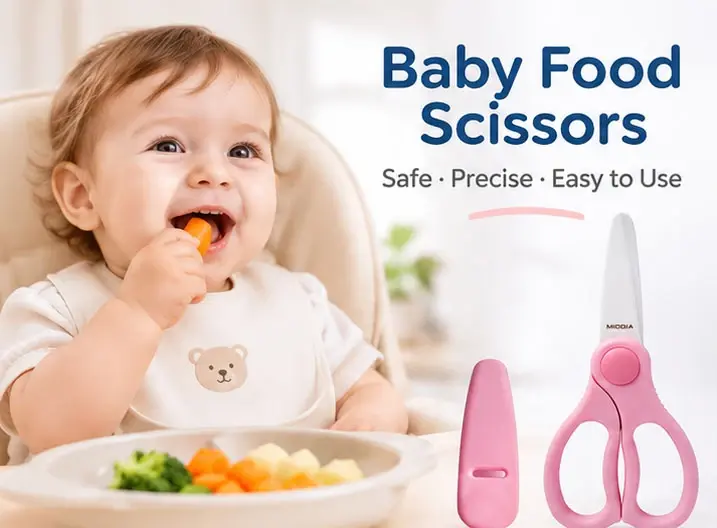
The blade material is one of the first things to examine when comparing baby food scissors. It affects cutting performance, resistance to corrosion, maintenance requirements, and how the scissors respond to accidental impact.
Two common material choices are stainless steel and ceramic. Both can be used in food preparation products, but their physical properties are different. Understanding these differences makes it easier to select a product that matches its intended use.
Stainless steel has been widely used in kitchen utensils and food preparation tools for many years. It offers good toughness, and its corrosion resistance depends on the steel grade, surface finish, and maintenance conditions.
Ceramic blades, particularly those made from zirconia (ZrO2), offer another set of characteristics. Zirconia is known for its high hardness, wear resistance, and excellent resistance to rust and many forms of chemical corrosion. It is a non-metallic material, so it does not develop the familiar red-brown rust associated with ordinary iron-based materials.
The following comparison provides a practical overview:
| Comparison | Ceramic Blades | Stainless Steel Blades |
|---|---|---|
| Rust Resistance | Excellent resistance to rust and many forms of corrosion | Depends on the steel grade and maintenance |
| Hardness | Very high hardness | Generally lower than zirconia ceramic |
| Wear Resistance | Good resistance to edge wear | Varies according to steel grade and heat treatment |
| Impact Resistance | More brittle and sensitive to impact | Generally tougher and more resistant to deformation |
| Maintenance | Does not require conventional rust prevention | May require more attention to corrosion prevention |
| Typical Food Preparation | Suitable for designated soft-food cutting tasks | Can accommodate a wider range of cutting applications depending on design |
Neither material is automatically the right choice for every situation. Stainless steel is generally more tolerant of bending and impact, while zirconia ceramic offers excellent hardness and corrosion resistance. The intended cutting tasks and the overall product construction should guide the decision.
Zirconia ceramic has become an interesting material choice for compact food preparation tools. Its high hardness helps maintain a sharp cutting edge during normal use, while its resistance to rust makes it suitable for products that regularly come into contact with moist foods and need frequent cleaning.
For baby food scissors, these properties offer several practical benefits:
Rust resistance: The ceramic blade does not rust like ordinary iron-based metals, which is useful for a product regularly exposed to moisture.
High hardness: Zirconia provides a hard cutting surface with good wear resistance.
Non-metallic construction: Ceramic blades offer an alternative to conventional metal cutting edges.
Low corrosion concerns: The blade material is resistant to many substances encountered during ordinary food preparation.
Practical maintenance: Users do not need to apply conventional rust-prevention treatments to the ceramic blade.
It is important to understand that ceramic hardness does not mean unlimited durability. Zirconia ceramic can chip or fracture if dropped onto a hard surface, twisted under excessive force, or used to cut materials beyond its intended application. A well-designed product should therefore balance blade performance with appropriate handling instructions and protective storage features.
For parents, the first consideration is whether the blade material suits the foods they normally prepare. Soft cooked vegetables, tender fruits, and boneless cooked foods are typical examples of tasks that compact baby food scissors may be designed to handle.
For retailers and distributors, the evaluation should go a little further. Ask the supplier for the actual blade material specification, food-contact documentation where applicable, and product testing information. A statement such as "ceramic blade" is not enough to establish the quality of the finished product.
It is also worth checking whether the material specification remains consistent across production batches. The blade material, edge finish, dimensions, and assembly quality all contribute to the final product experience.
Choosing the right material is only part of the process. Two pairs of scissors can use similar ceramic blades and still perform differently because of their blade geometry, length, alignment, and overall construction.
When evaluating baby food scissors, look at how the blades meet, how smoothly they move, and whether their design is appropriate for the food preparation tasks the product is intended to handle.
A suitable pair of baby feeding scissors should cut soft foods cleanly without requiring excessive hand pressure. If the blades do not align properly, food may become trapped between them instead of being cut efficiently.
Several details deserve attention:
Blade alignment: The two blades should meet consistently along the intended cutting area.
Cutting consistency: The scissors should produce reasonably even cuts during normal operation.
Opening and closing: Movement should feel controlled rather than excessively loose or stiff.
Edge finishing: The cutting edges should be properly finished without visible manufacturing defects.
Connection stability: The pivot and assembly should maintain stable blade movement.
Sharpness is important, but the sharpest product is not necessarily the most practical one. A compact feeding tool should provide predictable cutting performance while remaining comfortable to operate. Blade alignment and the relationship between blade length and handle design matter just as much as the material itself.
Blade length influences how the scissors feel during food preparation. A shorter blade can be convenient when working with small portions, while a slightly longer blade may offer a larger cutting area.
For example, MIDDIA offers different compact ceramic scissor designs, including models with approximately 2-inch and 2.5-inch blade lengths. These dimensions provide different options for brands and retailers targeting different feeding and portability preferences.
Tip design is another detail worth checking. Rounded or appropriately shaped tips can help reduce accidental poking during ordinary handling. However, rounded tips should not be treated as a substitute for careful use or safe storage.
Buyers should also consider the relationship between blade length and the full product dimensions. A longer blade does not automatically provide better control, and an extremely compact design may not suit every user's hand size.
For commercial buyers, product evaluation should include more than a simple cutting demonstration. A sample may perform well once but reveal problems after repeated opening and closing or when used with different soft-food textures.
Check the following points during sample evaluation:
Whether the blades remain properly aligned during repeated operation.
Whether the scissors cut the intended food samples without excessive pressure.
Whether the pivot becomes loose during normal use.
Whether there are visible chips, uneven edges, or assembly defects.
Whether the cutting performance is consistent across multiple samples.
These checks help retailers distinguish between a product that looks attractive in photographs and one that can deliver a more consistent user experience.
Baby food scissors are usually operated for short food preparation tasks, but comfortable handling still matters. A poorly designed handle can make a small cutting task feel unnecessarily difficult, especially when users prepare several portions during one meal.
The handle should allow natural finger placement, stable control, and smooth opening and closing. It should also work well with the overall size and weight of the scissors.
When comparing different baby food scissors, look at the shape and spacing of the finger openings. They should allow the intended user to hold the product without excessive finger pressure or an awkward wrist position.
A practical handle design generally considers:
Finger space: The openings should accommodate comfortable finger placement.
Grip stability: The handle should provide a secure hold during normal cutting movements.
Operating resistance: The scissors should open and close without unnecessary effort.
Weight distribution: The product should feel reasonably balanced in the hand.
Surface finish: There should be no obvious molding defects, uncomfortable edges, or rough surfaces.
It is also worth remembering that the end user may be a parent, grandparent, or caregiver with different hand sizes and levels of experience. An ergonomic design should be practical for a reasonably broad range of adult users rather than optimized only for appearance.
Many compact baby food scissors use PP (polypropylene) handles. PP is commonly used in household and consumer products because it is lightweight and can be molded into different shapes.
For a ceramic scissor design, the handle also needs to provide a stable connection with the blade assembly. This is particularly important because ceramic blades are hard but relatively brittle. The overall structure should not encourage unnecessary twisting, uneven pressure, or excessive movement at the connection points.
When examining a product sample, check the handle surface, molding quality, finger openings, and connection area. The two sides should fit together properly, and the scissors should not feel loose or unstable during ordinary operation.
Retailers and brand owners should consider the handle as part of the complete product specification. A comfortable design may improve the perceived quality of a feeding accessory, while inconsistent molding or poor assembly can lead to customer complaints.
During supplier evaluation, pay attention to:
PP material specifications and relevant documentation.
Consistency of handle dimensions and color.
Surface finish and molding quality.
Stability of the blade-to-handle connection.
Comfort and ease of operation during sample testing.
These details may seem small, but they contribute to the difference between a product that is merely inexpensive and one that is suitable for a long-term retail assortment.
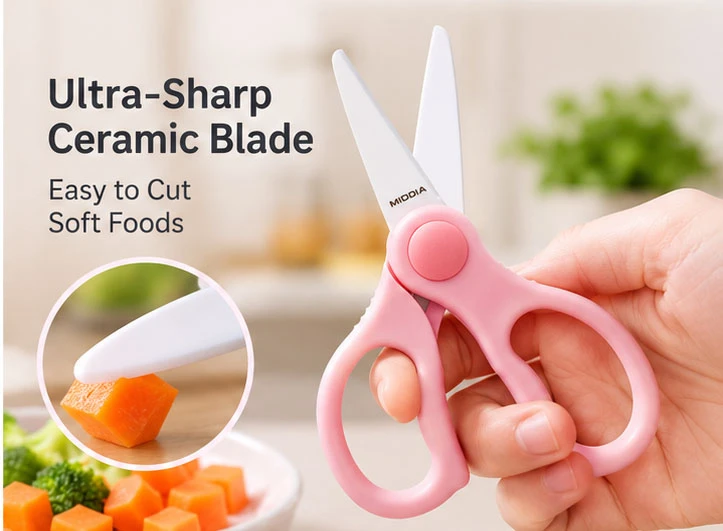
One reason parents choose baby food scissors instead of ordinary kitchen scissors is convenience. Feeding often takes place in different environments, including the home, restaurants, family visits, and travel situations. A compact product can be easier to store and carry, provided that it has appropriate blade protection.
Portable baby food scissors are designed to take up relatively little space. They may fit into a feeding accessory bag or a kitchen storage compartment, making them convenient for everyday use.
For families who regularly eat outside the home, a compact pair of scissors with a protective cover can be particularly practical. It allows adults to prepare suitable food portions without carrying a larger kitchen tool.
However, portability should not be judged by product size alone. Consider the full dimensions, weight, handle comfort, blade length, and the way the protective cover fits. A very small pair of scissors may be easy to carry but less comfortable to operate for some users.
The difference between a 2-inch and a 2.5-inch blade may appear minor, but it can influence the overall handling experience.
| Design | Typical Characteristics | Selection Considerations |
|---|---|---|
| 2-inch blade | More compact cutting area | Useful for small portions and users prioritizing compact storage |
| 2.5-inch blade | Slightly longer cutting area | Offers another option for general small-food preparation tasks |
These are general design considerations rather than strict performance categories. Actual usability also depends on handle dimensions, blade geometry, and the construction of the complete product.
Portability is not just a consumer convenience. It can also influence how a product fits into a retailer's assortment.
For example, compact feeding scissors may be positioned alongside baby feeding utensils, portable feeding sets, food storage accessories, and travel-related baby care products. E-commerce sellers can also use portability as a product feature when presenting the item to customers who need practical feeding accessories outside the home.
For distributors and private-label brands, offering more than one size or design can help serve different customer preferences. The key is to make the differences between models clear, using accurate dimensions and real product photographs rather than relying on vague descriptions such as "mini" or "extra compact."
A protective cover is one of the most useful features to examine when choosing baby food scissors. Because the product contains a cutting edge, storage design deserves as much attention as cutting performance.
Some models also include a safety lock or closing mechanism. Although these features are sometimes discussed together, they serve different purposes and should be evaluated separately.
A protective cover is designed to cover the blade when the scissors are not being used. This can help reduce accidental contact with the cutting edge during storage and make the product easier to carry with other feeding accessories.
For everyday use, a suitable cover should:
Fit securely over the blade area.
Be easy for an adult to remove and replace.
Stay in place during normal storage and transportation.
Have a smooth finish without obvious molding defects.
Be easy to clean and dry.
A cover that is too loose may fall off inside a bag, while one that is excessively tight may become inconvenient to use. Both conditions can reduce the practical value of the product.
A protective cover and a safety lock are not the same feature.
| Feature | Main Function | What to Check |
|---|---|---|
| Protective Cover | Covers the blade during storage | Fit, retention, ease of removal, and cleaning |
| Safety Lock | Helps keep the scissors in a closed position | Locking stability, ease of operation, and durability |
Not every baby food scissors model includes both features. Some designs focus on a protective cover, while others incorporate an additional locking mechanism. Buyers should check the specifications of each individual model rather than assuming that all products in a collection have identical safety features.
During product evaluation, remove and replace the cover several times. Check whether it fits consistently and whether the material shows any visible damage or deformation.
For manufacturers, cover design also involves dimensional consistency. Small differences in the molding dimensions can affect how securely the cover fits onto the blade assembly. This is one reason why inspection of the finished product matters.
For retail buyers, it is worth requesting samples from more than one production batch when possible. A protective cover that fits one sample perfectly does not necessarily prove that every unit will have the same fit.
Product testing provides additional information beyond what can be observed during a visual inspection. For baby food scissors, buyers should ask what tests have been performed, which product models were included, and what the test results actually demonstrate.
SGS 1-Meter Drop Test
MIDDIA products have undergone an SGS 1-meter drop test. This provides a reference point for evaluating product performance under the specific conditions described in the applicable test report.
For buyers, the important details are the tested model, drop-test procedure, impact conditions, inspection criteria, and recorded results. It is better to review the actual SGS documentation than to rely only on a general statement that a product has passed a drop test.
Also, a drop-test result should not be interpreted as a guarantee that a ceramic blade cannot chip or break under every possible impact. Zirconia ceramic remains a relatively brittle material compared with many metals, and users should avoid dropping, twisting, or misusing the scissors.
FDA and LFGB Documentation
Food-contact materials are another important consideration. FDA-related requirements in the United States and LFGB requirements in Germany are relevant reference frameworks when evaluating materials intended to come into contact with food.
MIDDIA can provide relevant FDA and LFGB documentation for its products and applicable materials. Buyers should confirm which components, materials, and product models are covered by each document, and whether the supporting test reports match the intended market requirements.
These documents should not be casually described as blanket FDA or LFGB certification of the entire assembled scissors. Their relevance depends on the actual material scope, testing basis, and applicable regulatory requirements.
For baby product brands and distributors, having clear documentation makes supplier evaluation more straightforward and helps support internal product compliance reviews.
Baby food preparation involves frequent contact with moist ingredients, sauces, fruit juices, and small food particles. Even a well-designed pair of scissors can become inconvenient if food residue collects around areas that are difficult to clean.
Cleaning convenience should therefore be part of the selection process, not something considered only after purchasing the product.
Pay particular attention to the pivot area, blade junction, and spaces where the blades meet. Small pieces of food can become trapped around these locations during cutting.
A practical design should allow adults to access the areas that need routine cleaning without unnecessary difficulty.
When examining a sample, consider:
Whether visible food residue can be removed from the blade area.
Whether the pivot and connection areas are accessible for cleaning.
Whether the protective cover can be cleaned separately.
Whether the product has narrow gaps that may collect food particles.
Whether the manufacturer provides understandable cleaning instructions.
Ceramic blades do not rust in the same way as ordinary iron-based metal blades, but that does not mean the scissors can be left dirty or wet after use. Food residue should still be removed promptly, and the product should be dried properly before storage.
A practical cleaning routine generally includes the following steps, provided they are consistent with the manufacturer's instructions:
Remove visible food residue. Clear away small pieces of food from the blade area after use.
Clean the accessible surfaces. Use an appropriate cleaning method for the blade, handle, and connection areas.
Rinse when permitted. Follow the product instructions regarding water exposure and cleaning agents.
Dry thoroughly. Pay attention to the pivot area and other locations where moisture may remain.
Store with the protective cover. Once clean and dry, cover the blade before putting the scissors away.
Do not use abrasive materials or apply excessive force when cleaning the ceramic blade. The aim is to remove food residue without damaging the cutting edge or stressing the blade assembly.
This is a question worth checking before purchasing any baby feeding accessory. Cleaning and sterilization are different processes, and not every product is designed to withstand high-temperature treatment.
Whether baby food scissors can be boiled, steam sterilized, or placed in a dishwasher depends on the specific construction and materials used in the product. The ceramic blade itself may tolerate conditions that other components, such as the PP handle, pivot, or protective cover, are not designed to withstand.
For this reason, never assume that all ceramic baby food scissors are suitable for boiling or steam sterilization. Follow the manufacturer's model-specific instructions and check the permitted temperature range before using any high-temperature cleaning method.
For retailers and distributors, clear maintenance instructions are a useful part of product documentation. They help consumers use the product correctly and reduce avoidable complaints caused by unsuitable cleaning methods.
Not every pair of baby food scissors is suitable for every type of food. A compact ceramic design may work well for soft ingredients but should not be treated as a replacement for heavy-duty kitchen shears.
Before choosing a product, think about the foods it will be used to prepare and whether those applications match the manufacturer's instructions.
Standard baby food scissors are generally intended for relatively soft foods that can be cut without excessive force. Depending on the blade design and product instructions, common examples include:
Soft cooked vegetables: Such as well-cooked carrots, potatoes, pumpkin, and broccoli florets.
Soft fruits: Such as ripe bananas, peeled pears, and other suitably prepared soft fruits.
Cooked pasta: Suitable pasta shapes can be shortened into smaller portions.
Boneless cooked fish: Soft cooked fish can be divided into smaller pieces after carefully checking for bones.
Tender cooked meat: Small pieces of boneless, appropriately cooked meat may be cut when the product is designed for this purpose.
The food should be soft enough for the scissors to cut without excessive pressure. Always follow age-appropriate feeding guidance and prepare food according to the child's developmental stage.
Compact baby feeding scissors are not intended for hard or unusually dense materials. This is particularly important for ceramic blade designs because their high hardness does not provide the same impact tolerance as a tough metal blade.
Avoid using standard baby food scissors for:
Bones or foods containing hard bone fragments.
Frozen foods or ingredients that are difficult to cut.
Hard nuts and seeds.
Hard raw vegetables that require substantial cutting force.
Very dense ingredients that may cause excessive pressure or twisting.
Non-food materials or other applications outside the manufacturer's instructions.
Applying excessive force, twisting the blades, or trying to cut hard ingredients may damage the blade or the connection structure. If an ingredient requires considerable pressure, a more suitable kitchen tool should be used.
One point should never be overlooked: baby food scissors are intended for adult food preparation. They are not toys and should not be given to babies or young children to handle independently.
Even when a product has rounded tips, a protective cover, or a locking mechanism, adults remain responsible for safe handling and storage.
Keep the scissors and protective cover out of children's reach when not in use. Check the prepared food carefully before serving, including its temperature, texture, and size. Cutting food into smaller pieces does not automatically eliminate choking risks.
Parents and caregivers should follow appropriate feeding recommendations for the child's age and developmental abilities. Food preparation tools can make daily tasks easier, but they do not replace adult supervision or safe feeding practices.
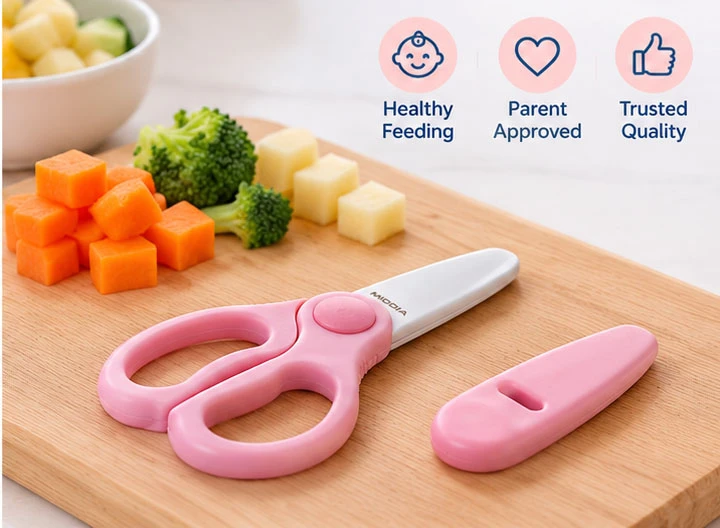
For consumers, product quality is often judged by how the scissors feel and perform during everyday use. For retailers, distributors, and baby product brands, the evaluation process needs to be more systematic.
A product may have an attractive design and competitive price, but that alone does not establish whether it is suitable for a retail assortment. Buyers should examine materials, documentation, manufacturing consistency, and the supplier's ability to maintain the same specifications across repeated orders.
Start by asking the supplier for a clear product specification sheet. It should identify the main materials and relevant dimensions rather than relying on broad descriptions such as premium quality or food-grade construction.
Depending on the product and target market, useful documents may include:
Zirconia ceramic blade material specifications.
PP handle material specifications.
Applicable food-contact material documentation.
Relevant FDA-related documentation for the intended market.
Applicable LFGB test reports or documentation.
SGS drop-test reports identifying the tested model and conditions.
Product drawings, dimensions, and inspection specifications.
Documentation should be checked carefully. A report for one material or component should not automatically be treated as evidence for every component in the finished product. Similarly, a test performed on one model should not be assumed to cover every product variation.
For buyers supplying multiple markets, it is useful to confirm the relevant regulatory and testing requirements before finalizing the product specification. Requirements can differ depending on the destination market, product classification, and intended use.
Sample quality matters, but consistency across production batches matters just as much. A good sample does not guarantee that every unit in a commercial order will have identical blade alignment, handle dimensions, or protective cover fit.
During supplier evaluation, pay attention to several manufacturing details:
Blade dimensions and alignment: Ceramic blades should meet the agreed dimensional and assembly requirements. Misalignment can affect cutting performance.
Handle molding quality: Check for visible defects, uneven surfaces, inconsistent color, or uncomfortable edges.
Protective cover fit: The cover should fit consistently and remain secure during normal storage.
Opening and closing performance: The scissors should operate smoothly without excessive looseness or stiffness.
Assembly quality: The blade, handle, and connecting components should be properly assembled, with no obvious movement or instability.
For larger orders, buyers should discuss the supplier's incoming material inspection, in-process quality checks, and finished-product inspection procedures. A documented inspection process provides a clearer basis for maintaining quality than a general promise that every product is carefully checked.
Baby product retailers rarely serve only one type of customer. Some focus on compact feeding accessories for travel, while others build broader baby care collections that include feeding utensils, storage products, and kitchen-related accessories.
Having several product designs available can help brands create a more suitable assortment.
For example, MIDDIA's ceramic scissors collection includes different designs, with variations in blade length, handle appearance, protective cover, and locking features depending on the model.
When comparing models, buyers should examine:
Compact designs with approximately 2-inch blades.
Models with approximately 2.5-inch blades.
Different handle shapes and color options.
Models supplied with protective covers.
Selected designs incorporating additional safety-lock features.
The important point is to compare the actual specifications of each model. A product collection may share a common design direction without every model having exactly the same features.
For private-label brands and distributors, product selection often involves more than choosing an existing design. Packaging, brand identity, product colors, and the way the scissors are presented at retail can all influence the final assortment.
Before placing an order, buyers should consider whether the manufacturer can support the customization requirements relevant to their market.
Common customization options may include:
Logo customization: Adding the brand identity to suitable product or packaging areas.
Color customization: Selecting handle or protective cover colors that match the brand's product range.
Packaging customization: Developing retail packaging suitable for online or physical retail channels.
Product selection: Choosing different models to create a more complete baby feeding accessory collection.
MIDDIA provides customization support for suitable projects. As a general reference, logo customization can start from approximately 2,000 pieces, while color and packaging customization can start from approximately 3,000 pieces. Actual requirements depend on the selected model, materials, customization scope, and order details, so buyers should confirm the conditions before placing an order.
For retailers and brand owners, the goal is to find a supplier that can provide more than an attractive sample. Clear specifications, applicable test documentation, consistent manufacturing, and practical customization support are all part of a reliable product sourcing decision.
If you are comparing several products and do not want to examine every specification separately, the following checklist provides a practical starting point. It covers the main features that matter for everyday feeding as well as the quality factors that retailers and distributors should verify.
| No. | Selection Criteria | What to Look For |
|---|---|---|
| 1 | Blade Material | Suitable food-contact materials, rust resistance, wear characteristics, and supporting documentation. |
| 2 | Blade Design | Appropriate blade length, consistent cutting performance, proper alignment, and suitable tip design. |
| 3 | Handle Ergonomics | Comfortable finger placement, stable grip, and smooth opening and closing. |
| 4 | Size and Portability | Compact dimensions, manageable weight, and convenient storage for everyday feeding. |
| 5 | Protective Features | A secure blade cover and, where applicable, a reliable safety-lock mechanism. |
| 6 | Cleaning and Maintenance | Accessible cleaning areas, removable or manageable covers, and clear maintenance instructions. |
| 7 | Food Compatibility | Suitable for intended soft-food applications and supported by clear usage limitations. |
| 8 | Product Quality Verification | Material documentation, applicable SGS testing, dimensional consistency, and manufacturing inspection. |
For individual consumers, these eight points can help narrow down the choices before purchasing. For retailers, distributors, and brands, the checklist can also serve as a basic product evaluation framework when comparing samples from different suppliers.
The best baby food scissors are not simply the sharpest, smallest, or cheapest. They should combine suitable blade materials, practical cutting performance, comfortable handling, appropriate protective features, convenient maintenance, and verifiable product quality.
Not every product needs to have the most advanced design or the longest list of features. What matters is whether the product performs its intended tasks reliably and whether its specifications match the expectations of the target market.
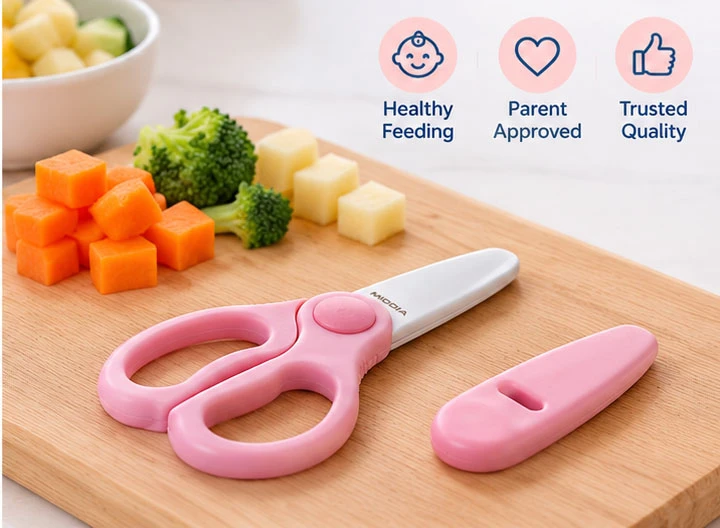
For retailers, distributors, and baby product brands looking to expand their feeding accessory collections, MIDDIA offers a range of ceramic scissors designed around compact food preparation and everyday convenience.
The collection includes different models with zirconia ceramic blades, lightweight PP handles, and compact blade designs. Depending on the selected model, product features may include protective covers, different handle styles, and additional safety-lock mechanisms.
MIDDIA's ceramic blade designs offer several characteristics that are relevant to everyday food preparation:
Zirconia ceramic blades: High hardness, good wear resistance, and excellent rust resistance.
Compact blade options: Different blade lengths, including approximately 2-inch and 2.5-inch designs.
Lightweight PP handles: Designed for practical everyday handling.
Protective cover options: Helping cover the blade during storage, depending on the model.
Additional safety features: Selected models include safety-lock designs.
Product testing and documentation: SGS 1-meter drop-test experience and relevant FDA/LFGB documentation, subject to the applicable model and material scope.
These features provide a foundation for retailers and brands evaluating ceramic scissors for baby feeding and food preparation categories. As with any product, the exact specifications and applicable documents should be confirmed for the selected model.
Different retail channels have different product requirements. A baby care retailer may prioritize a compact design that complements its feeding accessories, while an e-commerce brand may pay more attention to product appearance, packaging, and clear feature differentiation.
MIDDIA supports different product and customization requirements for suitable projects, including logo, color, and packaging options. Buyers can review the available designs first and then identify the models that best match their intended retail positioning.
Whether you are developing a new baby feeding accessory range, expanding an existing product collection, or evaluating ceramic scissors for distribution, starting with the actual product specifications and testing documentation is a practical way to make an informed decision.
Explore the MIDDIA Ceramic Scissors Collection to compare available designs and find a suitable option for your product range.
View MIDDIA Baby Food Scissors Collection
It depends on the intended use. Ceramic blades offer excellent rust resistance, high hardness, and good wear resistance, while stainless steel blades generally provide greater toughness and impact resistance. For compact baby food scissors designed for soft-food preparation, zirconia ceramic can be a practical material choice. Buyers should also consider blade design, construction quality, and maintenance requirements.
Look at eight main factors: blade material, blade design, handle ergonomics, size and portability, protective features, cleaning convenience, food compatibility, and product quality documentation. A good pair should suit the intended food preparation tasks, feel comfortable to operate, and provide appropriate protection during storage.
A protective cover helps cover the cutting edge when the scissors are stored, reducing the risk of accidental contact during handling and transportation. However, a cover does not make the product completely risk-free. Always store scissors out of children's reach and follow the manufacturer's safety instructions.
Depending on the product design, baby food scissors can be used for soft cooked vegetables, ripe fruits, cooked pasta, boneless cooked fish, and tender cooked meat. Avoid using standard compact feeding scissors for bones, frozen foods, hard nuts, or other ingredients that require excessive cutting force.
Remove food residue after use, clean the accessible blade and pivot areas according to the manufacturer's instructions, and dry the scissors thoroughly before storage. Keep the protective cover clean as well. Do not assume that every model is suitable for boiling, steam sterilization, or dishwasher cleaning.
Yes. Zirconia ceramic is very hard but can be brittle under impact. A fall onto a hard surface may cause chipping or fracture depending on the impact conditions. MIDDIA products have undergone an SGS 1-meter drop test under specified conditions, but this should not be interpreted as a guarantee against all forms of impact damage. Avoid dropping or twisting ceramic scissors.
Retailers should verify the blade and handle materials, applicable food-contact documentation, product dimensions, blade alignment, protective cover fit, and batch consistency. Request relevant SGS test reports and FDA/LFGB documentation, checking which models and materials are covered. It is also useful to evaluate packaging, customization options, and the manufacturer's quality inspection process.
Choosing the right baby food scissors involves more than finding a compact product with a sharp blade. Material selection, blade geometry, handle comfort, portability, protective features, and cleaning requirements all contribute to the overall user experience.
For consumers, the most suitable choice is a product that matches everyday food preparation needs and can be handled and stored safely. For retailers, distributors, and baby product brands, the decision should also include material verification, product testing, manufacturing consistency, and the availability of relevant documentation.
Zirconia ceramic offers a useful combination of high hardness, wear resistance, and rust resistance for designated soft-food cutting applications. When these material characteristics are supported by appropriate product design, reliable manufacturing, and clear usage instructions, ceramic baby food scissors can become a practical addition to a baby feeding accessory collection.
Use the eight-point checklist in this guide as a starting point when comparing different models. Looking at the complete product rather than one individual feature will help you make a more informed selection.
Choosing Baby Food Scissors for Your Product Line?
Looking for baby food scissors that combine practical cutting performance, easy maintenance, and thoughtful product design? Explore MIDDIA's zirconia ceramic baby food scissors and compare available models, blade designs, handle options, and protective features.
MIDDIA welcomes inquiries from baby product retailers, distributors, importers, and private-label brands looking for a reliable ceramic scissors supplier.
Zirconia ceramic blade options with excellent rust and corrosion resistance
Multiple baby food scissors designs for different product requirements
Available product samples and relevant test documentation
Logo, handle color, and packaging customization options
Copyright © 2011-2026 custom ceramic blades, ceramic fishing scissors, ceramic box cutter, baby food scissors, zirconia blade manufacturer, MIDDIA MIDDIA. All Rights Reserved. XML Map
