Zirconia ceramic fishing blades are known for their high hardness, excellent wear resistance, and resistance to rust and corrosion. These properties make them an attractive choice for fishing scissors and specialized line cutters designed for freshwater and saltwater applications. However, the performance of a ceramic fishing blade does not come from the material alone. The manufacturing process plays an equally important role.
From selecting zirconia powder to forming, sintering, precision grinding, and final inspection, every stage contributes to the quality of the finished blade. Small differences in material preparation, processing conditions, or edge geometry can affect dimensional consistency, cutting performance, and product reliability.
For fishing tackle brands, distributors, wholesalers, and private-label buyers, understanding how zirconia ceramic fishing blades are manufactured is useful when evaluating potential suppliers. It helps explain why two ceramic blades made from the same basic material may perform differently, and what manufacturing capabilities matter when developing a new fishing scissors product.
In this guide, we examine the main manufacturing stages behind zirconia ceramic fishing blades, explain how production quality affects cutting performance, and discuss what buyers should consider when choosing a ceramic fishing tool manufacturer for OEM or ODM projects.
Before looking at the manufacturing process, it is worth understanding why zirconia is used in fishing scissors. The material itself provides several useful characteristics, but these properties must be supported by appropriate processing and blade design to become practical advantages in a finished cutting tool.
Zirconia, also known as zirconium dioxide (ZrO2), is an advanced engineering ceramic used in applications that require high hardness, wear resistance, chemical stability, and dimensional performance.
Unlike traditional ceramics used for household products, engineering zirconia is developed for more demanding mechanical applications. Its properties depend on factors such as powder characteristics, chemical composition, stabilizer content, and manufacturing conditions.
Many industrial zirconia components use stabilized zirconia formulations. For example, yttria-stabilized zirconia is widely used in technical ceramics because its microstructure can provide a useful combination of strength and fracture resistance. The exact formulation, however, depends on the intended application and the manufacturer's material selection.
Several characteristics make zirconia relevant to ceramic cutting tools:
High hardness: Zirconia is significantly harder than many conventional metal materials, helping ceramic blades maintain their cutting characteristics during use.
Wear resistance: Its resistance to abrasive wear makes it suitable for applications where repeated contact with other materials occurs.
Corrosion resistance: Zirconia is chemically stable and does not develop conventional rust like iron-based steel.
Dimensional stability: Properly processed zirconia can provide consistent dimensions and surface characteristics.
Electrical insulation: As a ceramic material, zirconia is electrically insulating, although this is not a primary selection factor for fishing scissors.
These characteristics explain why zirconia is used in various industrial components, cutting applications, and specialized consumer tools.
Fishing scissors operate in conditions that are not always friendly to ordinary metal cutting tools. They may be exposed to seawater, fishing line coatings, moisture, dirt, and repeated contact with abrasive materials. For anglers who fish frequently, blade maintenance and corrosion are practical concerns.
Zirconia ceramic offers several advantages in this environment.
First, its corrosion resistance makes the ceramic cutting edge suitable for saltwater fishing applications. Unlike conventional carbon steel, the ceramic blade itself does not rust when exposed to moisture or seawater under normal fishing conditions.
Second, its hardness and wear resistance help maintain a usable cutting edge over repeated cutting cycles. This is particularly relevant for anglers who regularly cut braided PE line, fluorocarbon, and monofilament.
Third, zirconia can be processed into different blade configurations. Depending on the product design, manufacturers can develop straight-edge blades, serrated cutting edges, and compact cutting components for different types of fishing tools.
However, zirconia is not indestructible. Ceramic materials are generally more brittle than metals and may chip or fracture under impact or excessive lateral force. Blade geometry, edge thickness, assembly design, and proper handling all contribute to the reliability of the finished product.
When developing fishing scissors, brands often compare zirconia ceramic with stainless steel. Neither material is automatically the best choice for every application. The decision depends on the intended customer, product positioning, cutting requirements, and price expectations.
| Evaluation Factor | Zirconia Ceramic | Stainless Steel |
|---|---|---|
| Rust resistance | Excellent | Depends on steel grade and surface condition |
| Hardness | Very high | Depends on alloy and heat treatment |
| Wear resistance | Generally high | Varies by material and treatment |
| Impact resistance | More brittle | Generally more ductile |
| Edge processing | Precision ceramic grinding | Metal grinding and sharpening |
| Saltwater application | Excellent corrosion resistance | Depends on stainless steel grade and maintenance |
For fishing tackle brands, ceramic blades offer an opportunity to develop products with a different combination of corrosion resistance, wear characteristics, and maintenance requirements. Stainless steel remains a practical choice for many conventional scissors, especially where impact resistance and price are important.
The key is to select the material based on the actual fishing application rather than relying on a single performance specification.
Manufacturing a zirconia ceramic fishing blade involves several interconnected processes. Although the exact production route varies according to the blade design, material formulation, and manufacturing equipment, the general process includes raw material selection, powder preparation, granulation, molding, sintering, precision grinding, and quality inspection.
Each stage has its own purpose. A problem introduced during an early stage may become more difficult to correct later, particularly after the ceramic material has been sintered and hardened.
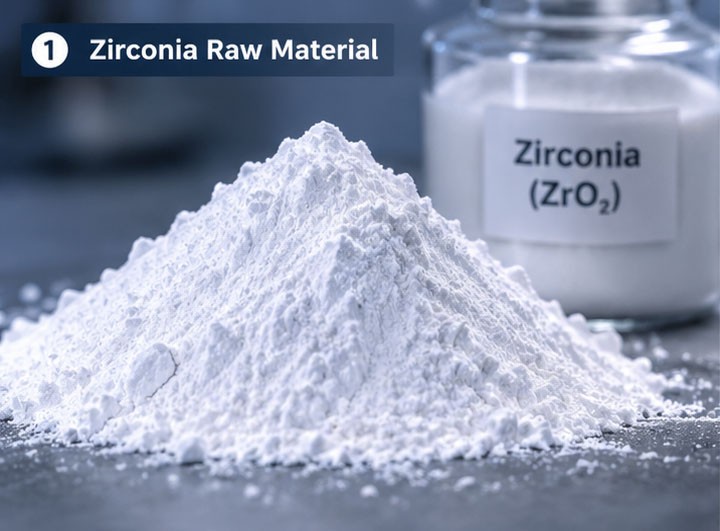
The first stage is selecting suitable zirconia raw materials. Unlike metal blades, which are usually produced from metal sheets or bars, technical ceramic blades begin with ceramic powders that must be prepared and processed before forming.
The quality of the powder has a direct influence on the potential properties of the final ceramic component. Important considerations include:
Chemical composition: The composition of zirconia and any stabilizing additives influences the material's phase structure and mechanical properties.
Particle size distribution: Powder particle size and distribution affect packing behavior, forming characteristics, and subsequent densification.
Purity: Unwanted impurities may influence sintering behavior and the quality of the final ceramic structure.
Powder consistency: Consistent incoming material helps manufacturers maintain more predictable processing conditions.
For fishing blade production, the objective is not simply to obtain a material with a high hardness value. The powder must also be suitable for forming and subsequent precision processing.
For buyers evaluating a ceramic blade supplier, it is useful to ask what type of zirconia material is used and whether the supplier can explain the material characteristics relevant to the finished product.
A supplier that understands the relationship between raw material selection and finished blade performance is generally better positioned to discuss technical requirements during product development.
After material selection, the zirconia powder is prepared for the forming process. Depending on the production route, this may involve mixing, dispersion, conditioning, and other powder-processing operations.
The objective is to achieve a sufficiently uniform powder mixture and suitable processing characteristics before the material enters the molding stage.
Why does this matter?
Uneven powder distribution can create differences in local composition or packing density. These variations may affect how the ceramic body behaves during forming and sintering. If the powder is not properly prepared, the resulting components may show differences in density, shrinkage, or structural quality.
Powder preparation also needs to be compatible with the selected forming method. The requirements for a powder used in dry pressing, for example, may differ from those used in other ceramic forming techniques.
For fishing scissors manufacturers, stable powder preparation is an important part of maintaining consistent blade quality across production batches. Although customers may never see this stage, its effects can appear later in the dimensions, mechanical characteristics, and processing behavior of the ceramic blades.
Granulation is used in many ceramic manufacturing processes to prepare powder into particles with more suitable handling and forming characteristics.
Depending on the selected production method, binders or processing additives may be introduced before granulation. The prepared material is then conditioned to achieve the required moisture level and powder characteristics.
Granulated powder can offer several advantages:
Improved powder flow during filling of the forming die.
More consistent material distribution inside the mold.
Better control of powder handling and feeding.
More predictable forming behavior during production.
Moisture control is another important consideration. Excessive or insufficient moisture may affect powder flow, compaction, and the quality of the formed ceramic body.
For manufacturers, this stage helps establish a stable starting condition for molding. A more consistent powder feed can make it easier to maintain uniformity between individual components.
Not every zirconia manufacturing route uses identical granulation or dehydration procedures. The specific method depends on the powder system and forming technology being used.
Once the powder has been prepared, it is formed into the required ceramic component. This stage is commonly referred to as molding or forming.
For certain ceramic components, dry pressing or other powder-compaction techniques are used. The prepared powder is placed into a mold and compacted under controlled pressure to create a preliminary shape.
The resulting component is known as a green body. At this stage, it has the approximate geometry of the intended product, but it has not yet developed the full density and mechanical properties of the finished ceramic.
Several factors are important during molding:
Mold design: The mold determines the initial shape and influences the dimensional characteristics of the formed component.
Filling consistency: Uniform powder distribution helps reduce density variations within the green body.
Compaction conditions: Appropriate forming conditions help achieve a stable preliminary structure.
Component geometry: Blade thickness, outline, and structural features need to be considered before production.
For ceramic fishing scissors, blade geometry is particularly important. Different products may require different lengths, widths, thicknesses, mounting features, or cutting-edge configurations.
For example, a compact ceramic fishing-line cutter may have a different structural design from a pair of conventional fishing scissors. A retractable cutter also needs to accommodate its sliding or protective mechanism.
These requirements should be considered during product development rather than waiting until the ceramic blade has already been manufactured.
It is also important to account for the dimensional changes that occur during sintering. The green body is not necessarily the same size as the final component.
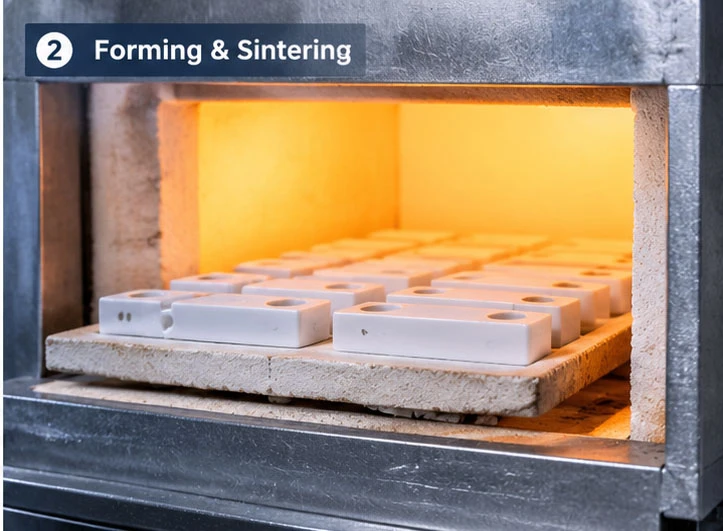
Sintering is one of the most important stages in zirconia ceramic manufacturing. It transforms the formed powder compact into a dense ceramic component with the mechanical characteristics required for its intended application.
During sintering, the ceramic body is heated according to a controlled temperature profile. Material transport processes cause the particles to bond and the structure to become denser. Porosity is reduced as the ceramic develops its final microstructure.
This is not simply a heating process. The sintering conditions influence the density, grain structure, shrinkage behavior, and mechanical properties of the finished component.
Several factors need to be controlled:
Sintering temperature: The selected temperature must be appropriate for the zirconia composition and intended material properties.
Holding time: The duration at the required temperature influences densification and microstructural development.
Heating and cooling rates: Controlled temperature changes help reduce the risk of unwanted thermal stresses.
Atmosphere and furnace conditions: Appropriate furnace conditions are necessary to maintain the required material characteristics.
Loading arrangement: The positioning and support of ceramic components can influence dimensional consistency and deformation behavior.
Another important consideration is shrinkage. Zirconia ceramic components normally become smaller as they densify during sintering. The amount of shrinkage must be considered during the initial forming and mold-design stages.
If shrinkage is not properly accounted for, the final component may not meet the required dimensions. Differences in shrinkage behavior can also create additional work during subsequent machining.
For fishing blade manufacturers, sintering consistency matters because the resulting material must be suitable for precision grinding and final blade processing.
A poorly controlled process may contribute to dimensional variation, structural defects, or inconsistent material properties. These issues can increase processing difficulty and affect the reliability of the finished ceramic blade.
For procurement teams, the important question is not simply whether a supplier has a sintering furnace. It is whether the manufacturer understands how the sintering process affects the final component and maintains appropriate production controls.
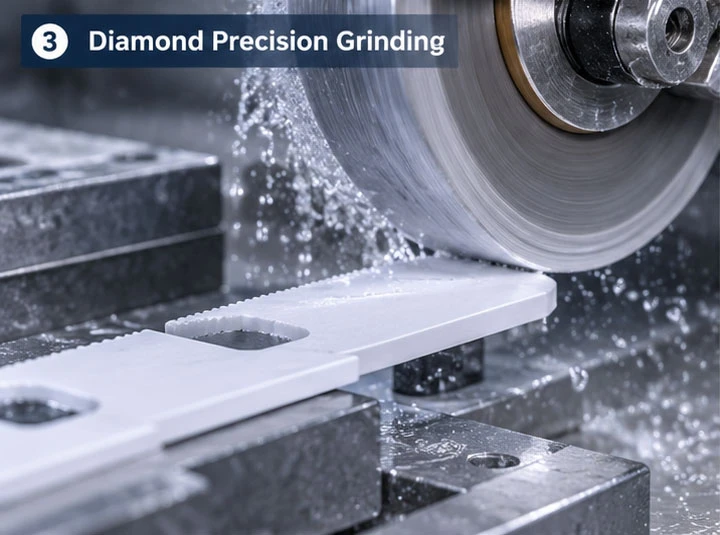
After sintering, zirconia ceramic becomes a hard and dense material. However, the component may still require dimensional finishing and cutting-edge processing before it can be used in a fishing scissors assembly.
Precision grinding is therefore a critical manufacturing operation.
Because zirconia is extremely hard, conventional metal-cutting methods are generally unsuitable for many finishing operations. Diamond grinding tools are commonly used to process technical ceramics because diamond abrasives can effectively remove material from hard ceramic surfaces.
The grinding process may involve several operations depending on the component design:
Grinding the outer blade profile.
Adjusting blade thickness and critical dimensions.
Finishing mounting or positioning features.
Processing the cutting edge.
Improving the required surface finish.
For fishing scissors, the cutting edge deserves particular attention. A ceramic blade can have excellent material properties, but those properties alone do not guarantee a clean and reliable cut.
The edge geometry, sharpness, thickness, and relationship between the two blades all influence the final cutting result.
Different fishing line materials have different surface characteristics and mechanical behavior. Braided PE line consists of multiple tightly woven fibers, while monofilament and fluorocarbon lines have different structures and deformation characteristics.
As a result, one blade configuration may not provide the same cutting experience across every line type.
For braided PE line, a suitable serrated edge can help engage the fibers and reduce the tendency of the line to move away from the cutting position. The actual result depends on the serration profile, tooth spacing, edge sharpness, and overall blade geometry.
For monofilament and fluorocarbon, the edge configuration and blade alignment also influence how effectively the line is held and separated during cutting.
Manufacturers may therefore develop different blade configurations to meet different product requirements.
Straight-edge blades have a continuous cutting edge and are commonly used in compact cutters and conventional scissor designs. Their performance depends on edge sharpness, geometry, and proper contact between the blades.
Serrated-edge blades feature a series of small teeth along the cutting edge. This configuration can help grip certain types of braided line during cutting. The tooth geometry must be carefully processed to achieve the intended cutting behavior.
Some fishing scissors use a one-sided serrated configuration, where only one blade has serrations while the opposite blade has a different edge profile. This is a specific design choice, not a requirement for every ceramic fishing scissors product.
For OEM projects, the blade configuration should be selected according to the target fishing line, intended users, and product positioning.
Precision grinding is therefore more than a finishing operation. It is one of the stages where material properties are translated into practical cutting performance.
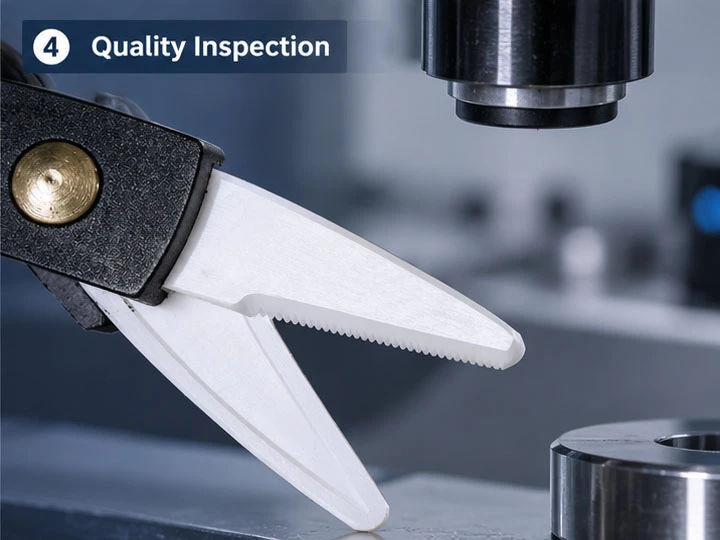
Once grinding and edge processing are completed, ceramic blades need to undergo inspection before they move into the final assembly process.
Quality control should consider both the ceramic component itself and its intended function within the finished fishing scissors.
Dimensional inspection
Critical dimensions such as blade length, width, thickness, and mounting features should be checked against the relevant product specifications. Dimensional consistency is important because the ceramic blade must fit correctly within the handle and assembly structure.
Surface and visual inspection
The blade should be examined for visible cracks, chips, surface damage, and other defects. Particular attention should be paid to the cutting edge because small defects can affect cutting performance and product reliability.
Edge inspection
Blade sharpness, edge condition, and geometry should be evaluated according to the product requirements. The inspection method should be appropriate for the blade design.
Functional cutting tests
Where applicable, cutting tests can be performed using specified fishing line types. Testing should consider the intended application, including braided PE line, monofilament, and fluorocarbon where relevant.
It is useful to distinguish between ceramic blade inspection and finished scissors inspection.
A ceramic blade may pass its individual dimensional and visual checks, but the assembled scissors can still perform poorly if the blade alignment, pivot structure, contact pressure, or handle assembly is incorrect.
For this reason, finished-product inspection should also consider:
Blade alignment and contact between the cutting edges.
Opening and closing smoothness.
Assembly stability.
Cutting performance under the intended application conditions.
Consistency between production samples and mass-produced units.
For buyers, this distinction is important. A supplier should not evaluate a fishing scissors product only by examining the ceramic blade in isolation. The finished tool needs to work as a complete cutting system.
Understanding the manufacturing process becomes more useful when it is connected to the actual performance of a fishing scissors product. Different production stages influence different characteristics, and several factors must work together to achieve a reliable cutting result.
Zirconia's high hardness is one of the reasons it is used in ceramic cutting tools. However, hardness alone does not determine how long a blade will remain effective.
Material composition, microstructure, sintering quality, and edge processing all contribute to the final wear behavior.
A blade made from an appropriate zirconia material and processed under controlled conditions can offer good resistance to abrasive wear. This is useful for fishing scissors that are used repeatedly to cut different types of fishing line.
For brands developing a premium ceramic fishing tool, it is therefore worth asking suppliers about the material grade and the manufacturing controls used to achieve consistent blade properties.
Even a hard and wear-resistant blade may produce disappointing results if its edge geometry is unsuitable for the intended line material.
Cutting efficiency depends on several related factors, including edge angle, edge thickness, sharpness, tooth profile, and the way the two blades interact.
For example, a serrated edge may be suitable for gripping braided PE fibers, while a different edge configuration may be preferred for another cutting application.
The design also needs to account for the practical needs of anglers. A compact cutter used for quick line trimming may have different requirements from a larger pair of fishing scissors intended for repeated cutting tasks.
This is why blade design should be evaluated through actual cutting tests rather than appearance or material specifications alone.
Dimensional accuracy is particularly important in scissors because the cutting result depends on the interaction between two blades.
If the blade dimensions vary too much, the assembly may become difficult to control. Incorrect alignment or unsuitable contact between the cutting edges can cause the fishing line to slip instead of being cleanly cut.
Blade thickness, mounting position, pivot design, and assembly tolerances all influence this relationship.
For ceramic scissors, the manufacturer must also consider the material's brittleness when designing the assembly. Excessive clamping force or unsuitable contact pressure can introduce unnecessary stress into the ceramic component.
Consistent dimensions and suitable assembly design therefore contribute directly to the usability of the finished product.
Zirconia ceramic offers excellent hardness and corrosion resistance, but it behaves differently from metal when subjected to impact.
Metal blades can often deform to some degree before breaking. Ceramic materials have lower tolerance for certain types of impact and tensile stress.
Potential issues include edge chipping, surface cracks, and damage caused by improper handling or assembly.
For manufacturers, material preparation, sintering control, grinding quality, and inspection are all relevant to reducing the risk of defects.
For fishing tool brands, the handle and blade protection design should also be considered. A protective cover, suitable blade housing, or retractable structure may help reduce accidental contact and damage during storage and transportation.
A high-quality ceramic fishing scissors product is therefore not defined by hardness alone. It is the result of suitable material selection, controlled manufacturing, precision edge processing, proper assembly, and appropriate product design.
For fishing tackle brands, importers, distributors, and private-label buyers, selecting a ceramic blade manufacturer involves more than comparing unit prices.
The supplier's ability to understand material characteristics, control manufacturing processes, develop suitable blade designs, and maintain production consistency can have a significant effect on the success of a product line.
The following points provide a practical framework for evaluating potential suppliers.
Start by asking what type of zirconia material the supplier uses and what experience it has with technical ceramic processing.
A manufacturer should be able to explain the basic production stages, including powder preparation, forming, sintering, and finishing. It should also be able to discuss how these stages relate to the requirements of ceramic cutting components.
Useful questions include:
What type of zirconia material is used for the blades?
What forming and sintering processes are used?
How are material and dimensional consistency controlled?
What experience does the manufacturer have with ceramic cutting tools?
Clear technical communication is often a useful indication of whether a supplier understands the products it manufactures.
Precision grinding is one of the most important operations in ceramic blade production. Buyers should therefore pay attention to the supplier's ability to process different blade shapes and edge configurations.
For fishing scissors projects, consider whether the manufacturer can support:
Different blade lengths and profiles.
Custom blade thickness and dimensions.
Straight-edge and serrated-edge designs.
One-sided serrated cutting configurations.
Custom mounting and assembly requirements.
Not every supplier offering ceramic products necessarily has the experience required to manufacture fishing scissors blades. The ability to process the material into a functional cutting component is just as important as access to zirconia raw materials.
A sample that performs well is a useful starting point, but it does not automatically guarantee consistent mass production.
For commercial orders, buyers should understand how the supplier checks product dimensions, appearance, edge condition, and finished cutting performance.
It is also useful to discuss how the manufacturer handles defective products, production changes, and inspection records.
For brands selling through retail channels or established distribution networks, batch consistency is particularly important. A noticeable difference between samples and delivered products can create customer complaints, returns, and additional quality-control costs.
Before placing a large order, buyers should agree on the relevant specifications and sample approval requirements.
Many fishing tackle brands do not want to sell exactly the same fishing scissors as every other supplier. They need products that fit their own market positioning, brand identity, and customer requirements.
This makes OEM and ODM support an important consideration.
Depending on the manufacturer's capabilities, customization may include:
Blade configuration: Selecting suitable straight-edge or serrated-edge designs.
Handle design: Developing different shapes, colors, and functional details.
Branding: Adding customer logos and brand identification.
Product configuration: Adjusting the overall tool design for different fishing applications.
Packaging: Developing retail packaging suitable for the customer's sales channels.
For private-label buyers, the ability to coordinate blade specifications, handle appearance, logo placement, and packaging through one manufacturing partner can make product development more straightforward.
Sample evaluation is an important step before committing to a larger order.
Instead of relying only on product photographs or general claims about blade sharpness, buyers should test the actual samples under conditions that reflect their target market.
For example, if the product is intended for braided PE line users, testing should include the relevant line diameters and constructions. If the product will also be marketed for monofilament or fluorocarbon, these materials should be included in the evaluation.
Buyers should consider the following:
Does the blade cut the intended line types cleanly?
Does the line move or slip during cutting?
Do the two blades maintain suitable contact?
Does the scissors open and close smoothly?
Are the handle and blade comfortable to use?
Does the product meet the required appearance and packaging specifications?
A practical development process generally follows this sequence:
Requirement Discussion → Sample Development → Cutting Performance Evaluation → Design Confirmation → Pre-production Approval → Mass Production
This approach gives both the buyer and manufacturer an opportunity to identify design or performance issues before they become more expensive to correct.
Manufacturing a reliable ceramic fishing scissors product requires more than assembling a handle and inserting a ceramic blade. It involves understanding the material, processing requirements, blade geometry, and the relationship between individual components in the finished tool.
MIDDIA brings ceramic manufacturing experience dating back to 2010. Its work with zirconia and other technical ceramic materials provides a foundation for developing ceramic cutting products for different applications.
With experience in ceramic product manufacturing, MIDDIA understands the importance of material preparation, forming, high-temperature processing, and precision finishing.
These manufacturing considerations are particularly relevant to zirconia ceramic blades, where the final product must combine suitable material properties with accurate dimensions and functional edge geometry.
For fishing tackle brands, this background is relevant when evaluating a supplier for ceramic fishing scissors and related cutting tools. The goal is not simply to source a ceramic component, but to develop a finished product that meets the expectations of its intended users.
MIDDIA's ceramic fishing tool range includes products designed for different fishing applications and user preferences.
Depending on the model and project requirements, the product range can include:
Zirconia ceramic fishing scissors.
Compact ceramic fishing-line cutters.
Retractable ceramic cutting tools.
Straight-edge ceramic blade configurations.
Serrated-edge ceramic blades for selected fishing line applications.
Different fishing markets may have different expectations regarding tool size, handle design, cutting performance, and retail presentation. These requirements need to be considered during product development.
For example, a compact line cutter intended for kayak fishing may prioritize portability and blade protection, while a conventional fishing scissors product may require a more familiar handle design and a different cutting configuration.
MIDDIA works with customers looking to develop ceramic fishing tools for their own product ranges. For brands, distributors, wholesalers, and private-label buyers, the development process can involve several aspects beyond selecting an existing product.
Depending on the project, customization options may include:
Product model and configuration selection.
Blade design and cutting-edge requirements.
Handle color and appearance customization.
Logo and brand identification.
Retail packaging development.
Sample evaluation and product confirmation.
Whether you are introducing a new ceramic fishing scissors product or expanding an existing fishing tool collection, the first step is to define the target application, required specifications, and expected order quantity.
By discussing these details early, both sides can establish a clearer development direction and reduce unnecessary changes during the sampling and production stages.
The primary material is zirconium dioxide (ZrO2), commonly known as zirconia. Depending on the intended application, manufacturers may use stabilized zirconia formulations with specific material characteristics. Powder purity, particle size, composition, and processing consistency all contribute to the properties of the finished ceramic blade.
Zirconia blades are generally produced through a powder-based ceramic manufacturing process. The powder is prepared and formed into a preliminary shape, often using a suitable molding or pressing technique. The formed component is then sintered at high temperature to develop its dense ceramic structure. After sintering, precision grinding is used to achieve the required dimensions and cutting-edge geometry.
Zirconia is an extremely hard material, making ordinary metal-cutting tools unsuitable for many finishing operations. Diamond abrasives are commonly used because they can effectively grind hard technical ceramics. This process allows manufacturers to refine blade profiles, control critical dimensions, and produce the required cutting-edge geometry.
No. Zirconia ceramic blades offer high hardness and good wear resistance, but ceramic materials are more brittle than most metals. They can chip or fracture when subjected to strong impact, excessive lateral force, or improper handling. Appropriate blade design, protective structures, careful assembly, and normal operating practices are important for product reliability.
Yes. Material preparation, sintering quality, precision grinding, edge geometry, and final assembly all influence the cutting performance of a ceramic fishing scissors product. Even when two blades use the same basic zirconia material, differences in manufacturing precision and design can lead to different cutting results. Testing with the intended fishing line types is therefore important.
Yes, customization may be possible depending on the manufacturer's capabilities and the product design. OEM and ODM projects can involve blade dimensions, straight or serrated cutting edges, handle colors, product configurations, logo customization, and retail packaging. Buyers should discuss their technical requirements and target order quantities with the manufacturer before starting sample development.
Choosing a ceramic fishing scissors manufacturer is not just about finding a supplier that offers zirconia blades. It is about working with a manufacturing partner that understands ceramic materials, precision processing, cutting-edge design, and the requirements of the finished fishing tool.
At MIDDIA, we support fishing tackle brands, distributors, wholesalers, and private-label buyers looking to develop ceramic fishing scissors and fishing-line cutters for their markets.
Whether you need a straight-edge ceramic blade, a serrated configuration for braided PE line, a compact cutting tool, or a customized fishing scissors product, we welcome discussions about your project.
To help us understand your requirements, please share:
Your target fishing line types: PE braided line, monofilament, or fluorocarbon.
Your preferred blade configuration and product model.
Your customization requirements, including handle colors, logo, and packaging.
Your estimated order quantity and target market.
Our team can discuss suitable product options and the next steps for sample evaluation and OEM/ODM development.
Looking for a Zirconia Ceramic Fishing Scissors Manufacturer?
The quality of a zirconia ceramic fishing blade depends on more than the raw material. Powder preparation, molding, sintering, precision grinding, edge design, and quality inspection all contribute to the performance and consistency of the finished product. Choosing an experienced manufacturing partner is essential when developing reliable ceramic fishing tools for your market.
MIDDIA brings ceramic manufacturing experience dating back to 2010 and supports fishing tackle brands, distributors, wholesalers, and private-label businesses with ceramic fishing scissors OEM/ODM projects. Whether you need straight-edge or serrated ceramic blades, customized product configurations, branded handles, or retail packaging, share your product requirements and estimated order quantity with our team to discuss suitable solutions and sample development.
Copyright © 2011-2026 custom ceramic blades, ceramic fishing scissors, ceramic box cutter, baby food scissors, zirconia blade manufacturer, MIDDIA MIDDIA. All Rights Reserved. XML Map
