Baby food scissors are a practical addition to the baby feeding and baby care product categories. For baby product brands, retailers, distributors, and importers, they offer an opportunity to expand an existing feeding collection with a compact product designed for everyday food preparation. However, bringing a baby food scissors product to market under your own brand involves more than choosing a model and putting a logo on its packaging.
Product materials, blade design, protective features, color selection, packaging, quality documentation, and minimum order quantities all need to be considered before production begins. Buyers also need to decide whether an existing product can meet their requirements or whether a more customized development approach is necessary.
At MIDDIA, we work with customers who are developing their own ceramic baby food scissors products and looking for practical private label manufacturing solutions. We understand that different buyers have different priorities. An established baby care brand may already have a clear visual identity, while an importer entering the category for the first time may need help selecting a suitable product model and packaging configuration.
This guide explains how OEM baby food scissors manufacturing works, what can be customized, how MOQ and product costs are determined, and what buyers should check before choosing a long-term manufacturing partner. Whether you are planning your first private label baby feeding product or expanding an existing product range, understanding these details can help you make a more informed sourcing decision.
1. What Are OEM Baby Food Scissors?
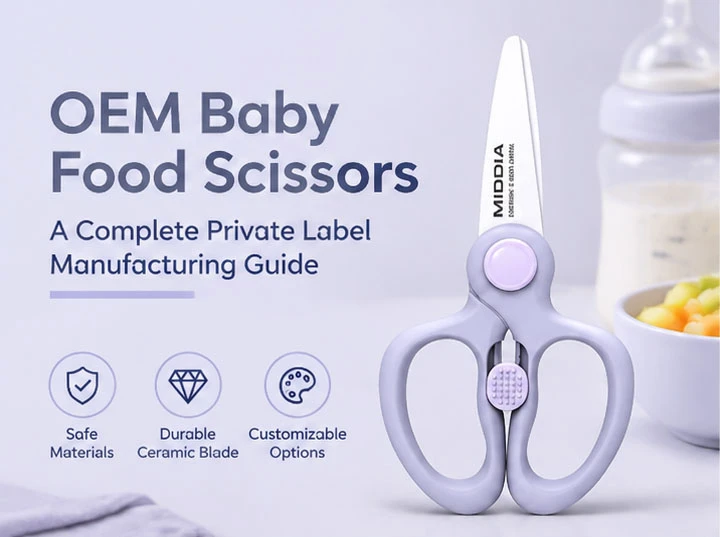
OEM baby food scissors are products manufactured by a supplier for another company's brand. Instead of setting up their own production facilities, baby product brands and distributors work with an experienced manufacturer to produce baby food scissors according to agreed product specifications and branding requirements.
In many cases, the manufacturing partner already has existing product designs that can be used as a starting point. The buyer selects a suitable model and then decides which elements need to be customized. These may include the brand logo, product color, protective cover, retail packaging, and other presentation details.
For a company entering the baby feeding category, this approach can be more practical than developing a completely new product from the beginning. It allows the buyer to focus on brand positioning, distribution, and customer demand while working with a manufacturer that understands the production process.
Understanding OEM Baby Food Scissors Manufacturing
OEM manufacturing is based on an agreement between the brand owner and the manufacturer. The brand owner defines the commercial requirements, while the manufacturer produces the product according to the confirmed specifications.
For example, a baby care brand may select an existing ceramic baby food scissors model and request its own logo on the product. The same project may also include a coordinated protective sheath and a printed retail box carrying the brand's colors and product information.
The finished product is then prepared for sale under the customer's brand, subject to the agreed production, quality, and packaging requirements.
One important point for buyers is that OEM does not necessarily mean that every part of the product must be newly developed. In fact, using an existing model is often the most efficient way to begin. It reduces unnecessary development work and gives both parties a clearer starting point for discussing product specifications.
Why Do Baby Product Brands Choose OEM Manufacturing?
There are several reasons why brands choose an OEM partner instead of manufacturing baby food scissors themselves.
First, it reduces the need for in-house manufacturing investment. Establishing a production operation requires equipment, technical personnel, quality control procedures, material sourcing, and ongoing management. For many baby product companies, these activities are outside their main business focus.
Second, it can shorten the product development process. When a manufacturer has existing models available, buyers do not need to start with a completely blank design. They can evaluate the available options, select a suitable product, and concentrate on the customization elements that matter to their market.
Third, OEM manufacturing gives brands more control over product presentation. A standard product can look very different when it is combined with a recognizable logo, coordinated colors, and retail packaging that matches the rest of a baby feeding collection.
Finally, it creates an opportunity to develop a longer-term supply relationship. Rather than sourcing a different product from multiple suppliers every time, brands can work with a manufacturing partner that becomes familiar with their product specifications and quality expectations.
Which Buyers Can Benefit from OEM Baby Food Scissors?
OEM baby food scissors are relevant to several types of businesses, although their sourcing priorities are not always the same.
| Buyer Type | Typical Requirements | What They Usually Prioritize |
|---|---|---|
| Baby product brands | Private label products with consistent branding | Product differentiation, quality, and brand presentation |
| Baby product retailers | Products suitable for existing retail collections | Product appeal, packaging, and retail readiness |
| Distributors and wholesalers | Reliable products for resale through distribution channels | MOQ, pricing, supply stability, and product range |
| Importers | Manufacturing partners for repeat orders | Documentation, production communication, and delivery planning |
| E-commerce sellers | Products with their own brand identity | Product presentation, packaging, and market positioning |
A retailer may simply want to add a useful baby feeding accessory to an existing collection. An established brand, on the other hand, may be more concerned with maintaining consistent colors and packaging across multiple products. Understanding the intended sales channel before contacting a supplier makes it easier to identify the right customization options.
2. OEM vs. ODM: Which Manufacturing Model Is Right for Your Brand?
When researching baby food scissors manufacturers, buyers will often encounter two terms: OEM and ODM. Although they are related, they describe different approaches to product manufacturing and development.
Choosing between them depends largely on how much control you want over the original product design, how quickly you want to launch, and how much development work your project requires.
What Is OEM Manufacturing?
OEM manufacturing generally starts with an existing product design or an established product specification. The buyer chooses a suitable model and works with the manufacturer to confirm the product configuration, branding, and packaging.
For private label baby food scissors, common OEM requirements include:
Adding a company logo to an existing product.
Selecting from available product models and sizes.
Choosing suitable colors where customization is supported.
Customizing the protective cover or other available accessories.
Developing branded retail packaging.
Confirming product specifications and quality requirements before mass production.
This model is particularly suitable for companies that already understand their target customers but do not need to create a completely new scissors design.
What Is ODM Manufacturing?
ODM stands for Original Design Manufacturing. Under this model, the manufacturer takes a more active role in product design and development. Depending on the supplier's capabilities, this may involve modifying an existing structure, developing a new appearance, or working on specific technical requirements.
For example, a brand may want a baby food scissors product with a different handle shape, a particular protective structure, or a design that fits a larger collection of feeding accessories. Such requests may require technical evaluation, design adjustments, sample development, and additional tooling.
Not every manufacturer offers the same level of ODM support. Buyers should therefore ask what development work can actually be completed in-house and which requirements would need additional resources or external support.
OEM vs. ODM Baby Food Scissors: Key Differences
| Comparison | OEM Manufacturing | ODM Manufacturing |
|---|---|---|
| Starting point | Existing product model or confirmed specification | New or modified product design |
| Product development | Usually limited customization | More extensive design involvement |
| Development time | Generally shorter | Depends on design complexity |
| Initial development cost | Generally lower | May involve design and tooling costs |
| Logo customization | Usually available | Can be incorporated into development |
| Color customization | Subject to available materials and MOQ | Subject to design and production feasibility |
| Packaging customization | Available where supported | Can be developed around the new product |
| Suitable for | Brands seeking a practical market entry | Brands requiring greater product differentiation |
For many of our customers at MIDDIA, starting with an existing ceramic baby food scissors model is a practical approach. It allows them to concentrate on brand identity and product presentation without immediately taking on the complexity of a new product development project.
When a customer has more specific requirements, we first need to understand the intended design changes and evaluate their feasibility. Not every requested modification can be treated as a standard logo or color customization, so discussing the details before placing an order is important.
Which Option Should You Choose?
If your main objective is to launch a branded baby food scissors product within a manageable development schedule, OEM is usually the more straightforward starting point. You can select an existing model, confirm the logo and packaging, and move through the sample approval process.
If your brand needs a product with a substantially different structure or appearance, ODM may be worth exploring. However, you should be prepared for a longer development process and potentially higher initial costs.
There is no universal answer. A well-selected existing product with thoughtful branding may be a better commercial decision than a completely new design that requires considerable development investment.
3. What Can You Customize in OEM Baby Food Scissors?
One of the main reasons companies choose private label manufacturing is the ability to make an existing product feel consistent with their own brand. For baby food scissors, customization is not limited to the logo. The product's appearance, protective accessories, and retail packaging all influence how customers perceive it.
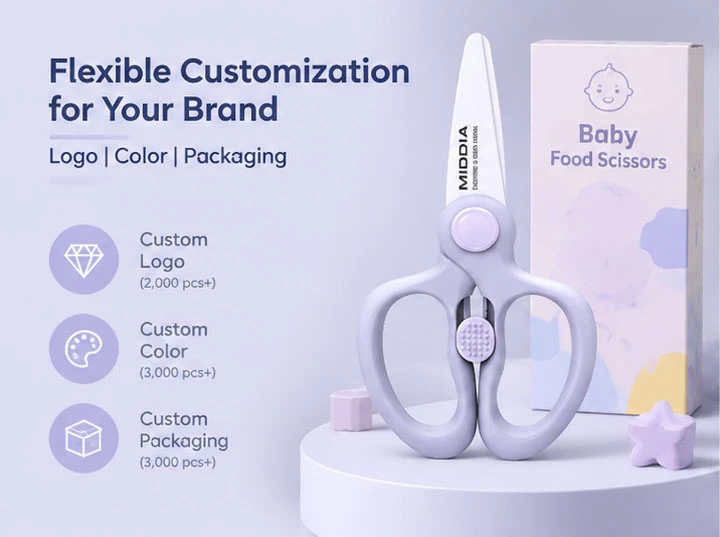
At MIDDIA, we organize our standard customization options around three main areas: logo, color, and packaging. Buyers can also evaluate our existing product models to find a configuration that suits their product range.
3.1 Custom Logo for Private Label Baby Food Scissors
A brand logo is often the first customization requirement discussed during an OEM project. For a company selling baby feeding accessories, having a consistent logo across scissors, feeding utensils, storage products, and packaging can help create a recognizable product collection.
Before production, buyers should consider several details:
Logo artwork: Provide a clear, high-resolution logo file. Vector artwork is preferable when available.
Logo position: Confirm where the logo should appear and whether the available product surface can accommodate it.
Logo size: The design should remain readable without interfering with the product's appearance or normal use.
Application method: Confirm the actual available logo application process with the manufacturer.
Sample approval: Review the logo's appearance on a physical sample before approving mass production.
At MIDDIA, our standard MOQ for custom logo baby food scissors starts at 2,000 pieces.
We recommend that buyers confirm the logo artwork and placement early in the project. Making these decisions before mass production helps avoid unnecessary changes after the order has entered the production stage.
3.2 Custom Colors for Ceramic Baby Food Scissors
Color is more than a decorative detail in the baby care market. It can help a product fit into a particular brand identity, communicate a certain visual style, and create consistency across a retail collection.
Some brands prefer soft pastel colors for their baby feeding products, while others use distinctive colors that match their existing packaging and visual identity. A retailer may also want several color options to create a more varied product selection.
When planning custom colors, buyers should consider:
The brand's existing color palette.
The available colors and materials of the product components.
Whether the protective cover should match or contrast with the scissors.
How the selected color will appear under different lighting conditions.
Whether the color can be reproduced consistently in future production batches.
For private label projects at MIDDIA, the standard MOQ for custom colors starts at 3,000 pieces.
We suggest confirming the color through a physical sample rather than relying entirely on a computer screen or printed color reference. Digital displays can show the same color differently, and the final appearance may also depend on the material and surface finish.
3.3 Custom Packaging for Private Label Baby Scissors
Packaging plays an important role when baby food scissors are sold through retail stores, online marketplaces, or branded e-commerce websites. It protects the product during transportation, presents essential product information, and helps customers recognize the brand.
Depending on the target market and sales channel, buyers may consider several packaging elements:
Retail box design: A custom printed box that matches the brand's visual identity.
Brand logo: Consistent logo placement and visual presentation.
Product information: Product name, model, material information, and appropriate usage instructions.
Barcode and SKU: Information required by the buyer's inventory and retail systems.
Protective packaging: Appropriate internal protection to reduce the risk of damage during transportation.
For buyers targeting different countries, packaging information should also be reviewed against the requirements of the destination market. Language, labeling, product claims, and other regulatory details should not be treated as identical across all markets.
At MIDDIA, the standard MOQ for custom packaging starts at 3,000 pieces.
We recommend providing the packaging artwork and required product information as early as possible. This gives both parties time to review the design, check the available packaging specifications, and confirm the final version before production.
3.4 Product Selection and Existing Model Customization
Before deciding on logo, color, or packaging, buyers should first select the right product model. A well-designed private label product starts with a configuration that meets the needs of its intended users.
For ceramic baby food scissors, several product details deserve attention:
Blade size: Different sizes may suit different product positioning and handling preferences.
Handle design: The handle should be evaluated for comfortable handling and practical use.
Protective cover: A suitable cover helps protect the blades during storage and transportation.
Safety lock: Where available, a locking feature can help keep the scissors closed when stored.
Overall dimensions: Product size affects packaging, portability, and the intended retail category.
At MIDDIA, we offer existing ceramic baby food scissors models with different product configurations. Buyers can review the available options on our ceramic baby food scissors product page before deciding which model is appropriate for their brand.
Rather than choosing a product based only on appearance, we encourage buyers to consider the intended use, target customer, packaging format, and sales channel together. This makes the product selection process more meaningful and helps avoid unnecessary customization.
Comparing the Main OEM Customization Options
| Customization Item | MIDDIA Standard MOQ | What Buyers Need to Confirm |
|---|---|---|
| Custom logo | 2,000 pieces | Logo artwork, position, size, and application method |
| Custom color | 3,000 pieces | Color reference, product components, and sample appearance |
| Custom packaging | 3,000 pieces | Packaging structure, artwork, printing, and product information |
These are the standard starting quantities for the individual customization options. If a project combines multiple requirements, the final MOQ and production arrangement should be confirmed according to the selected model and specific customization details. Buyers should not assume that every combination will automatically qualify for each individual minimum quantity.
4. What Is the MOQ for OEM Baby Food Scissors?
The MOQ for MIDDIA OEM baby food scissors depends on the type of customization required. For standard private label projects, our current starting quantities are 2,000 pieces for custom logo orders and 3,000 pieces for custom color or custom packaging orders.
For buyers planning their first order, understanding these quantities early can make product planning and budget allocation much easier.
| Customization Type | Starting MOQ |
|---|---|
| Custom Logo | 2,000 pieces |
| Custom Color | 3,000 pieces |
| Custom Packaging | 3,000 pieces |
Why Does MOQ Differ Between Customization Options?
Different customization requirements involve different preparation and production considerations. A logo customization project may use an existing product model and require a specific branding process. Custom colors may involve additional material preparation, color matching, and production arrangements. Printed packaging, meanwhile, can be influenced by printing setup, packaging materials, and the minimum quantities required by the packaging supplier.
This is why the MOQ for custom logo orders may differ from the MOQ for color or packaging orders.
For buyers, the important thing is not simply finding the lowest possible quantity. It is understanding what the quoted MOQ actually includes. Does it cover the selected product model? Is the protective cover included? Does the order include custom packaging, or is the packaging supplied separately? These details should be confirmed before comparing quotations from different manufacturers.
Can Buyers Combine Different Customization Options?
Yes, buyers can discuss projects that combine logo, color, and packaging customization. In fact, combining these elements is a common way to create a more complete private label product.
However, the final MOQ needs to be evaluated according to the actual project requirements. For example, a buyer requesting an existing model with a custom logo and standard packaging may have different production requirements from a buyer requesting a new color, a custom printed box, and additional product adjustments.
At MIDDIA, we recommend discussing the full customization plan before confirming the order quantity. This allows us to review the selected product, the requested branding details, and the packaging requirements together rather than treating each item as an isolated request.
How Should New Brands Plan Their First OEM Order?
For a brand entering the baby feeding category for the first time, it is worth thinking about the initial order in relation to the intended sales channel.
A company selling through established retail stores may need packaging that meets specific shelf presentation requirements. An e-commerce seller may place more emphasis on product photography, compact packaging, and the information displayed on the product listing. A distributor may be more concerned with product variety and the quantity needed to serve multiple customers.
Before placing an order, buyers should estimate their expected sales volume, identify the preferred product model, and determine which customization elements are essential for the first launch.
It is not always necessary to customize every possible element at once. Starting with an existing model and a clear branding plan can be a more manageable way to introduce a new product category.
5. What Affects the Cost of OEM Baby Food Scissors?
There is no single price for all OEM baby food scissors projects. The final quotation depends on the product configuration, customization requirements, order quantity, and packaging specifications. Two buyers may select the same basic scissors model but receive different quotations because their branding and packaging requirements are not the same.
When reviewing an OEM quotation, it helps to understand the main factors that influence the cost rather than comparing only the final unit price.
Product Materials and Design
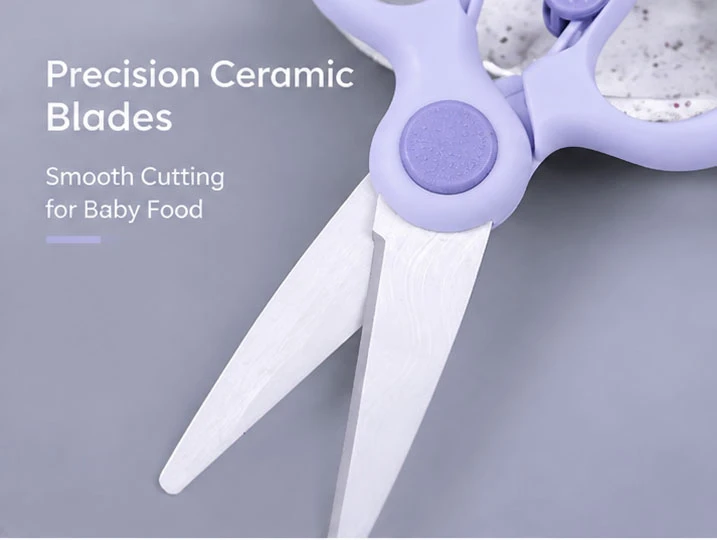
The product itself is the starting point of the quotation. For ceramic baby food scissors, the zirconia ceramic blade is an important component, but the overall product also includes the handle, connection structure, and any protective accessories supplied with the scissors.
Product size and configuration can influence material requirements and production arrangements. A model supplied with a protective cover may also have different component and assembly requirements from a model without one.
Buyers should therefore make sure that the product specifications are clearly identified when requesting quotations. Comparing two prices without checking whether the products have the same configuration can lead to an inaccurate assessment.
Customization Requirements
Logo, color, and packaging are three common cost considerations in private label manufacturing.
A logo may require a particular application process and production preparation. Custom colors may involve additional material or color-matching work. Custom packaging can vary according to the box structure, printing method, materials, and quantity.
For this reason, it is useful to separate the basic product price from any additional customization costs when reviewing a quotation. This makes it easier to understand where the budget is being allocated and which options can be adjusted if necessary.
Order Quantity and Production Requirements
Order quantity is another important factor. Production planning, material purchasing, and packaging preparation may differ between a smaller initial order and a larger repeat order.
Buyers should also communicate any special quality inspection requirements before production begins. If a project requires particular inspection points, packaging checks, or documentation, these should be discussed and agreed upon rather than added as an assumption after the order has been placed.
How Can Buyers Get an Accurate OEM Quotation?
The easiest way to avoid repeated quotation adjustments is to provide the manufacturer with a reasonably complete project brief. You do not need to have every detail finalized at the first inquiry, but the following information will make the initial evaluation more useful:
Preferred product model: Identify the ceramic baby food scissors model or configuration you are interested in.
Estimated order quantity: Provide your expected quantity or purchasing range.
Logo requirements: Share the brand logo and any preferred placement details.
Color requirements: Indicate whether you need an existing color or a custom color.
Packaging requirements: Explain whether you need standard packaging or a custom retail box.
Destination market: Identify the country or region where the product will be sold.
When buyers contact us for an OEM quotation, we first review their preferred model and customization requirements. This gives us a clearer understanding of the project and helps us evaluate the appropriate production and packaging options before preparing a quotation.
A detailed inquiry at the beginning usually saves time for both the buyer and manufacturer. More importantly, it creates a clearer basis for sample confirmation, order planning, and the eventual production agreement.